Something is quietly catching US outbound sales and customer service teams off guard, and it is not the language barrier or time zone math. The EU AI act transparency obligations that came into force under the EU's landmark AI regulation create real compliance exposure for any American business using automated voice agents to reach consumers in EU member states - and most legal teams on the US side have not fully absorbed what that means in practice yet.
Something is quietly catching US outbound sales and customer service teams off guard, and it is not the language barrier or time zone math. The EU AI act transparency obligations that came into force under the EU's landmark AI regulation create real compliance exposure for any American business using automated voice agents to reach consumers in EU member states - and most legal teams on the US side have not fully absorbed what that means in practice yet.
EU AI Act Voice Agents: What the Regulation Actually Demands
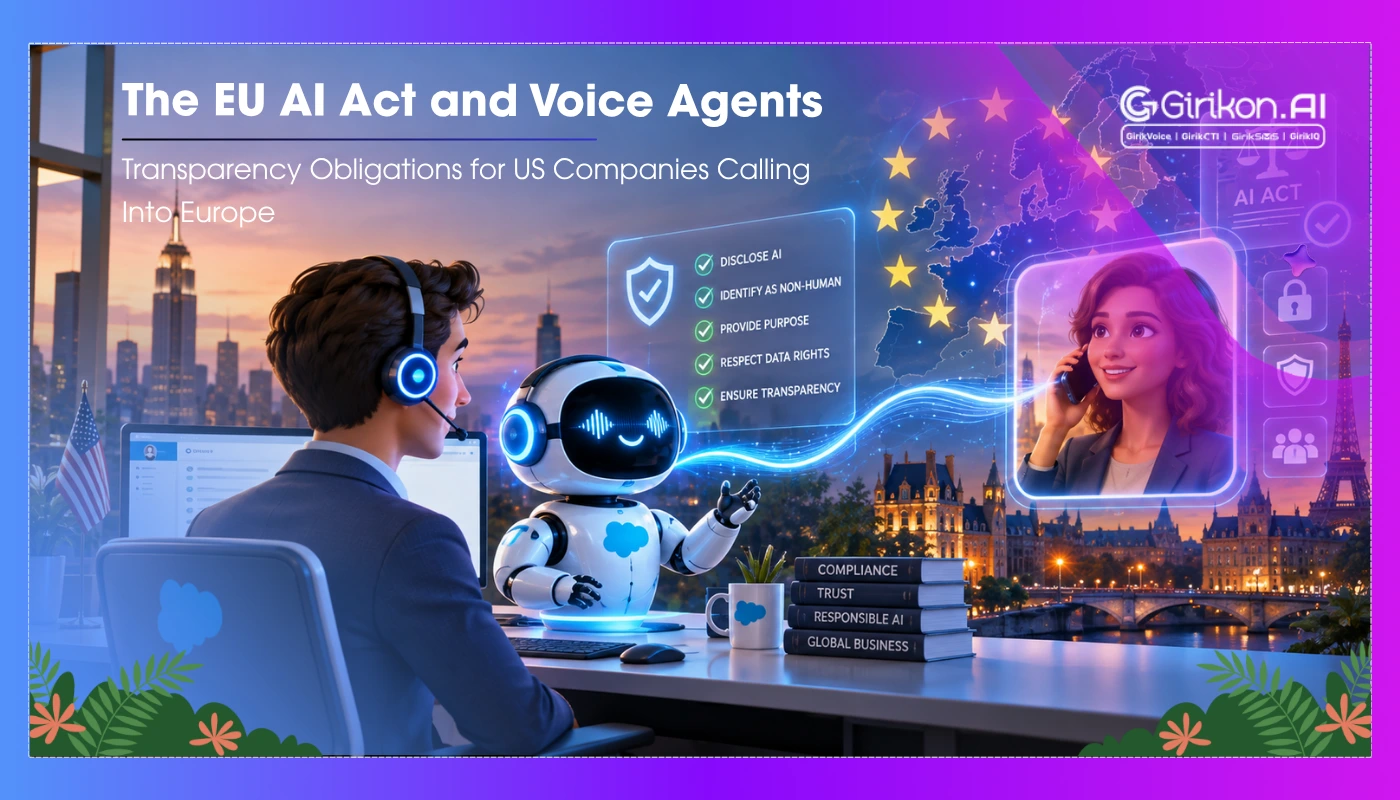
The core disclosure requirement is blunter than most compliance language tends to be. If a person is interacting with an AI system and could reasonably believe they are talking to a human, the operator must tell them they are not - full stop, no wiggle room. That obligation lands at the start of the interaction, not tucked away in a post-call email or a terms-of-service page nobody actually opens.
Worth noting: the regulation does not require that disclosure to be awkward or alarming. Something like "This is an automated assistant calling on behalf of [Company]" at the top of the call - brief, clear - handles the spirit of it well enough. The problem is that many voice agent deployments are built specifically to minimize that friction, to feel natural, to shed the robotic cadences that make people hang up before the second sentence. Those design choices, which make complete commercial sense from a conversion standpoint, are exactly what regulators are targeting.
The tension here is real and it is not the kind that gets resolved cleanly with a policy memo. The AI voice agents that actually perform are the ones that stop feeling like voice agents - and what the regulation is essentially asking is that teams take a voluntary swing at their own effectiveness by leading with a declaration. That is a hard sell internally, and honestly, it should be.
Scoping the Risk: Which Calls Actually Trigger Compliance Obligations
Not every automated call into Europe creates the same exposure level. The regulation distinguishes between different categories of AI systems, and understanding where voice agents land in that taxonomy matters a lot before anyone starts rebuilding their call scripts.
General-purpose AI systems interacting with individuals in real time are covered by the basic transparency rules. But when that voice agent is being used in contexts that touch on health decisions, financial products, employment screening, or debt collection - the classification shifts upward. An AI act high risk system classification carries heavier obligations around documentation, human oversight, and conformity assessments that go well beyond a disclosure sentence.
| Deployment Context | Likely Classification | Key Obligation |
|---|---|---|
| Sales outreach for consumer goods | General AI system | Disclosure at call start |
| Insurance or credit product calls | Likely high-risk | Disclosure plus documentation |
| Healthcare appointment or triage | High-risk | Oversight, logging, conformity |
| Debt recovery or enforcement | High-risk | Full risk management requirements |
| Survey or market research | General AI system | Disclosure at call start |
The debt recovery row in the table above deserves particular attention for US-based collections or revenue cycle companies that operate across borders. That context almost certainly triggers high-risk classification under the regulation's Annex III categories, and the compliance gap there is significant for teams that are currently treating voice agents as a simple call center efficiency tool.
What US Companies Are Getting Wrong About Extraterritorial Reach
Here is the part where some US-based operators are still underestimating their exposure. The EU AI Act applies based on where the affected person is located, not where the company deploying the AI is incorporated. Calling EU customers with AI from a server in Dallas, a company registered in Delaware, and a voice platform built in California does not place you outside the regulation's reach. If the person picking up the phone is in Frankfurt or Lisbon, the regulation applies.
Same jurisdictional logic that turned GDPR into a genuine headache for US companies not so long ago - the AI Act is running the same play. Companies that figured GDPR did not really apply to them, right up until a supervisory authority came knocking, are set up to make the exact same miscalculation here, except the stakes are higher: fines up to thirty million euros or six percent of global annual turnover for serious violations.
To be fair, enforcement is still in relatively early stages and the implementing guidelines are continuing to develop. But waiting for a formal enforcement action before building a compliance posture is a strategy that tends to look much worse in retrospect than it does in the planning meeting where it gets approved.
Building a Disclosure Practice That Does Not Destroy Call Performance
The practical challenge is real. Teams that have spent months tuning voice agent personas for warmth, natural pacing, and low early-hang-up rates are understandably resistant to bolting a compliance disclaimer onto the front of every call. And in some cases, that resistance has merit - a badly written disclosure can tank pickup and engagement rates in ways that are measurable within a week.
What the better-performing teams seem to be working out is that disclosure language can be integrated rather than prepended. A few approaches worth considering:
- Natural-voice disclosure - writing the disclosure into the agent's opening line so it reads like a professional introduction, not a legal warning being read off a form. Something like "Hi, I'm an automated assistant from [Company], calling about your account" hits differently - less defensive, less clinical - than "This call may be recorded and is being made by an AI system.".
- Consent-linked outbound lists - building EU-specific contact segments where the consent record already captures prior awareness of AI-assisted contact, reducing the heaviness of the real-time disclosure requirement.
- Human escalation pathway - having a clearly accessible route to a human agent during any call, which satisfies the spirit of oversight requirements and also tends to improve customer satisfaction metrics independently of the compliance benefit.
- Call logging and retention - documenting that disclosure was made, when, and in what form, because the regulation's accountability requirements mean that "we always do this" is not sufficient; operators need to be able to demonstrate it per interaction.
The teams that execute the natural-voice approach well tend to find that disclosure does not hurt performance as much as initially feared. The resistance to doing it is usually bigger than the actual conversion impact.
What the Timeline Looks Like and Why Waiting Is a Specific Kind of Gamble
The EU AI Act came into force in August 2024. The transparency obligations for general-purpose AI systems, including the real-time interaction disclosure rules, applied from August 2026 under the regulation's phased timeline - but high-risk system requirements have their own schedule, and some provisions affecting AI system providers came into effect earlier. Compliance teams should not be treating this as a future problem right now, because the phase-in period has been absorbing quietly while many US-based deployments continued unchanged.
The broader tension here is that voice AI deployment has been accelerating faster than the compliance infrastructure around it. Platforms that enable AI calling have generally not been building EU-specific compliance guardrails into their default configurations - partly because their primary market is US-based, and partly because the regulatory requirements were still being interpreted during the early deployment wave. That leaves the compliance burden sitting with the companies running the campaigns, not the platforms enabling them, which is probably the right legal answer but creates a gap that nobody has necessarily filled yet.
Whether the enforcement posture tightens quickly or builds gradually through a few high-profile cases before creating broader urgency is, honestly, an open question. But the direction of travel is clear, and US companies using voice agents to reach EU residents are operating on borrowed time if they are still treating disclosure as optional.