Explore dialer types, key features, TRAI compliance requirements, and tips for choosing the right dialer for call center operations in India.
Getting more customers on the phone sounds simple enough — until you have to figure out the best way to make those calls. A predictive dialer might seem like the obvious choice when speed and call volumes matter. But is making more calls always the smartest move?
In India — choosing an outbound dialing system involves more than agent productivity. With TRAI's evolving framework for automated and commercial calling — how a call is initiated matters just as much as how efficiently it is handled.
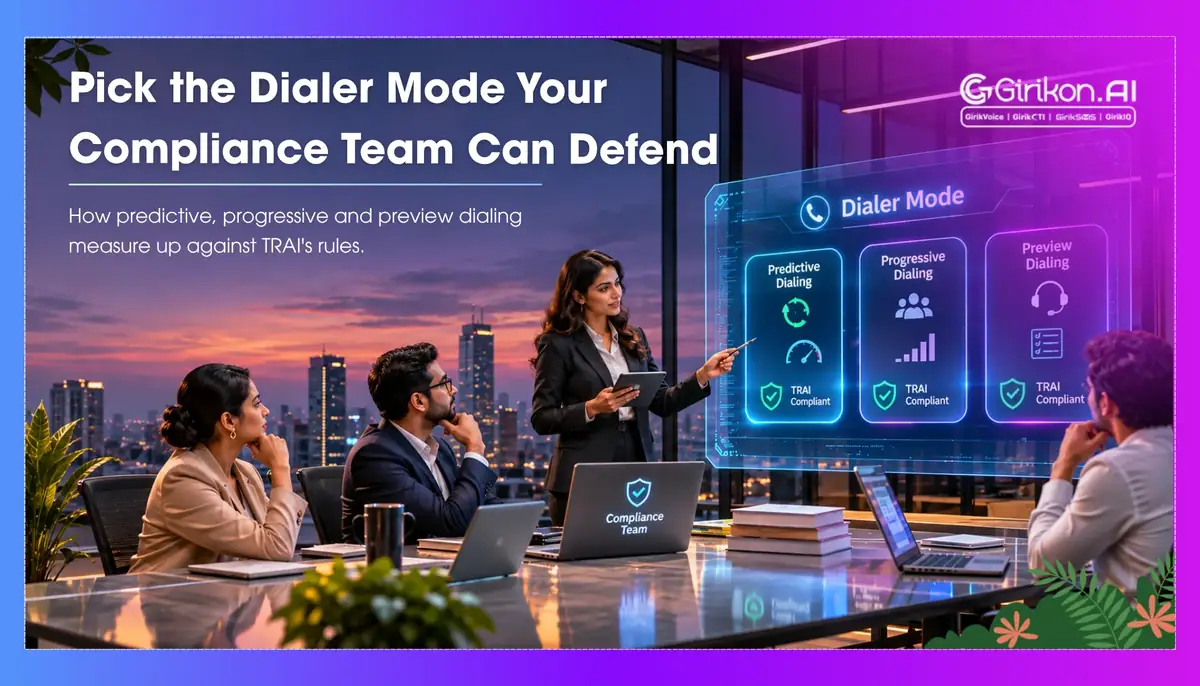
For businesses considering a dialer for call center operation, this creates a much larger issue than that of selecting among preview, progressive, and predictive dialers. These work differently in handling call placement, which is significant when considering regulations on autodialers and application-to-person (A2P) calling.
Hence, before committing an outbound calling software solution, it's worth asking: Which dialer works for your outbound calling, and what does TRAI regulation allow?
Understanding the 3 Dialer Modes Used in Call Centers
Not every call center needs to reach customers in the same way — some conversations require agents to review customer details before calling, while others involve reaching a large number of people in less time. That is where the choice of dialer makes a difference.
Here are the three common modes and how each one handles outbound calls:
Preview Dialer
The preview dialing tool gives the agents an opportunity to look at the customer's profile before placing a phone call. Agents can view the history of contact, understand why this customer is being called, and select the right time to make the call — it is most suitable for follow-up calls, premium prospects, and personal chats.
Progressive Dialer
A progressive dialer places the next call when an agent becomes available. Unlike preview dialing, agents do not need to manually start each call.
The system goes through the contact list by making calls one after another, assisting organizations to minimize idle time for their agents while avoiding overloading multiple calls to the same agent.
Predictive Dialer
A predictive dialer software analyzes the call pattern and the availability of an agent to predict the availability of the agent and make multiple calls before the prediction comes true.
Once someone answers the call, the system routes the call to an available agent. This makes predictive dialers valuable for bulk campaigns; however, unanswered calls and customers being routed to an unready agent must be handled properly.
Also read: The best predictive dialers for Salesforce
| Dialer mode | How it works | Best suited for |
|---|---|---|
| Preview | Agent reviews details and starts the call | Personalized sales and follow-ups |
| Progressive | Dials the next number when an agent is available | Steady outbound calling |
| Predictive | Dials multiple numbers based on expected agent availability | High-volume campaigns |
While these modes are often grouped under auto dialer software — they do not work in the same way. The distinction matters when choosing a call center dialer: the fastest option may not be the right one for every team.
And when evaluating outbound calling software in India, there is another question to consider — how does each mode fit within TRAI's rules for automated calling?
TRAI Compliance: What Call Centers Must Check Before Using a Dialer in India
A dialer for call center operations can help agents reach more customers in less time — but higher calling volumes also require careful attention to India's telecom regulations. Before running outbound campaigns — businesses need to ensure their calling practices follow the requirements set by the Telecom Regulatory Authority of India (TRAI).
Here are three important things call centers should consider:
- Business registration: Businesses sending commercial communications through voice calls or SMS must register as Principal Entities (PEs) with a telecom service provider under the DLT framework.
- Use of designated number series: Promotional voice calls must use the designated 140 series. The 1600 series is required for services and transactions made by certain regulated BFSI organizations and governments. The companies should make sure that they have established the correct compliance requirements with their telecommunications supplier.
- Customer consent and preference: The call centers should make sure that they follow the right customer consent and preference rules to avoid any UCC taking place.
If the company decides to evaluate the dialer itself, then it should pay attention to compliance during the process and ensure that the dialer works well with the telecommunications system used by the company.
5 Key Features to Look for in a Dialer for Call Center Operations
A dialer is not only software that helps make automatic calls but also a tool which makes agents' work more convenient.
Here are five features worth looking for —
- CRM Integration: It’s crucial to get a dialer that will work with your CRM system and enable agents to view information about customers before and while making calls. Besides, the software should be capable of automatic call logging.
- Different Ways of Calling: There are various needs depending on the nature of each specific campaign. Make sure the tool you opt for provides preview, progressive and predictive calling.
- Monitoring and Reports: You must allow your managers to analyze call volume, agent performance, loss of calls, as well as campaign results in general. This type of analysis will give you an opportunity to see what needs to be changed.
- Contacts and Campaigns Management: Good software for outbound calling must help you manage contacts and campaigns and decrease the number of redundant calls.
- Compliance & Call Control: The software needs to have approved processes in place for making calls, preferences, and telecommunications settings.
An ideal dialer for call center is one that fits your calling team and has enough visibility for the managers.
How to Choose the Right Dialer for Your Call Center in India
Not every call center needs the same calling setup — the right dialer for call center operations depends on daily call volumes, the type of campaigns you run, and how your agents manage customer interactions.
Here are four things to consider before choosing one:
- Call Volume per Day: Small groups could go for a preview dialer or a progressive dialer, but for large groups which make numerous outbound calls, predictive dialer software will be the best option.
- Campaign Requirements: Sales, customer service, and service teams have different call requirements; hence, ensure that you select dialer software which is appropriate for the campaign without making things complex.
- Integration with CRM System: In case your business group uses a CRM such as Salesforce, then you can consider call center dialer software which is compatible with the CRM system.
- Outbound Calling Software: Outbound calling software that is appropriate for the telecommunications company and helps meet growing call requirements will beneficial.
The right solution should fit your team's existing workflow — simplify everyday calling and give managers better control over outbound operations.
The Bottom Line
Choosing the right dialer can significantly impact the process of managing daily operations at a call center. From the right choice of dialing mode, through proper management of outbound campaigns, to compliance with TRAI regulations, every step is important to facilitate better calling operations.
When it comes to businesses operating in India, the aim should be to pick out a dialer for call center which will provide you with efficient calling performance and increased productivity of agents along with CRM integration and compliance support.
Want a smarter way to handle calls from customers on the Salesforce platform? Explore GirikCTI to see — how Salesforce CTI can bring calling activities closer to your team's everyday workflow.