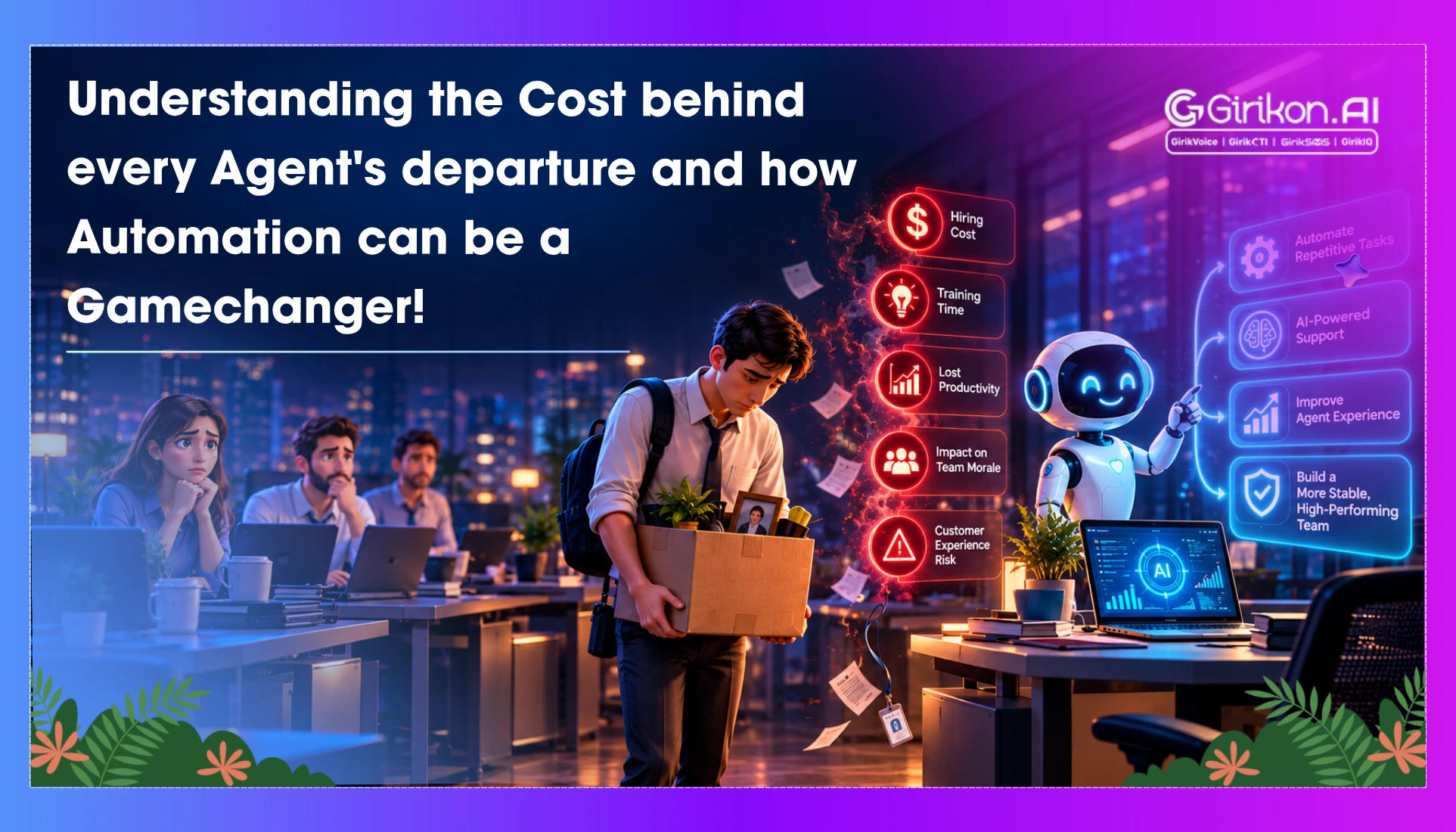
Call centre attrition costs more than recruitment alone. From hiring and training to lost productivity and declining service quality, every departure impacts the bottom line. Discover how to calculate the true cost of agent turnover and where automation can reduce repetitive workloads, improve agent retention, and deliver measurable operational savings.
A customer support agent suddenly quits in the middle of a week. By the next morning, the team leader is busy repositioning shifts with the HR busy in looking for a new hire, and the training team preparing another onboarding batch. This puts additional pressure on other agents to make extra calls – leading to longer wait times for customers, and managers struggling to maintain service quality without exhausting the team.
While the resignation may apparently look like a regular HR event, it can initiate a chain of events that might impact hiring budget, output, client expectations, and revenue. Businesses rarely or fail to see the actual cost of losing an agent or in other words call center attrition. This pattern can be disrupted via automation but only when it focuses on the right issues.
This article highlights the latent costs and where exactly technology can make a tangible difference.
Demystifying the Arithmetic Behind Call Center Attrition
When agent departures become frequent, a continuous cycle of hiring, training, and employee replacement happens before they become efficient.
Research conducted reveal significant attrition challenges faced by contact centres with annual agent attrition to be around 30–45% in the industry. While the figures do not necessarily reflect universal benchmarks; actual rates might vary by process, location, benefits and compensation, and working conditions.
So, attrition isn’t about how many agents leave. Rather, it is how organizations spend replacing their experience, as well as output.
Determining the Agent Turnover Cost
The actual agent turnover cost goes way beyond advertisements for recruitment and HR interviews. Every exit creates cost pressure including decline in productivity, direct spending, and client-service challenges. Indirect costs, such as the time and money spent training new hires and the increased fatigue caused by existing employees working overtime, are equally important factors to consider when implementing call center cost reduction strategies. Apart from this, missed targets, longer waiting times, redundant calls, etc., can impact client satisfaction. These expenses, when added up, reveal the actual impact of agent turnover.
Understanding Attrition Mathematics
Let's build a simple illustrative model for a 100-agent operation.
Let’s say that substituting one agent costs ₹70,000 including losses combining recruitment, training, and initial productivity.
| Metric | Calculation | Annual Impact |
|---|---|---|
| Employees | 100 agents | 100 |
| Annual Rate of Attrition | 35 percent | 35 percent |
| Exit | 100× 35% | 30 agents |
| Metric | Calculation | Annual impact |
|---|---|---|
| Workforce | 100 agents | 100 |
| Annual attrition rate | Assumed at 30% | 30% |
| Departures | 100 × 30% | 30 agents |
| Replacement cost per departure | Illustrative estimate | ₹75,000 |
| Total annual replacement cost | 35 × ₹70,000 | ₹24.5 lakh |
The calculation doesn’t take into consideration any supplementary losses not described in the ₹75,000 estimate, such as client churn, contractual fines, or remarkably high overtime expenses.
How would reducing attrition from 35% to 30%, while keeping staff size and replacement costs unchanged, affect overall costs and key contact center performance metrics?
It would replace 30 agents instead of 35.
This means lesser departures and an annual saving of ₹3.5 lakh.
This is where attrition math becomes powerful. An apparently modest improvement in retention can create tangible savings, mainly in large operations where substitution costs persist throughout the year.
Can Call Center Onboarding Make a Tangible Impact on Retention?
Whether a new joiner departs early or becomes a capable team member relies on their initial experience. Call center agent onboarding can leave users intimidated if it isn't planned properly. Apart from this, strict targets, new systems and complex client interactions might lead to unpleasant experiences. When expectations fail to match the promoted job, early resignations tend to become more likely. Research conducted on the Indian call centre industry has acknowledged repetitive work, demanding conditions, limited career development, and better opportunities at a different place among the major factors related with employee turnover.
A planned onboarding process combines clear job previews, structured training, supported learning, and call center customer service best practices. New hires must understand their job responsibilities, learn compliance requirements, and develop the skills needed to deliver consistent, high-quality customer service. They should also practice interacting with clients before managing them independently. Automation can further ease the onboarding process through AI-generated practice set-ups, appropriate knowledge resources, training schedules, reminders for assessment, and more. This will help trainers recognize knowledge gaps and address repeated mistakes early.
Where Can Automation Truly Help?
AI call center automation can minimize redundant tasks, support agents during customer interactions, and optimize contact center efficiency across several key areas:
- Automate Mundane Interactions: Besides managing appointment confirmations, enquiries of order-status, AI voice agents and chatbots can handle frequently asked questions - reducing recurring assignments.
- Provide Help in Real-time: AI tools can propose responses, repeat discussions, and retrieve relevant data. This helps new agents fix customer issues with certainty.
- Improve workforce planning: Predictive analytics help anticipate demand, figure out gaps, and support reasonable scheduling - helping managers balance workloads and decrease employee burnout.
Why is Human Strategy Needed for Retention?
The challenge of employee retention cannot be solved alone by technology. Effective contact centre retention needs supervisors to manage compensation, flexible shifts, assignments, career growth, gratitude, and manager support.
- Listen to employees: Use response to recognize stress points and optimize working conditions.
- Provide support: Introduce procedures that can augment escalation, regular breaks, and tailored guidance.
- Offer career growth: Create routes into team leadership, quality assurance, skills development, and workforce management.
- Track retention patterns: Early exits may signal onboarding or hiring issues, while expert employees leaving may indicate compensation, management or issues related to career-development.
Attrition isn’t Just an HR Problem
One of the major issues of running a call center is when agents decide to quit. It affects operations and costs in many ways. After losing agents, call centers have to hire and train new employees, as well as pay to fill the gap of lost agents for a period of time. Automation may seem like a good way to save money and increase the number of calls, but it doesn't really work, and can actually do the opposite. Book a demo of our software to learn how your call center can become more efficient and retain more agents.
With proper onboarding, robust automation tools, and actual support, contact centres can optimize employee retention rate, manage costs while building resilient and more capable teams.