Average Handle Time (AHT) has long been a key metric for measuring contact center performance—but AI is changing what that metric means. As AI handles routine, short calls, teams need to shift their focus toward resolution quality, customer outcomes, agent efficiency, and the complexity of human-assisted interactions. This blog explores what contact centers should optimize when AI takes the short calls and AHT is no longer the complete picture.
- 1Shift focus from Average Handle Time (AHT) to optimizing resolution, client effort, and business outcomes as AI handles simpler calls.
- 2Recognize that human agent AHT may increase with AI, reflecting increased call complexity rather than inefficiency.
- 3Avoid optimizing solely for speed, as rushing calls can lead to unresolved issues, repeat contacts, and decreased customer satisfaction.
- 4Prioritize First-Contact Resolution (FCR) alongside AHT to ensure customer issues are resolved effectively on the first try.
- 5Implement a broader set of metrics that measure efficiency, resolution rate, and customer experience, rather than just call duration.
Call center productivity relies on multiple factors, with Average Handle Time (AHT) being a key metric for measuring call center productivity. AHT measures the average time taken by a representative to resolve a customer interaction—from initial contact to final resolution. By optimizing AHT through efficient workflows and Telephony for Salesforce, businesses can help customers get their issues resolved faster while enabling agents to assist more customers effectively.
For years, contact centers have been focusing on lowering talk time, after-call work and hold time in the search of efficiency. Yet, 'quicker=better' is prone to risk as businesses risk eating away first contact resolution leading to repeat calls thereby weakening customer satisfaction. However, the call center landscape has changed drastically with AI agents changing the equation.
With AI voice agents for inbound support and self-service automation taking over simple and redundant calls, human agents are left with conversations that need judgment, empathy, analysis, and complicated problem-solving. This means the conventional relationship between shorter calls and optimal performance is starting to break down.
While a human agent requiring more time to resolve a complex customer problem isn't a sign of inefficiency, the question isn't, "How fast did the agent finish the call?" It is rather 'did the customer get the necessary resolution with minimal and unnecessary effort?'
That transition requires contact centers to reconsider 'AHT call center' strategies and shift from optimizing handle time in seclusion to augmenting resolution, client effort and business outcomes.
Why AHT Were Relevant in the Traditional Contact Center?
Average Handle Time was a significant operational metric in traditional contact centers. Significant variations between agents handling the same kind of call could indicate training, information, or process gaps. At scale, even small decreases in handling time can create substantial capacity. Contact centers, as a result, focused on optimizing training, knowledge access, routing, workflows, after-call work, and agent assistance, with AI call summarization helping reduce the time agents spend documenting customer interactions. However, AHT has a fundamental constraint: speed does not equal efficiency. A five-minute unsettled call may create another escalation, while an eight-minute call that completely handles the issue can reduce both—making handle time vs. resolution a more significant performance lens.
What are the Implications of AI Removing the Calls That Made Low AHT Easy to Attain?
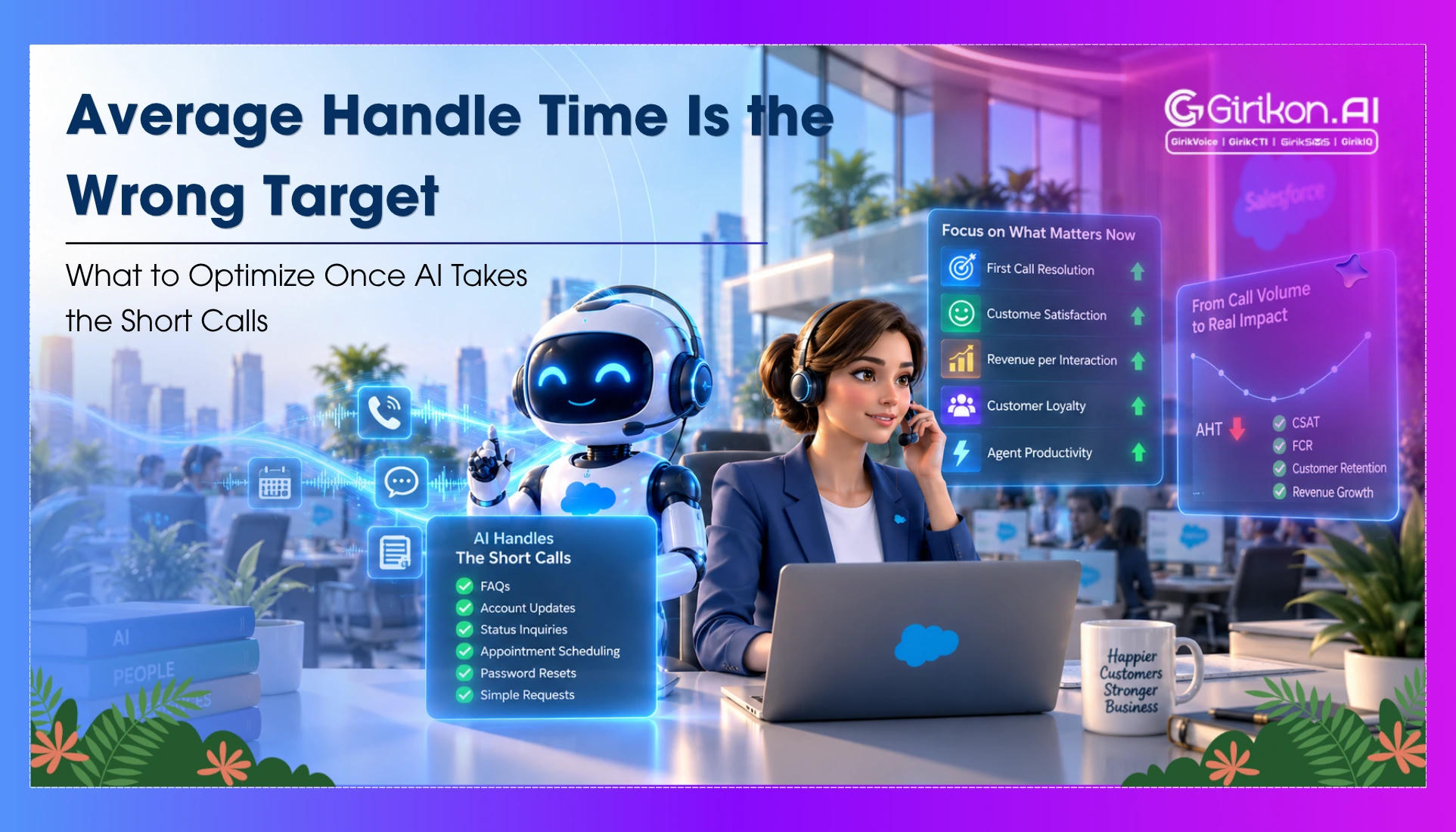
AI is creating a significant shift in how contact centers should comprehend average handle time (AHT). Routine discussions such as tracking order, password resets, scheduling appointment, account updates and basic policy queries can be handled by AI. This changes the organization of the human queue.
Before AI: Simple → Moderate → Complex calls
After AI: AI handles regular calls, while agents tackle moderate and complex communications. Consequently, human-agent AHT may increase even though complete contact-center efficiency optimizes. A higher AHT can reflect greater discussion complexity instead of poor performance.
If AI manages regular calls, organizations must expect human calls to grow more difficult. This forces agents to meet obsolete AHT targets thereby undermining resolution quality.
The Danger of Trying to Reduce Average Handle Time
When AHT becomes a major performance target, agents inherently optimize for speed. They may rush discussions, interrupt customers, evade deeper probe, shift complex cases, or end calls before issues get completely resolved. The result might be lower AHT but higher overall cost to serve.
Consider two scenarios: a 5-minute call that leaves an invoicing issue unsettled leading to another call, against an 8-minute interaction that probes and settles the issue completely. The second case, although takes longer yet, decreases customer effort and repeat interaction.
The goal shouldn't be just to shorten calls. It should rather be to do away with unnecessary time while safeguarding the time needed for efficient resolution. This makes First-Contact Resolution (FCR) a critical metric besides AHT.
What Should Contact Centers Optimize Instead?
Rather than being an ultimate objective, AHT should become an analytical metric. In an AI-driven contact center, performance must be assessed using a broader record that squares efficiency, outcome, and customer experience.
-
Resolution Rate
Contact centers should assess whether the customer's issue was truly fixed. First-Contact Resolution is crucial because it associates operational efficiency with client experience. AI-powered smart routing, agent support, knowledge management, and communication analytics can help optimize FCR by associating customers with the right resources and agents at the right time.
-
Customer Effort
Customer effort analyzes how much work clients must do to get their problems resolved. This includes the number of transfers, contacts, recurring excuses, channel switching, delaying, and escalations. A five-minute communication requiring 4 follow-ups may be way less efficient than a 10-minute interaction that entirely resolves the customer's issue.
-
Repeat Contact Rate
Rather than shifting it from one agent to the other, AI should minimize recurring customer demand. If customers get in touch with an organization about the same issue, a low AHT can create a confusing picture of efficiency. Tracking the same contacts repeatedly helps identify inherent issues, including fragmented processes, inadequate knowledge content, and gaps in AI replies. It also offers a clear view of whether a discussion actually delivered a sustainable resolution.
-
Quality and Accuracy
AI and human agents must be assessed on whether the data provided was precise and whether the correct procedure was followed. A fast but wrong answer can be far more expensive than a slower, precise response. Salesforce call monitoring and automated conversation analytics can analyze interactions at a much larger scale than conventional manual quality sampling. This enables companies to identify errors, compliance issues, and quality gaps more consistently.
-
Cost per Resolved Issue
This may be more significant than AHT. Rather than asking, "How much time did this interaction utilize?", organizations should ask, "How much did it cost to easily fix the customer's issue?" This metric can account for AI restraint, human effort, shifts, same contacts, and more. It also creates stronger enticements to optimize quality resolution rather than just shorter interactions.
Final Words
AI will make regular conversations significantly shorter, but human interactions may require more time. As AI voice agents manage redundant demand, human agents will shift their focus to circumstances that require reasoning, empathy, mediation, and problem-solving. The goal should shift from decreasing AHT to agreeing what to automate, remove, or conserve for human expertise.