Anyone who has spent time listening to how automated voice systems respond to Indian English speakers knows something is clearly broken - not broken in a dramatic way, but in that quiet, friction-heavy way where the system keeps asking you to repeat yourself and the caller just gives up somewhere around the third attempt. The problem isn't new. What's newer is that some teams are actually building around it rather than ignoring it. AI voice agent for India deployments, for a long time, were really just global systems parachuted into local markets with minimal tuning, and the results were about as polished as you'd expect.
Anyone who has spent time listening to how automated voice systems respond to Indian English speakers knows something is clearly broken - not broken in a dramatic way, but in that quiet, friction-heavy way where the system keeps asking you to repeat yourself and the caller just gives up somewhere around the third attempt. The problem isn't new. What's newer is that some teams are actually building around it rather than ignoring it.AI voice agent for India deployments, for a long time, were really just global systems parachuted into local markets with minimal tuning, and the results were about as polished as you'd expect.
Why Indian English Is Actually a Harder Problem Than It Looks
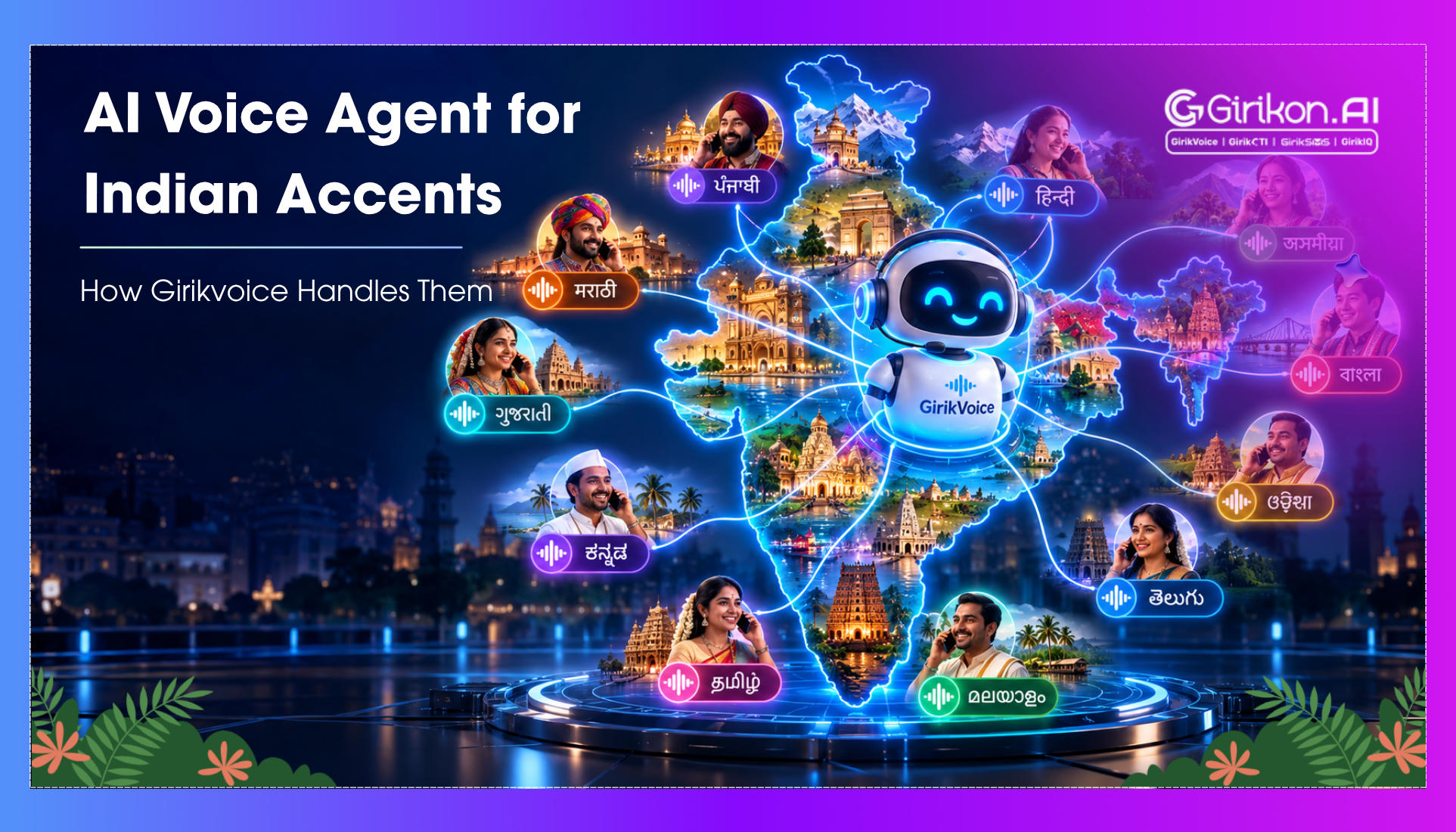
That label - "Indian accent" - carries far more phonemic weight than it can honestly support, and the gap between what it implies and what it actually describes is where the real problem begins. What it describes isn't one thing - and that's kind of the whole issue, actually. Marathi-inflected English from Pune sits in a completely different phonemic space than Tamil-inflected English from Chennai, and neither of those sounds anything like the Hindi-belt cadence out of Lucknow, which itself diverges from a Malayali speaker who has learned English in a way that's phonetically precise but rhythmically its own thing entirely. Then on top of all that you've got code-switching - speakers moving between English and a regional language mid-sentence without much warning - and vowel sounds that are mapped to different phonemic anchors than anything in American or British English, and retroflex consonants (the "t" and "d" sounds made with the tongue curled back) that are basically absent from most Western training datasets altogether.
Standard ASR - automatic speech recognition - systems were largely trained on American and British English corpora. That's not a conspiracy, it's just where the commercial incentive was. The consequence is that these systems produce error rates that most enterprise teams would consider unacceptable if they saw them clearly. Worth noting: the issue isn't that Indian English is difficult in some absolute sense. The models were designed from the ground up without that speech ever entering the training picture, which is a fundamentally different problem than the audio being inherently complex.
The Girikvoice AI Voice Agent Approach to Regional Variation
What Girikvoice rejects at the outset - before any discussion of architecture or training data becomes meaningful - is the idea that one generalised model, however broad its coverage, can be pulled across every accent, dialect pattern, and regional phoneme cluster Indian English produces without collapsing at the exact moments when commercial reliability is what actually matters. That's actually the first thing worth understanding about how it's positioned. The failure mode of generic voice AI is over-generalisation - building a model that performs adequately at everything and well at nothing specific enough to matter commercially.
What Girikvoice does is train on Indian English specifically, with attention to regional phonemic variation rather than averaging across it. The distinction matters because a model built on averaging treats Punjabi-inflected English and Kannada-inflected English as points on a spectrum to be smoothed out, which means it ends up with a shallow, diluted approximation of each accent rather than genuine competence in either one - producing the worst possible outcome for high-stakes calls where what a caller actually said has to be understood correctly the first time. Reliability in voice AI - especially for outbound calls in financial services, healthcare follow-ups, or collections - isn't a nice-to-have. A misheard confirmation in a loan context carries downstream consequences that nobody in the compliance chain wants to explain.
Honestly, the smarter framing is less "how does the model handle accents" and more "what does the system do when it's uncertain." Girikvoice incorporates contextual disambiguation at the intent layer, which means that when the acoustic signal is ambiguous - which it will be, often - the system leans on the conversation context and the likely intent of the caller at that point in the interaction to fill the gap. This is closer to how a skilled human agent actually processes partial hearing than how most ASR pipelines behave.
What This Means for Real Deployment Scenarios
| Scenario | Common ASR Failure | Girikvoice Handling |
|---|---|---|
| Retroflex consonant misread | "Thirty" parsed as "dirty" | Phoneme model trained on Indian retroflex variants |
| Code-switching mid-sentence | Utterance flagged as unrecognized | Intent preserved from pre-switch context |
| Anglicised regional nouns | Proper noun mismatch | Custom entity recognition layer |
| Vowel reduction in unstressed syllables | Word-level error cascade | Contextual language model compensation |
The code-switching row in that table is the one that gets underestimated. In informal Indian English conversation, it's completely natural to answer a yes/no question with the equivalent word in the regional language - "haan" instead of "yes," for instance. When a system carries no built-in capacity to recognise code-switching of this type, the failure does not stay contained at the level of a single missed word - what happens instead is that the full response gets assigned to the wrong category, the conversation gets redirected onto a path that was never built for that scenario, and every turn that follows compounds the original misclassification rather than correcting it, compounding the error with every subsequent turn.
How the Conversation Layer Is Actually Designed
A conversational AI voice agentlives or dies on more than transcription accuracy. The transcription problem is real, it matters, but getting that part right doesn't automatically produce a conversation that's actually useful. What Girikvoice builds above the ASR layer is a dialogue management system that keeps the conversational thread intact across corrections, clarifications, and the kind of natural digressions that characterise real Indian English phone conversations.
Indian callers, broadly speaking - and this is a generalisation with plenty of exceptions - tend to add context before getting to the direct answer. Asked "have you made your payment this month," the response might open with an explanation of why things are the way they are before it ever arrives at the actual yes or no. A system built around Western conversational patterns treats this as a non-answer and prompts again, which comes across as dismissive, maybe a little rude, and creates friction that compounds. Girikvoice's dialogue model is trained to wait for the resolution of that kind of extended preamble before acting on the utterance.
Handling Interruptions Without Losing the Thread
One consistent friction point in voice AI deployments across India is the barge-in problem. Indian conversational norms run toward more overlapping speech than a lot of Western contexts - partial interruptions, verbal acknowledgements while the other party is still mid-sentence, that kind of thing. A voice agent that reads any overlapping audio as a signal to stop its own turn ends up in a choppy, exhausting back-and-forth that callers figure out pretty quickly isn't worth dealing with - usually within the first thirty seconds or so.
Tip for deployment teams: Train your QA process around the barge-in rate specifically, not just the overall call completion rate. A voice agent can technically complete a call successfully while having handled barge-ins so poorly that the caller experience was frustrating throughout.
The Trust Problem Nobody Talks About Enough
There's a dimension to this that sits outside the technical architecture entirely. Indian phone call culture has a complicated relationship with automated voices, partly because robocall scams are genuinely prevalent and callers are conditioned to be suspicious of any synthetic voice that contacts them. A voice agent that sounds stilted, over-formal, or robotically cadenced in a way that doesn't match the warmth and informality of real Indian conversational English is going to lose caller trust before it has a chance to complete its purpose.
Girikvoice's TTS - the voice synthesis side - is built with Indian English prosody in mind. That means the rhythm, pacing, and intonation patterns of the synthetic voice are tuned to what Indian callers recognise as natural. That said - and this is worth being honest about - prosody is still an unsolved problem across the whole category, not something any single vendor has fully cracked. The teams that treat it as secondary to ASR accuracy are just optimising for the easier half of the problem.
The Accuracy Benchmark Question
People tend to ask about accuracy figures early in any evaluation conversation, and it's a fair question - the answer is just genuinely frustrating. Published accuracy benchmarks for voice AI are almost always measured on clean, studio-recorded speech with consistent audio quality. Real calls don't look like that at all. Background noise, telecom compression, someone speaking from a moving auto-rickshaw - these are the conditions that actually determine whether a deployment works.
What matters more than the headline number is how accuracy holds up under degraded conditions - which is where Girikvoice's tuning specifically for Indian telecom network characteristics starts to matter practically. Indian mobile networks, especially in tier-2 and tier-3 cities, deliver variable audio quality that generic voice AI systems weren't designed around.
Where This Is All Heading and What It Hasn't Solved Yet
The AI voice agent for India category is genuinely maturing, faster than most people outside the sector have noticed. Girikvoice is building in a direction that takes linguistic specificity seriously rather than treating it as an afterthought that can be patched with post-processing.
That's the right direction. But the genuinely honest observation here is that even regional voice AI built with real linguistic care is still landing in deployments where the conversation design - the logic, the branching, the failure recovery - has not kept pace with what the underlying model can now do, and that structural mismatch between model capability and implementation maturity is where the preponderance of real production failure actually originates. The technology is ahead of the implementation playbook, and the implementation playbook is what most enterprises are still working out.