There is a version of your call center - and this is not a hypothetical - that runs around the clock, never calls in sick, handles three hundred simultaneous conversations, and costs a fraction of what your current headcount runs you each month.
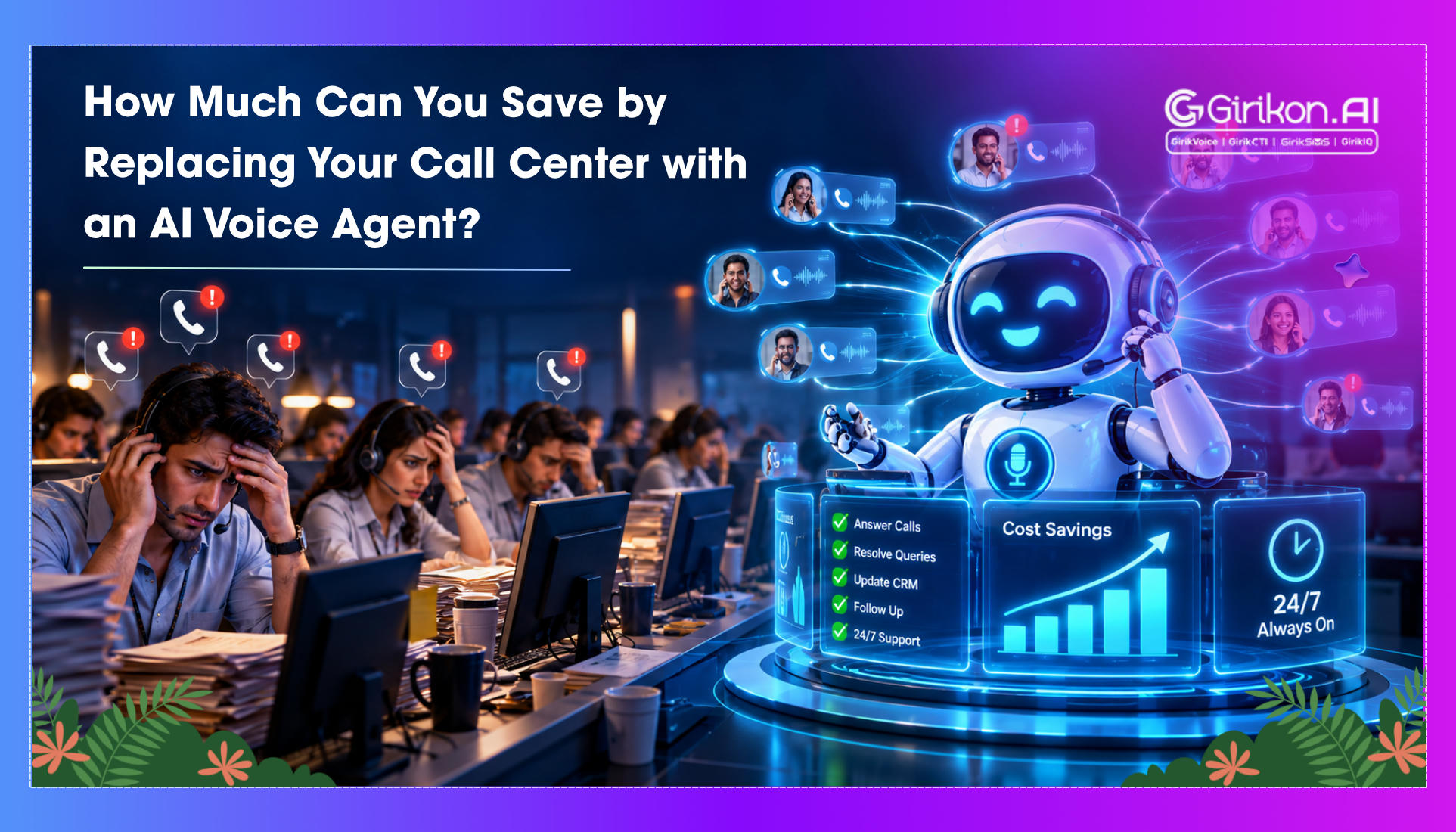
There is a version of your call center - and this is not a hypothetical - that runs around the clock, never calls in sick, handles three hundred simultaneous conversations, and costs a fraction of what your current headcount runs you each month. It exists right now, and a growing number of companies have quietly moved toward it over the last couple of years. Some did it out of cost pressure. Some because the Conversational Voice AI Agent category has matured enough - genuinely, not just in press releases - that it can handle a realistic slice of what used to require a warm body on the other end of the line. Worth flagging upfront though: the savings are real, but the math gets messier than vendor pitch decks tend to show, and anyone telling you the transition is clean and painless probably has a number to hit this quarter.
Anyway, let us talk about where the actual money is.
The Costs of Operating a Human Call Center
Most organizations walk into this calculation already behind - agent salaries land on the spreadsheet first, get treated as the definitive figure, and the conversation rarely goes much further, when the reality is that salaries are simply the surface reading of a cost structure that runs considerably deeper than that visible line item. On top of that baseline is recruitment, which for high-churn call center roles tends to run higher than people expect. Then training, onboarding, the long slow period before a new agent is actually reliable. Then supervisors, QA staff, scheduling software, workforce management overhead, and if you have a physical floor, the not-insignificant cost of keeping the lights on and the seats filled. And then there are the calls that land outside business hours - they either go unanswered or get routed to an expensive overflow provider, neither of which is free.
Industry research from organizations like Deloitte and Salesforce has pointed - pretty consistently, across multiple years - to fully-loaded costs somewhere between $25 and $45 per handled call at midsize enterprise call centers. That number shifts around quite a bit - call complexity matters, geography matters, who you've got on the floor matters. Moving work offshore can reduce that per-call figure, certainly, but the reduction comes bundled with a set of compounding trade-offs that are easy to underestimate from a distance: quality that fluctuates in ways that resist systematic tracking until a frustrated customer forces the problem into view, language and cultural nuance gaps that accumulate quietly beneath the surface metrics, and the scheduling friction of operating across multiple time zones - which reads as a minor logistical footnote in a planning document but becomes a slow, grinding organizational drain once the team is actually inside it every day.
Most call centers are carrying a cost structure that was designed for a world where humans were the only available option. That world is not the current one - not anymore. Consider that agent attrition in call centers averages 30 to 45 percent annually according to NICE and Mercer workforce studies - meaning a 30-person team might replace 10 to 13 people every year. Each replacement cycle costs roughly 16 percent of that agent's annual salary in recruiting and lost productivity alone, a figure that rarely appears on any single budget line but accumulates into a significant and largely invisible drag on operational efficiency.
Where a Conversational Voice AI Agent Genuinely Performs - and Where It Does Not
Here is where things get murkier than the vendor decks would have you believe, honestly. Not every call type can be automated - not even close - and the companies that have genuinely made this work are not the ones that tried to automate everything on day one. They are the ones that sat down, mapped their call volume by type, and found the high-frequency, structured-interaction categories where automation performs reasonably well without falling apart at the edges. That part - the mapping - is less glamorous than the demo, and it is where a lot of organizations do not spend nearly enough time.
| Call Type | Automation Fit | Human Involvement Still Needed |
|---|---|---|
| Account status inquiries | Strong | Escalation only |
| Appointment scheduling and confirmation | Strong | Rescheduling edge cases |
| Payment processing and reminders | Strong | Dispute handling |
| FAQ and product information | Moderate to strong | Complex or unusual queries |
| Complaint resolution | Weak to moderate | Usually required |
| Emotionally sensitive conversations | Weak | Almost always required |
| Technical troubleshooting (multi-step) | Moderate | Frequently required |
The pattern that tends to hold across industries is that somewhere between 40 and 70 percent of inbound call volume at a typical customer-facing operation falls into the automatable or partially automatable categories - depending on how well the company has structured its data, how clearly its processes are defined, and whether the voice system can actually integrate with the backend tools that hold customer information. That last part is where a lot of implementations quietly run into trouble.
The Savings Framework - A Realistic Walk-Through
Here's a scenario worth running through - not a best case, just a plausible one. Mid-sized e-commerce brand. Inbound support. Call volume somewhere around fifteen thousand per month, give or take. The team: thirty agents full-time, a couple of supervisors, one QA lead. Fully loaded monthly cost somewhere around $180,000 to $220,000 - when you account for everything above the salary line, which most internal estimates do not quite do. About sixty percent of those calls - order status, returns initiation, basic account questions - are structured enough to automate without things going sideways.
If the voice AI is implemented reasonably well and actually hits that sixty percent mark, nine thousand calls per month stop touching the human queue. At that volume, you're not eliminating the team - but you're probably cutting it back pretty substantially, to the people who handle escalations, complaints, real judgment calls. A realistic resized team might be twelve to fifteen agents rather than thirty, plus the supervisory layer compresses too.
Platform pricing is genuinely hard to pin down right now - vendor quotes in this space are all over the map, and comparing them isn't always apples to apples - but the rough range for enterprise-grade voice AI tends to fall somewhere around $0.05 to $0.15 per minute of conversation, or structured as per-call pricing with tiers depending on volume. Nine thousand calls, average call length around four minutes - you're somewhere in the $1,800 to $5,400 per month range for the platform itself at those rates, before you get into setup fees, integration work, and the ongoing tuning that nobody budgets for but everyone ends up doing.
Net savings in this kind of scenario - and this is being genuinely conservative, not optimistic - can come out somewhere between $60,000 and $90,000 per month. Annually, that is a material number. And that is before you factor in the after-hours coverage that the AI handles at no incremental cost, which previously either went unanswered or went to overflow. To make the comparison concrete: if that e-commerce brand was routing 1,200 after-hours calls monthly to a third-party overflow provider at $8 to $12 per call, eliminating that contract alone adds $9,600 to $14,400 back to the monthly savings figure - a line item that is easy to overlook during scoping but shows up immediately on the first post-launch invoice comparison.
The AI Voice Agent Deployment: Where Things Get Complicated
Open admission: a lot of companies have gone into these implementations expecting the savings to materialize quickly and cleanly, and that has not always been the outcome.
The failure mode that keeps showing up is an integration problem. One that got waved through during scoping because nobody wanted to be the one to slow the project down. A voice AI system needs live customer data pulled mid-conversation - order records, account status, appointment availability - and it needs that data to actually be current. When the backend is fragmented, when APIs are missing or documented by someone who left two years ago, when data quality is just kind of inconsistent in ways nobody has fully mapped, the AI starts confidently telling callers things that are no longer true. That does not blow up dramatically. What it does instead is quietly erode trust - CSAT scores drift downward, the support team starts getting "I already called about this" complaints, and it takes a while before anyone connects the dots back to the data feed.
There is also the handling of sentiment. Most voice AI platforms have made genuine progress here over the last couple of years - they can detect rising frustration, offer to transfer, modulate tone slightly. But the transition from automated to human handling is still a friction point in most implementations. That context - the caller has already explained their problem once and now has to repeat the whole thing - is real friction. Not catastrophic, especially when the alternative was twenty minutes on hold, but it requires actual design attention. You cannot bolt it on and assume the seams will be invisible.
Worth saying plainly: staff reduction plans need to be handled with some care - both on the human side and the operational side. The employees worth fighting to keep through any restructuring - and this is a distinction that gets blurred badly when headcount pressure takes over - are not necessarily the ones defined by years on the payroll or raw throughput numbers, but rather the ones holding something that resists reconstruction once it's gone: the kind of granular, lived-in product knowledge that only comes from having handled thousands of edge cases, compounding over time into contextual familiarity with internal processes that no onboarding document can replicate, alongside the specific, almost unteachable interpersonal capacity to pull a conversation back from the brink when the person on the other end has moved well past frustrated and is edging toward outright hostility. And those qualities don't map neatly onto tenure or title, which matters when you're deciding who stays. Sometimes they show up in mid-tenure agents who have never been particularly visible in a headcount-driven staffing model, and those are exactly the people a poorly designed reduction process tends to lose first.
Building a Comparison That Is Actually Useful
| Factor | Traditional Call Center | AI-Augmented Model | Fully Automated (Where Applicable) |
|---|---|---|---|
| Cost per handled call. | $25-$45. | $8-$18. | $1-$6. |
| Coverage hours. | Business hours + overflow cost. | 24/7 at flat rate. | 24/7 at flat rate. |
| Scalability. | Linear - hire more to scale. | Near-instant for structured calls. | Near-instant. |
| Quality consistency. | Variable, agent-dependent. | Consistent within trained parameters. | Consistent but narrow. |
| Complex complaint handling. | Strong. | Weak to moderate. | Generally poor. |
| Implementation timeline. | Immediate (hire and train). | 3 to 6 months typically | 4 to 8 months. |
The "AI-augmented" column in that table is, honestly, where most organizations realistically land after a first deployment - not full automation, but a meaningfully leaner human team working alongside systems that handle the routine volume. The fully automated column applies to specific use cases - outbound reminders, appointment confirmations, simple account servicing - where the conversation path is constrained enough that edge cases are genuinely rare.
What the Savings Calculation Tends to Miss
Two things that almost never appear in the vendor ROI calculator but show up in actual post-implementation reviews.
First: the cost of getting it wrong in the first six months. There's a stretch at the beginning - could be a few weeks, could be longer - where the AI is still being trained on your specifics, edge cases are surfacing constantly, and the escalation logic needs reworking almost every other week. During that window, you probably cannot reduce headcount yet because you need those agents to catch what the AI mishandles. The savings timeline gets pushed back by at least one to two quarters in most implementations we have observed, and the budget needs to account for that delay.
Second: the outbound capability that tends to come bundled with the platform and then gets ignored for months. A lot of companies deploy voice AI for inbound and then realize - sometimes by accident, a few months in - that the same system can run proactive outbound campaigns too. What makes this outbound category genuinely different - payment reminders dispatched early enough to catch customers before their accounts lapse, confirmation calls that pull down the rate of costly missed appointments, churn-prevention nudges sent at the moment they are most likely to land - is that it represents work which, under a purely human-staffed model, the unit economics simply never supported: every single dial consumed agent time, and executing it consistently at volume required a level of staffing expenditure that made the whole thing financially indefensible. That is usually where the second wave of savings materializes, and putting a number on it ahead of time is genuinely difficult, because it depends heavily on how the company's workflows are structured and how carefully the outbound sequences actually get built out rather than just switched on.
The Honest Position on ROI Timelines
Return on investment timelines for these implementations typically fall somewhere in the six-to-eighteen-month range, and that gap is not random noise - it traces back almost entirely to two distinct variables. The first variable - integration complexity, which is almost always more deeply entrenched in whatever technical infrastructure the organization has inherited than anyone's initial scoping exercise revealed - is also the one that compounds in ways that genuinely catch experienced teams off guard; legacy systems do not surface their full burden upfront, fragmented data layers create friction that only becomes visible mid-build, and undocumented dependencies keep arriving in waves, each one expanding the delivery effort until what began as a defined project has ballooned by a factor of two or three before the platform reaches anything resembling a stable, live state. Second, and this is the one that actually derails more projects: whether the company is disciplined enough to reduce headcount rather than just layering AI on top of a staffing model that was never adjusted. That failure mode - paying for both - is more common than anyone publicly admits.
Companies that see the returns they expected are usually the ones that made the staff resizing decision before the deployment went live, not after. This is an important consideration for any AI Voice Agent for India deployment. Whether most organizations are culturally ready to make that commitment upfront - rather than waiting to see how it performs first and then facing a harder conversation six months later - is, honestly, still an open question in how this technology is getting adopted across the market.