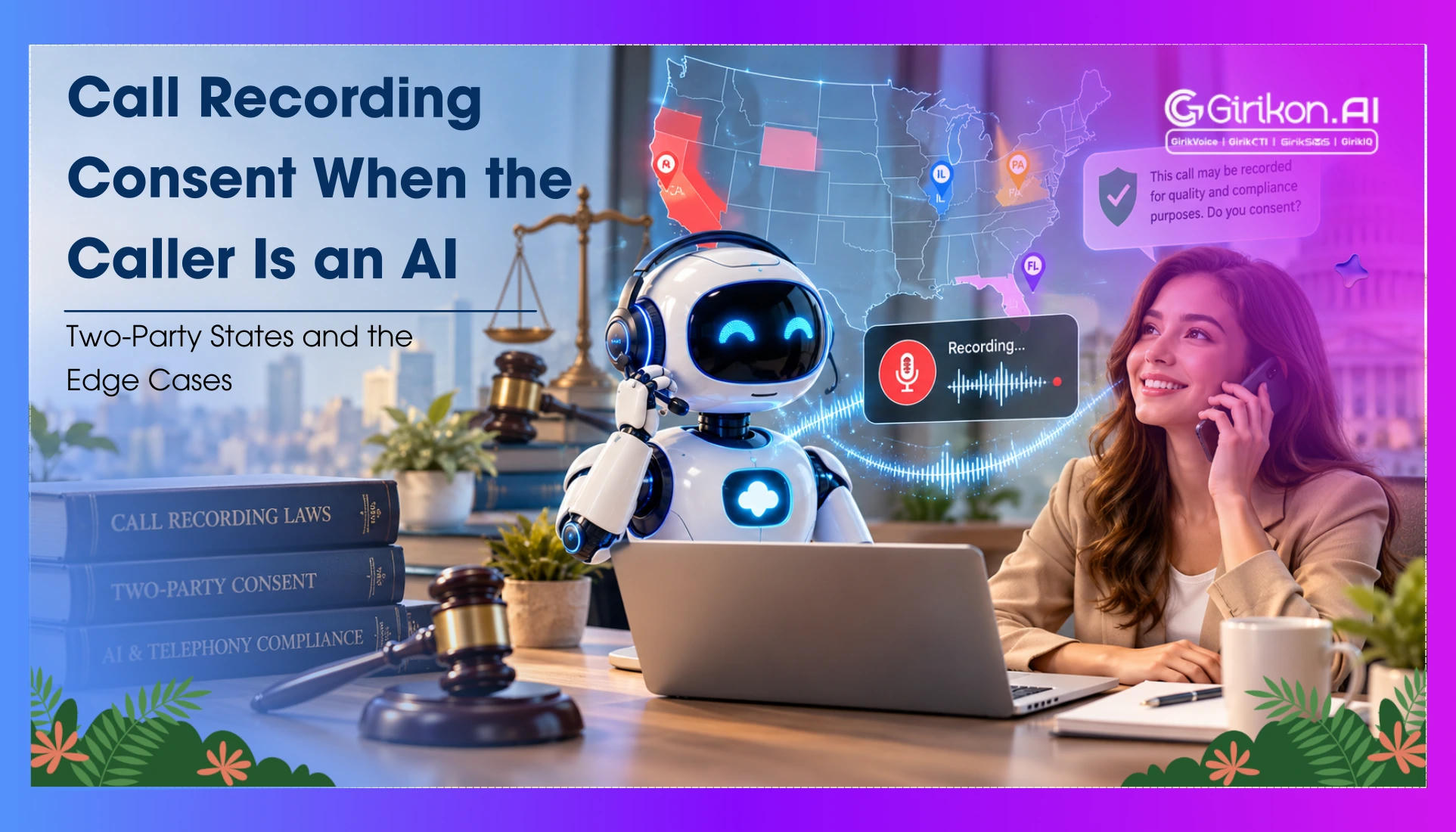
This blog explores those requirements and the edge cases businesses must navigate when an AI is the caller.
AI-powered calls are becoming a preferred way for businesses to interact with clients — providing faster responses and making conversations feel more natural. But it also raises a question for customers: is their conversation being recorded?
Knowing whether a call is being recorded matters because it serves many purposes — from improving AI performance and training personnel to tracking the conversation with clients. But before businesses can record these conversations, they must obtain AI call recording consent.
However, requirements for obtaining consent aren’t always straightforward, particularly when calls involve people across different states. In two-party consent states, even a routine AI call can raise important questions about disclosure, agreement, and recording.
What Counts as a Consent on an AI Call?
When businesses record a call made by an AI voice agent, there are two different issues involved:
- The issue of disclosure: Is the caller aware that they are speaking to an AI?
- The issue of consent to record: Is the caller aware that the call is being recorded and has consent been provided in accordance with the applicable law?
These are not necessarily the same thing. Telling a caller that they are speaking to an AI does not solve the issue of recording consent.
This distinction becomes relevant where the call crosses state boundaries, as there could be different requirements for recording.
Two-Party Consent States: Where AI Calls Get Complicated
Two-party consent states add another level of complexity since the recording process will require consent from all the participants involved in the call. Organizations also need to find out when it is legal to begin the recording and how to proceed if consent is not given.
It becomes even more complicated in cases where the caller and business are operating in two different states. The call may be made between jurisdictions with varying laws on recording; hence, the businesses cannot assume that their consent procedures will apply to every case.
In the case of two party consent AI calls, the AI voice agent must be programmed to:
- Disclose recording prior to recording when required.
- Obtain the caller’s response rather than interpreting non-response as consent.
- Avoid recording in case the consent is not given.
- Proceed with the call following a certain path when the call is refused.
Timing is a major factor. If the recording starts before taking the consent, then the subsequent disclosure cannot address the problem. It has to be ensured that the consent is taken before starting the recording.
Your AI Can Handle Calls. But Can You Trust Your CRM?
Recording consent is one piece of the puzzle. See what secure AI voice for your CRM should look like.
See Why GirikVoice Stands OutCall Recording Consent: The Edge Cases Businesses Miss
A typical recording-consent workflow follows a straightforward pattern: inform the caller about the recording, gather the needed consent, and proceed with the phone call. Voice AI agents add additional dynamics to this procedure, making consent gathering and status somewhat ambiguous.
- Two-party consent state: In this case, the AI should be programmed to gather the necessary information regarding the recording before recording begins.
- States are different: The company may have to evaluate the requirements for the recording according to the states the participants are in.
- Recording occurs prior to obtaining consent: To prevent this, it is vital to configure the system to start recording only after the consent-gathering process is done.
- The caller does not consent to the recording: The AI should know how to continue the interaction without starting the recording process.
- Mid-call transfer: In case the recording is continued after the transfer of the call, the company must determine the status of the consent.
- Consent is changed in the course of the conversation: When a caller requests to stop the recording, this has to be acknowledged by the system.
The focal point here is that the AI call recording consent is not only an upfront disclosure at the start of the call but should somehow stay linked to the actions performed by the AI during the conversation.
How Businesses Should Handle AI Call Recording Consent
The best approach is to consider consent as part of the call logic rather than an add-on during the recording process itself.
A possible AI call recording consent workflow could be as follows:
Before recording → Determine the proper consent requirement and provide the necessary disclosure.
Get consent → Request that the caller give a clear response.
Consent given?
→ Yes: Start recording and continue the call.
→ No: Stop recording using the appropriate non-recording configuration.
During the call → Continue tracking of consent status throughout transfer of call, recording status changes, and request to stop recording.
Overall, the objective is very straightforward; AI will be able to determine when to start recording, when recording is not allowed, or if the consent status changes to mid-call.
This will provide businesses with a more dependable method of managing consent states' call recording depending on various scenarios in the call.
Wrapping Up
While AI can increase efficiency and scalability in making business calls, there is a legal obligation to properly record these calls. AI call recording consent is not a one-time disclosure or a routine script to be used in all calls.
States with two-party consent laws, interstate calls, rejections by callers, call transfers, and consent changes are just some of the things that can determine how recording should be done. There have to be specific rules for the AI to follow in each case—and for companies to ensure that they comply with the corresponding standards.
The point is not to complicate everything with AI calls, but to make consent explicit and deliberate.