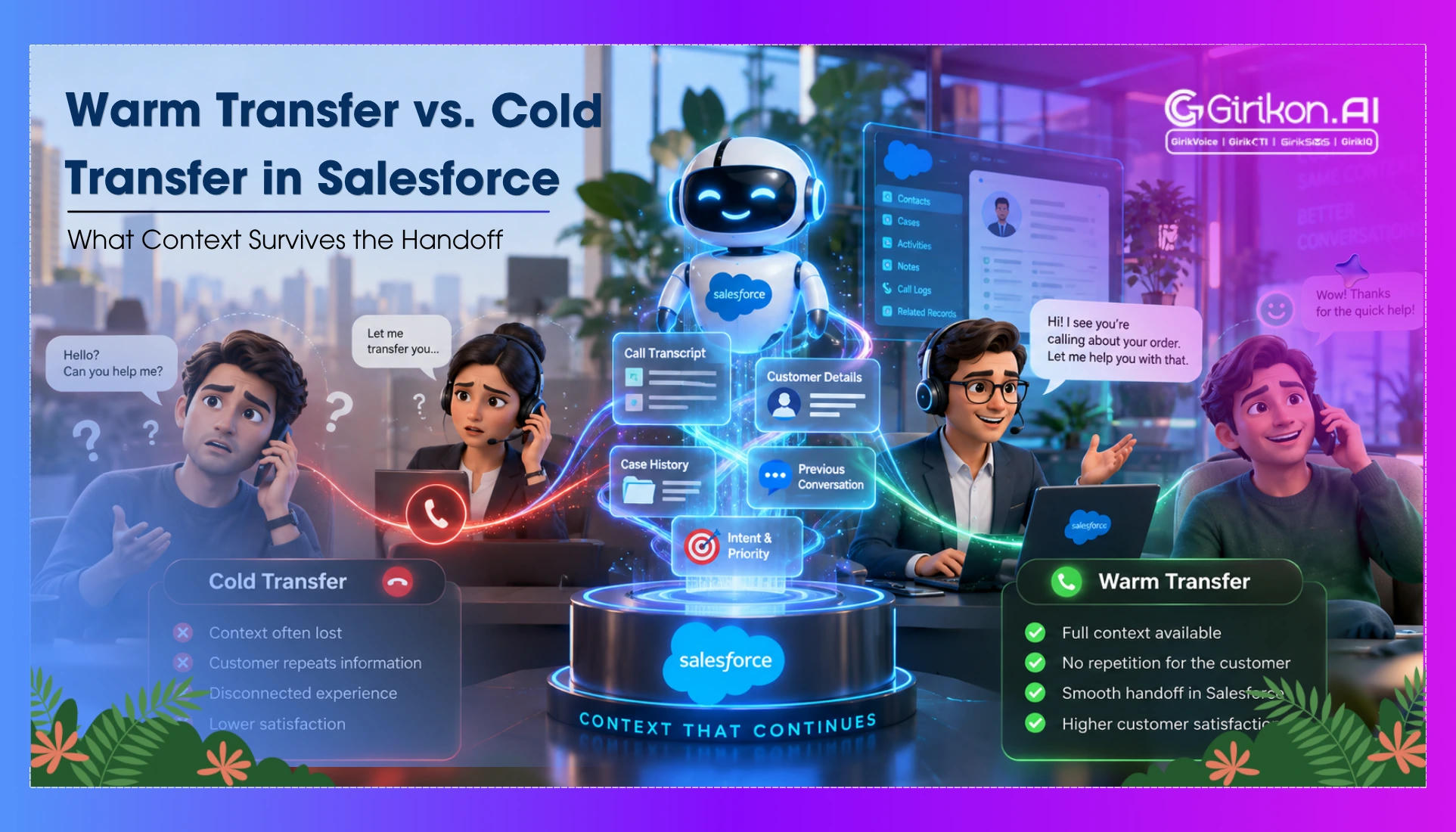
When a customer interaction needs to move from one Salesforce agent to another, the type of transfer can determine how much context survives the handoff. A warm transfer allows the receiving agent to get up to speed before taking over, while a cold transfer moves the customer directly with little or no live context. This guide explains the key differences between warm and cold transfers in Salesforce, what customer and conversation data carries over, and how each approach can affect agent efficiency and the customer experience.
- 1Prioritize warm transfers to ensure the receiving agent inherits crucial, unrecorded context from the first agent's conversation, preventing customers from repeating information.
- 2Understand that a cold transfer relies entirely on pre-existing Salesforce record context; if the transfer reason is unrecorded, it leads to customer frustration and repeated explanations.
- 3Recognize that call transfers move the telephony connection but not necessarily the full conversational context, which often resides with the first agent.
- 4Leverage Salesforce AI call notes to actively capture and document key details from conversations that can be easily reviewed by subsequent agents during handoffs.
- 5Ensure your Salesforce CTI integration is correctly configured to associate the right interaction metadata with customer records during transfers to maintain context for the receiving agent.
Every agent handoff has a cost. Sometimes it's just a few seconds of catch-up before the next agent gets oriented. Other times, the customer ends up repeating the entire story from scratch. Usually, the receiving agent's prior knowledge decides which one happens.
A Salesforce record can show the customer, account, case history, and previous interactions. But that does not mean it contains everything the first agent learned during the current conversation. Salesforce AI call notes can help capture and document key conversation details, making them easier for the next agent to review and act on.
The first agent may have spent ten minutes understanding the issue, checking the account, ruling out possible causes, and setting expectations. If that context does not cross the handoff, the next agent starts with a gap. That is what makes Salesforce call transfer and the choice between a warm transfer vs. cold transfer an operational decision, not just a telephony feature comparison.
The Transfer Moves the Call, Not Necessarily the Context
Two things happen during a transfer, and they're not the same thing. The telephony system moves the live call, while the CRM holds whatever's on record about the customer and the interaction. With Salesforce CTI, Salesforce might have the Contact, Account, Case, past interactions, agent notes, and other customer details, while the contact-center integration can also tie call activity back to those records.
What it won't have is whatever the first agent figured out on this call that never got typed in: what the customer already tried, what didn't work, what was promised, why this needs to go further. That creates the real handoff problem. The receiving agent can inherit the record without inheriting the conversation.
Warm Transfer Carries Context Through the First Agent
A warm transfer gives the first agent a chance to brief the receiving agent before leaving the call. With Salesforce call conferencing, this briefing can be short:
- The customer has already been verified.
- These troubleshooting steps have been completed.
- This is what the issue appears to be.
- This is why the call is being transferred.
- This is what the customer expects next.
The value isn't the introduction between two agents. It's the transfer of information that may not exist anywhere else. This is particularly important when the first agent has already done diagnostic work. If a specialist receives a technical case after several failed troubleshooting steps, knowing what has already been ruled out prevents the specialist from starting the investigation from zero. That is where the extra seconds of a warm handoff can save much more time downstream.
Cold Transfer Depends on the Context Already Available
A cold transfer sends the customer to the next agent or queue without that live briefing. That can work perfectly well when the receiving agent already has enough context. For a straightforward request, the Salesforce record may contain the relevant Case, customer information, and notes, making it easier to maintain context through effective Salesforce call queue management. If the telephony integration also performs the correct record association or screen pop, the next agent can begin working without needing the first agent to explain the situation.
But the dependency is important. A cold transfer is only as good as the context available to the receiving agent. If the reason for transfer exists only in the first agent's head, the customer becomes the missing source of information. That's when the familiar sequence begins: the customer explains the issue again, the agent repeats questions, and previously completed troubleshooting gets repeated.
Salesforce and Telephony Need to Preserve the Right Association
This is where Salesforce-focused transfer design becomes more technical. The question isn't simply whether Salesforce contains customer data. The question is whether the right interaction is associated with the right record at the moment the receiving agent answers.
What a contact center involves depends on the platform and integration setup: call IDs, interaction records, screen pops, case association, transfer metadata, dispositions, recordings, agent notes, sometimes all of it, sometimes only part. Because behavior varies by integration, don't assume a transferred call drags every piece of metadata along with it. Salesforce call logging helps preserve the relevant call details within the CRM, while telephony handles the call state. Get the ownership right, and it works: telephony manages the call state, Salesforce holds the CRM context the agent actually needs. The handoff works when those two layers remain connected.
Warm Transfer vs Cold Transfer: When Each One Fits
The decision gets easier once you weigh the cost of losing context. In Salesforce inbound calling, a warm transfer gains a few additional seconds if the first agent acquires information that the second one does not have: troubleshooting issues, escalated cases, billing issues, complex investigations, or commitments made during the conversation. It does not matter what department receives the call. What matters is the amount of conversation-related information that has been acquired before the transfer. A 30-second request needs almost no briefing. A 15-minute troubleshooting call usually needs a real one.
The opposite holds, too. When the receiving agent has access to the open case, the reason for the transfer, and relevant notes, a direct handoff is faster than keeping two agents occupied on the line. This is where a blind transfer works well, for simple, well-defined interactions where nothing critical lives only in the first agent's head. For any warm transfer call center, the real variable in warm transfer vs cold transfer is how much context would be lost without a briefing.
Measure the Handoff, Not Just the Transfer
Transfer volume tells you how often calls move between agents. It doesn't tell you whether those transfers are working. More useful measures include:
- Repeat explanations
- Post-transfer handling time
- Multiple transfers within one interaction
- First-contact resolution
- Customer satisfaction
If transferred calls consistently take longer because customers have to reconstruct the conversation, the problem may not be routing. It may be context preservation. That distinction matters when deciding whether the answer is better routing, better Salesforce data capture, a different integration pattern, or more warm handoffs.
Conclusion
The real distinction is how context crosses the gap between agents. Warm transfer uses the first agent as part of that bridge. Cold transfer relies on Salesforce and telephony context alone. Neither is universally better: simple interactions suit a direct transfer; complex ones need a live handoff. The test: can the second agent continue, or do they have to reconstruct it?