Voice AI systems can encounter misunderstandings, interruptions, unclear inputs, or unexpected failures during customer conversations. Learn how effective failure handling and fallback strategies help AI voice agents recover smoothly, maintain context, and deliver reliable customer experiences without unnecessarily escalating every issue to a human agent.
- 1Design for voice AI failure handling from the initial phase to ensure a positive customer experience, as failures are inevitable in real-world scenarios.
- 2Identify and categorize common voice AI failure modes, such as intent misunderstanding, context loss, and API timeouts, and define specific, appropriate recovery responses for each.
- 3Implement fallback strategies that define how the AI should proceed when it cannot recover from a failure, including options like retry, degrade, failover, or escalate to a human agent.
- 4Develop clear criteria for identifying when to switch recovery strategies to avoid frustrating customers with prolonged waits or endless loops.
- 5Proactively test voice AI systems for failure responses before deployment by simulating component failures like API timeouts and intent/context issues to ensure robust fallback mechanisms.
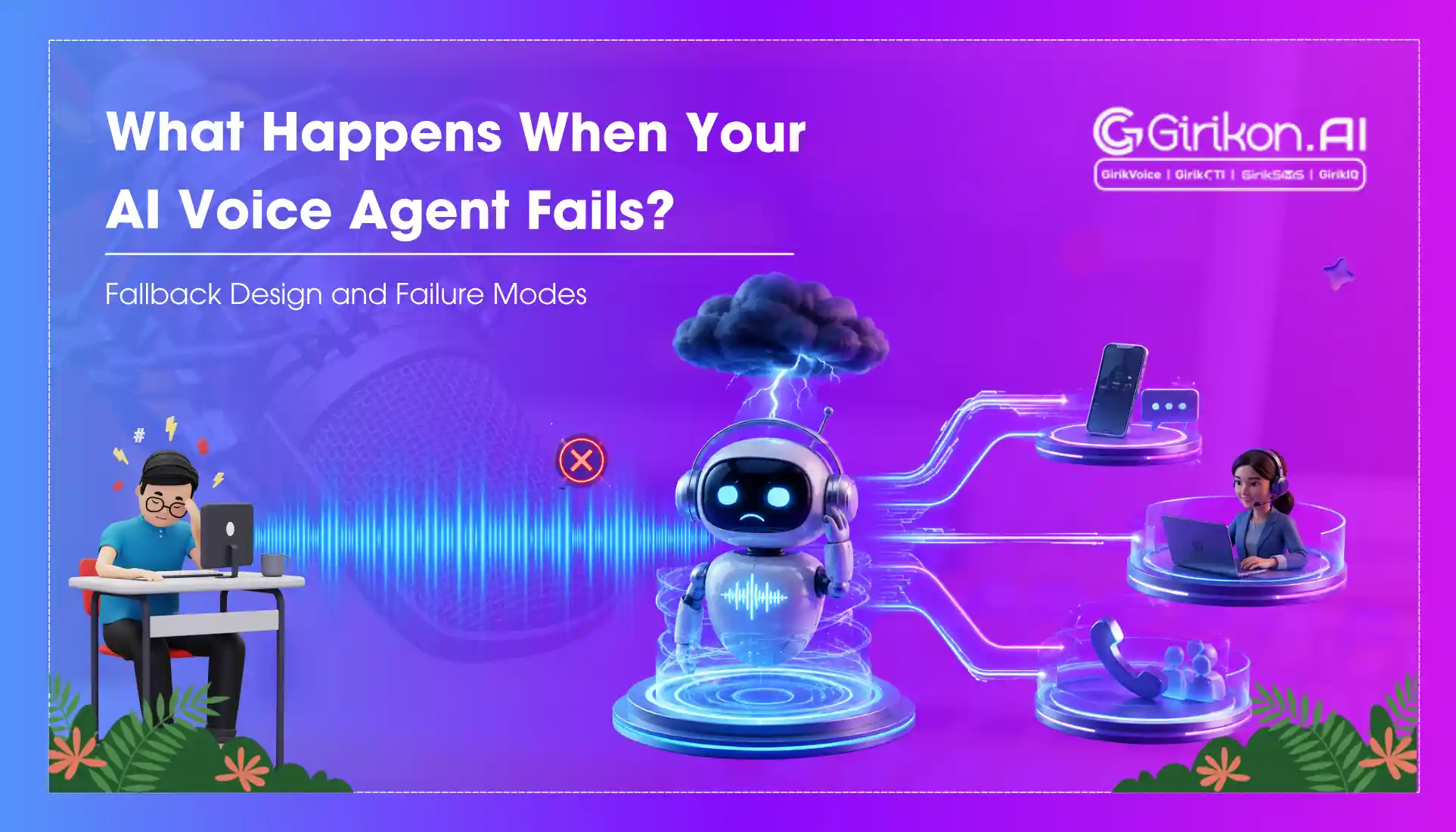
What Happens When Your AI Voice Agent Fails? A Guide to Voice AI Failure Handling and Fallbacks
The real test of a voice AI agent isn’t how well it performs when everything goes as planned—it’s what happens when something goes wrong.
The user asks an unexpected question to the agent, and the API call takes too long to respond. Meanwhile, the voice AI agent fails to understand the intent or the context and finds itself in a situation where it couldn’t give a suitable response.
Such situations might not take place during the development process—but they can happen in real life, anytime.
And if a poorly designed recovery path makes the agent struggle to recover from these failures, it results in a bad customer experience—or a lost opportunity. That is why voice AI failure handling should be discussed in the initial phase only.
Voice AI Doesn’t Always “Break” —Sometimes It Fails Quietly
A voice AI agent doesn’t need to crash to fail. There are cases where the call is active, yet the conversation gets off track.
For instance:
- Misinterprets the caller and fails to comprehend the intent.
- Fails to keep context and ask for data provided by the caller.
- An API or a tool timeout, leaving the agent waiting for a response.
- The agent falls into a loop and asks the same question repeatedly.
- The backend service crashes, and the agent cannot fulfill the request.
- An AI or telephony vendor crashes, making the primary flow impossible.
These failures might have a different technical nature; however, they lead to the same issue: the caller wants the conversation to move forward, even when the primary AI flow does not work anymore.
Here is when voice AI failure handling kicks in. The next step is to define the most common failure types in production and how the agent should react to each of them.
Common Voice AI Failure Modes and the Right Response
Every type of failure requires a different recovery approach. An agent that fails to recognize the caller’s speech should not follow the same recovery path as one experiencing a backend or system failure.
First, it is necessary to diagnose the problem and then proceed with the proper recovery flow:
| Failure Mode | What Happens | Recommended Responses |
|---|---|---|
| Intent Misunderstanding | The agent cannot understand what the customer wants to achieve. | Ask clarifying questions and try again. |
| Context Loss | The agent forgets or uses wrong information previously gathered. | Check out the last known context instead of asking the customer to repeat everything. |
| API/Tool Timeout | There is a delay in the required services response. | Try to recover or fail within a reasonable number of attempts. |
| Conversation Loop | The agent keeps asking/saying the same thing. | End the loop and offer an alternative solution, for example, human assistance. |
| Backend Failure | The agent understands the request but cannot perform an action. | Explain limitations and provide an alternative. |
| Provider Outage | Primary service is unavailable. | Initiate a voice agent fallback. |
The goal is not to avoid every single failure. This would be impossible to do in a production environment. The aim is to ensure that every possible failure has a subsequent course of action.
This is when fall back design takes on a whole new role in the discussion architecture.
What Happens to the Call When the Agent Can’t Recover
A failed voice AI agent doesn't necessarily mean that the call must end. What happens next depends on the type of failure.
There are different ways for the system to proceed:
- Recovery: The agent understands the request, recovers the context, and continues the interaction.
- Retry: In case of a temporary API or tool failure, it is retried within a certain limit.
- Degrade: If a non-essential function is unavailable, there is a concept of degraded mode of voice AI which lets the agent continue the interaction with reduced functionality.
- Failover: The call is shifted to another AI, service, or process in case the primary path is not available.
- Escalate: The call will be escalated to the human agent when AI cannot handle the interaction successfully.
The important element here is the ability to identify when to change strategies. In the absence of any predetermined criteria for switching, the agent would continue with efforts, keeping the customer waiting, or getting into an endless loop.
Defining these outcomes is a necessary first step towards a good solution. The second one would be deciding how to switch to each recovery approach.
Preparing for Voice AI Failures Before They Happen
Fallback strategies are useful when they work under real-life conditions. Before deploying a voice AI agent, a business needs to check how the system responds when individual components fail.
Testing must include the following:
- API and tool timeouts for checking whether the system retries and tries other options.
- Intent and context failures for checking whether the system can recover without frustrating the caller.
- Fallback calls stimulate an AI agent outage to check whether the system can switch to a backup service and workflow.
- Handoffs with preserving relevant context of the caller.
- Degraded mode of voice AI for checking that critical services are still available while non-critical ones are out.
All the testing must have clear success criteria. It is not important whether the system can withstand errors—but whether the system can handle them without making a user think that the system is failing.
This makes a fallback design part of production readiness.
Conclusion
Failures in Voice AI will occur, but that doesn't necessarily imply that it will lead to a bad customer experience. Whether it is a wrong understanding of intent, an unresponsive API, a conversation loop, failure of back-end processes, or any service failure, there should be a way to fix it.
Effective use of voice agent fallback will guarantee that, in case anything goes wrong with the main path of AI, there is always another way of continuing the communication. By predicting possible failure situations and checking backup plans beforehand, companies will ensure that their voice AI systems are still operational despite any unexpected occurrences.