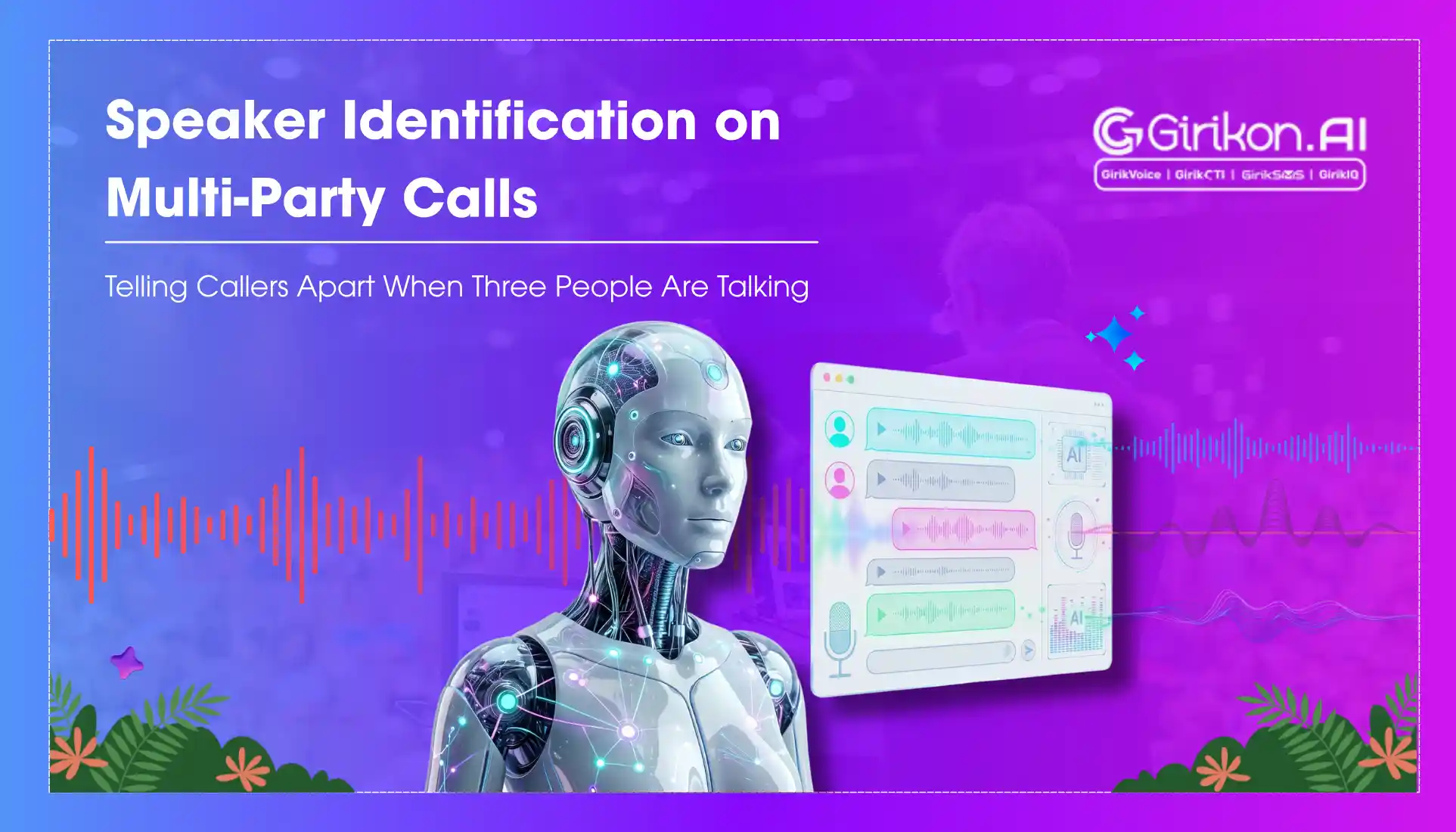
Speaker identification and diarization turn a multi-party call transcript into a record of who said what, and change how call reviews, intent and summaries work.
- 1Implement speaker identification and diarization technologies to distinguish between multiple speakers in multi-party calls.
- 2Leverage speaker-aware transcripts to understand who said what and at what time, transforming raw text into structured conversations.
- 3Enhance call quality reviews by enabling supervisors to accurately assess agent performance and customer responses.
- 4Improve customer intent analysis by differentiating between statements from the customer and those from other participants.
- 5Generate more useful call summaries by accurately attributing information to specific speakers, leading to better data insights.
Speaker Identification on Multi-Party Calls: Distinguishing Callers When Three People Are Talking
A transcript gives a detailed report regarding the actual telephonic conversation. However, what if the conversation involves three people?
A customer explains an issue. A spouse adds more details. An agent asks follow-up questions. Multiple people speak at nearly the same time.
If the transcript simply records everything as one stream of text, you are left with a bigger question. Who actually said what? This is where speaker identification calls and speaker diarization calls become important.
For firms handling intricate calls, understanding the text analysis process is just half the story. They also need to comprehend who spoke, at what time, and what role that individual held in the communication. With the help of voice technology, organizations will be able to transform from ordinary transcription to speaker-aware and structured conversations that are easier to analyze, review, and act on. Read throughout to learn more.
What is Speaker Identification on a Call?
Identifying a speaker signifies the process of realizing which of the participants was speaking at a given moment of the call.
Suppose three participants are engaged in a phone conversation:
Agent: The customer service representative
Customer: The person calling
Additional Caller: The customer’s spouse or colleague
Without speaker identification, the transcript may be produced in a single line that you can understand the conversation, but you don’t identify who said what? That’s why, a speaker-aware transcript organizes the conversation as;
Customer: I need to change my appointment
Agent: Sure, what date would you prefer?
Customer: Friday would work for me.
Additional Caller: Actually, Saturday works better.
This distinction becomes particularly valuable when more than two people participate in a call. Instead of simply transcribing every word, speaker identification helps businesses separate participants and understand who provided each piece of information.
What is Speaker Diarization in Calls?
Speaker diarization calls refers to the technology that helps to understand the “who spoke when” aspect of an audio conversation. It uses the difference between the times when one speaker finishes talking and another speaker starts to divide the speech into parts of conversation as:
00:00- 00:04—Speaker 1 (Agent): How can I help you?
00:05- 00:09—Speaker 2 (Customer): I would like to change my appointment.
00:10- 00:13—Speaker 3 (Spouse): Can we do that on Saturday?
00:14- 00:16—Speaker 2 (Customer): Yes, Saturday is fine.
00:17- 00:21—Speaker 1 (Agent): Okay, I will check the availability.
This distinction becomes especially important in multi party call transcription where several people join the same conversation. Instead of receiving one continuous block of text, businesses can review a structured transcript that is easier for humans and AI systems to understand and analyze.
Why Does “Who Said What” Matter?
Understanding what is said on a call is useful. But knowing who said it can make that information even more valuable.
The customer provides information about the incident, the spouse gives another piece of information, and the agent asks a question to complete the claim. When the transcript includes all these voices in one chunk of text, it is impossible to understand which speaker contributed to what part.
However, a speaker aware transcription can separate the conversation:
Agent: When did the incident occur?
Customer: It happened on Monday evening.
Spouse: I think it was Tuesday.
Customer: Yes, that’s true.
Now the conversation is much easier to understand, helping the team make a difference in several areas:
Better Call Quality Reviews
With the help of transcripts, it will be easier for supervisors to assess the way agents perform and how the clients are responding, as well as to locate the significant turning points in the conversation. This allows for the identification of the missing questions, when escalation happened, and what should be improved during training.
More Accurate Customer Intent
Not every statement during a call comes from the customer. An interpreter, caregiver, spouse, colleague, and another participant may ask questions, make suggestions, and provide additional information. The transcript that does not indicate different speakers will make it impossible to determine who gave a certain piece of information or if it is really the response of the customer. That’s why a multi-party call transcription is important for accurately capturing the conversation.
More Useful Call Summaries
A basic transcript may capture the statement, but a speaker-aware system can understand that the customer initially provided one date; the spouse corrected it, and the customer confirmed the corrected information. This allows AI to create a more useful summary, such as:
Incident date: Tuesday evening, confirmed by the customer after the spouse provided a correction.
It allows both agents and supervisors to understand important information without reading the whole conversation.
How Does Multi-Party Call Transcription Work?
A typical speaker-aware transcription workflow can be thought of in several stages.
- Capture the Conversation
The voice system receives the audio from the customer conversation that may involve multiple participants. - Detect Different Speakers
AI distinguishes one voice from another and creates separate conversational segments by analyzing characteristics within the audio. - Transcribe Each Segment
The transcript maintains speaker boundaries and converts speech into text from each segment. - Assign Speaker Labels
The system associates sections of the transcript with speaker labels that can be mapped to known roles or participants. - Generate Context of the Conversation
Dividing the dialogue in various speaker portions makes it easier for the supervisors to access the context in which the people taking part in the conversation, like who asked what questions, who cleared what doubts, who provided the information, and so forth.
Conclusion
The knowledge of who is speaking to whom at which point in time during multiple-person conversations can be the key difference between a mere transcript and a meaningful conversation. Speaker diarization gives additional structure to the communication process by isolating different speakers and preserving the process of communication.
With GirikVoice, you can take this speaker-aware approach further by turning complex voice conversations into more structured and actionable insights. So, are you ready to make every call more intelligent? Explore GirikVoice today.