Learn the differences between short-term and long-term AI memory, why hybrid memory architectures matter and how they improve enterprise voice agent performance.
- 1Implement a hybrid AI memory architecture for voice agents, combining short-term and long-term memory, to enable meaningful conversations and improve customer experience.
- 2Utilize short-term memory for real-time conversational context within a single session to reduce redundant questioning and enhance fluidity.
- 3Leverage long-term memory to store customer history, preferences, and institutional knowledge across all sessions, recognizing returning callers and enabling personalization.
- 4Employ distinct long-term memory types – Episodic, Semantic, and Procedural – to manage past interactions, factual knowledge, and task execution respectively.
- 5Adopt hybrid memory architectures to achieve seamless context continuity and faster resolution rates by pre-loading agents with relevant customer information.
Short-Term vs Long-Term AI Memory Types: Which Do Your Voice Agents Need?
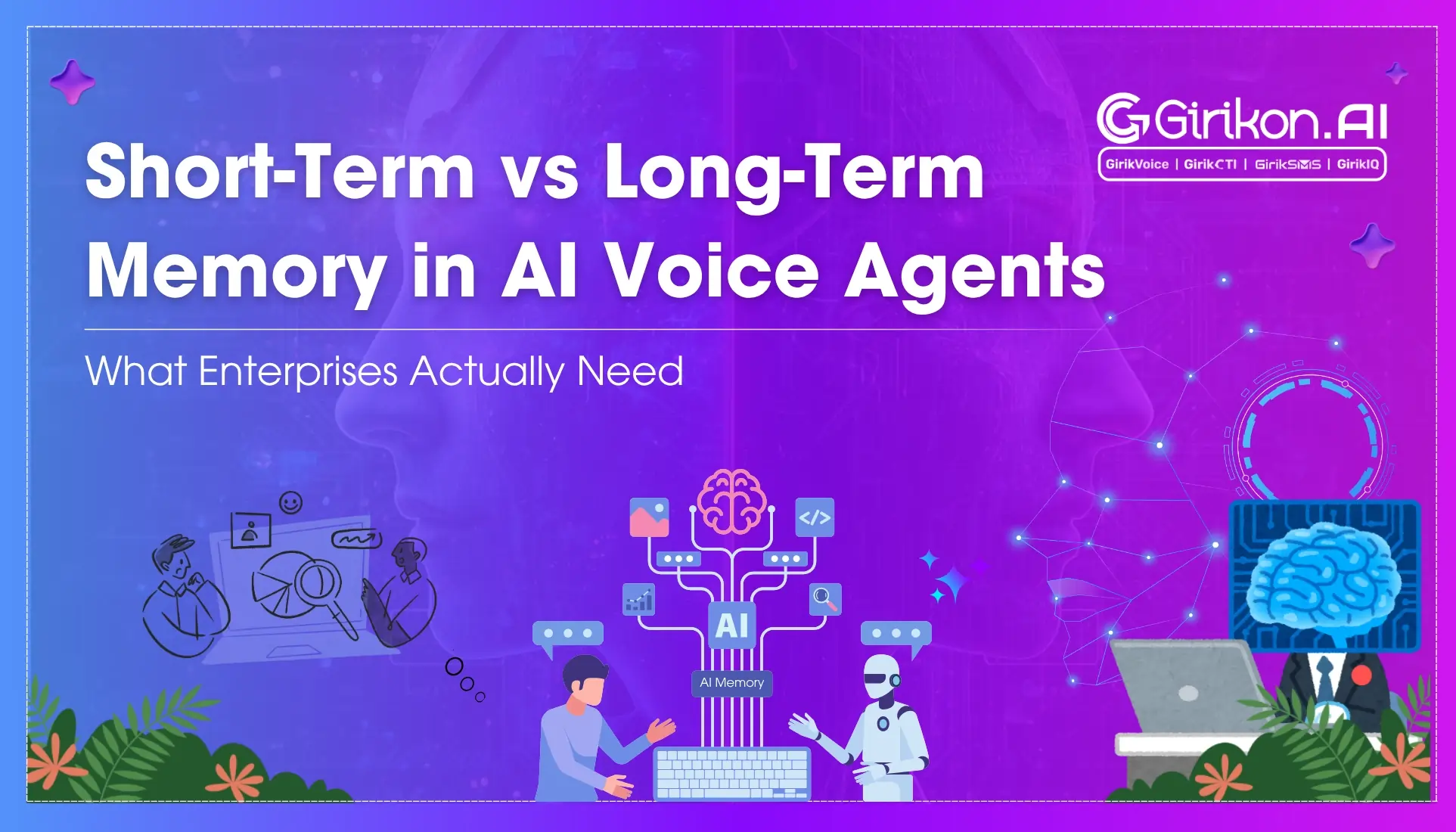
Modern voice AI agents are expected to hold meaningful conversations, not just route calls. Yet most deployments fail at a basic level: every interaction starts from zero. Standard LLM-based setups lack recall, forcing customers to repeat issues already reported. That gap between expectation and memory is the real engineering challenge. Addressing it requires understanding agent memory types and adopting a hybrid design that combines short-term context with persistent long-term storage.
Also read: persistent memory AI voice agents
Also read: AI voice agent memory
When systems carry the right information into each exchange, handle times drop, frustration decreases, and resolution rates improve. This blog explains short-term and long-term memory and how hybrid architectures strengthen enterprise voice agents.
What is Short-Term Memory in AI Voice Agents?
Short-term memory allows agents to retain recent inputs within a single session. It provides context from earlier parts of the call, enabling coherent multi-turn dialogue without repeating questions.
Advantages of Short-Term Memory AI:
- Enables fluid, contextually relevant responses within a single session
- Reduces redundant questioning and improves caller experience
- Lightweight to implement with minimal infrastructure overhead
- Processes updates in real time without external database calls
Limitations of Short-Term Memory AI:
- All context is lost permanently once the session ends
- Returning callers receive no recognition or continuity
- Token budgets restrict how much dialogue the model can retain simultaneously
- Sliding window mechanisms drop earlier parts of long conversations automatically
- No support for personalization beyond the active call
Token budgets and sliding windows are the core technical constraints here. When a conversation exceeds the model context window, older exchanges are discarded. For lengthy enterprise calls and troubleshooting sessions, for instance this can cause the agent to lose critical details about mid-conversation.
What is Long-Term Memory AI?
Long-term memory or LTM lets agents have context remembered long after a session ends. The agent can retrieve relevant customer history, preferences, and institutional knowledge before a conversation begins.
3 Types of Long-Term Memory AI
Enterprise voice applications typically require three distinct sub-types of long-term memory:
Episodic Memory can store specific past interactions in a chronological record, and this context shapes the entire conversation. It’s quite helpful in case-based reasoning where the agents need to remember what it learned from past events to make better decisions in the future.
Semantic Memory in voice AI agents store fact-based knowledge repositories like product catalogs, pricing structures, regulatory guidelines, and internal policy documentation. So, instead of depending on training data, it can retrieve data by querying these sources directly, making accurate and current outputs.
Procedural Memory governs multi-step task execution like refund workflows, escalation protocols, and authentication sequences. This type of memory can recall skills or events to perform tasks without explicit reasoning and ensures the agent follows established operational logic consistently across every call.
Advantages of Long-Term Memory AI:
- Recognizes returning customers and references prior interactions
- Supports personalization at scale across thousands of concurrent users
- Reduces average handle time by eliminating repeated context-gathering
- Enables proactive service based on behavioral patterns
- Strengthens compliance and audit trails through structured data retention
Short-Term vs Long-Term Memory: What’s the Difference
| Factors | Short-Term Memory | Long-Term Memory |
|---|---|---|
| Memory Duration | Session only | Across all sessions |
| Latency | Near-instant | Slight retrieval delay |
| Storage Cost | Minimal | Scales with data volume |
| Personalization | None beyond current call | Deep, history-driven |
| Complexity | Low implementation overhead | Requires external infrastructure |
| Privacy Risk | Low (no data retained) | Higher (requires governance) |
| Use Case Fit | Transactional, single-session queries | Relationship-driven, recurring interactions |
Why Hybrid Memory Architectures is Best to Power Voice Agents: 5 Benefits
Hybrid memory architecture is best because it combines both memory types. So, they give the speed and focus of short-term memory AI for immediate tasks, while using long-time memory in the mix helps you get continuity and context across interactions. There are other benefits like
1. Seamless Context Continuity
A hybrid architecture combines in-session awareness with historical retrieval. The agent tracks what is being said right now while simultaneously referencing what happened in prior calls. Customers experience a single, connected relationship, not a series of isolated interactions.
2. Faster Resolution Rates
When agents enter a call pre-loaded with customer history, diagnostic progress, and account context, conversations move directly to resolution. Teams that have deployed conversational AI memory architectures consistently report measurable reductions in handle time.
3. Intelligent Personalization
Hybrid systems cross-reference real-time cues against stored customer profiles. An agent can detect sentiment, reference a past complaint, and adjust tone, all within the first thirty seconds. That level of context aware AI behavior is only possible when both memory layers operate together.
4. Resilience During Extended Conversations
Long enterprise calls stress token limits. Hybrid architecture compensates by offloading older context into retrievable long-term storage rather than discarding it. Critical details remain accessible even as the conversation extends.
5. Scalable Knowledge Management
Semantic and procedural memory layers can be updated centrally: new product lines, revised policies, regulatory changes without retraining the underlying model. It keeps the agent accurate and current across the entire organization.
How to Choose the Right AI Agent Memory Types: Key Considerations
Latency: It’s non-negotiable in voice environments. Every retrieval operation adds milliseconds. Long-term memory calls must be architected for speed, vector databases and indexed retrieval help, but architecture choices matter significantly at scale.
Cost: It compounds with data volume. Long-term memory requires persistent infrastructure, query optimization, and storage governance. Organizations should map expected query frequency against infrastructure costs before committing a full implementation.
Privacy and compliance: Neglecting privacy and compliance brings in challenges and fines. Since your business deals with a lot of data, adhering to regulations such as GDPR and CCPA require strict handling of interaction histories across sessions is a must. Enterprises in regulated industries need to have retention policies, consent frameworks, and access controls before deploying persistent memory at scale.
Risk of Attention Truncation: Selecting the wrong memory design creates serious operational issues. In long calls, short-term token limits are exhausted, and eviction policies cut off context mid-conversation. Long-term memory can also fail when retrieval pipelines truncate or mis-prioritize records, leaving out relevant history.
In both cases, critical data is lost, agent loops, and failed API executions. So, robust persistence and careful attention management are required to avoid these breakdowns.
Closing Remarks on AI Agent Memory Types
Short-term memory vs long-term memory is not an either/or decision for enterprise voice systems. Session-level context handles immediate conversation; persistent storage builds the relationship over time. So, the best and most capable voice agents are those that can operate with both layers working in coordination, one handling the present exchange, the other carrying the weight of every interaction that came before it.
To learn more about enterprise voice agents with hybrid memory, and how short-term plus long-term layers together improve customer interactions, connect with us today!