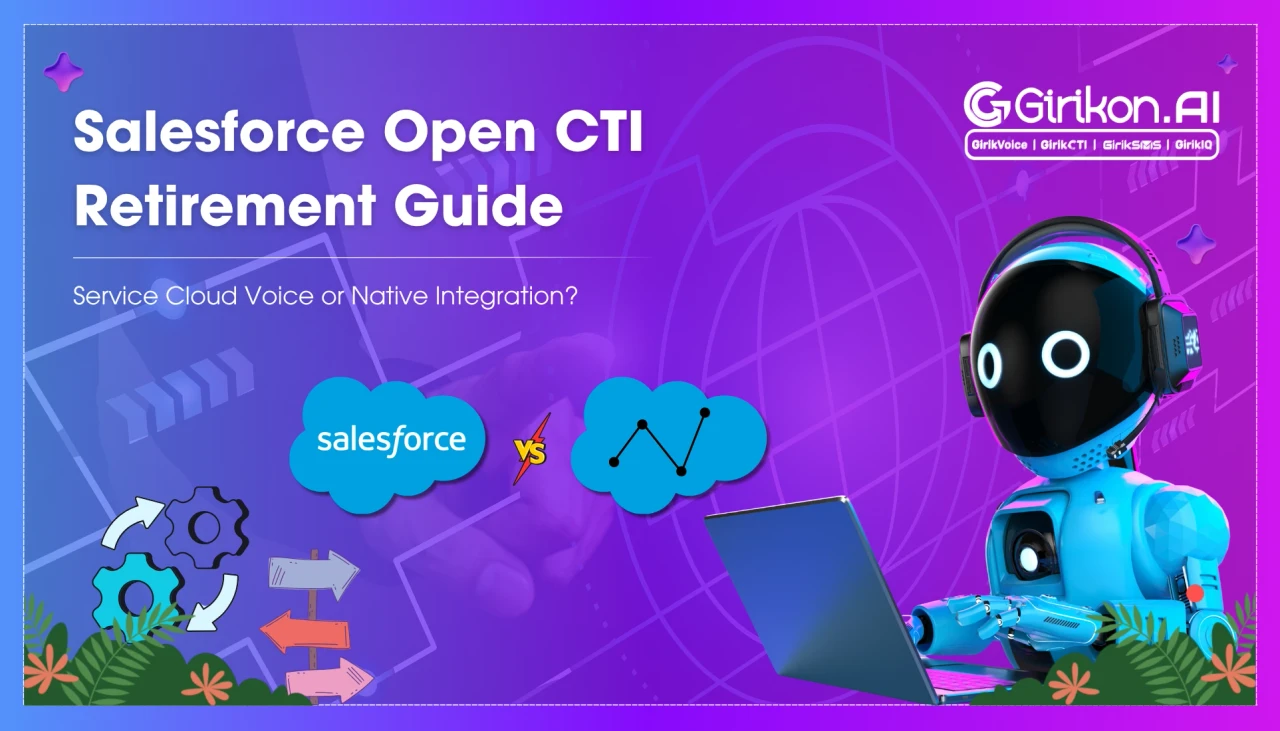
As Salesforce plans to retire Open CTI in 2028, businesses need to evaluate their next move. Explore the key differences between Service Cloud Voice and native telephony integrations, and learn which migration path best fits your contact center's future.
- 1Plan your migration from Salesforce Open CTI immediately, as it will be fully decommissioned on February 28, 2028.
- 2Evaluate whether migrating to Service Cloud Voice or building a native CTI solution better aligns with your organization's future needs and AI integration strategy.
- 3Understand that the retirement of Open CTI signifies Salesforce's shift towards a more integrated, AI-driven voice architecture requiring a mandatory transition.
- 4Consider Service Cloud Voice for easier adoption of future Salesforce AI features and reduced infrastructure management if platform dependency is acceptable.
- 5Explore rebuilding around an external CTI model if you require greater control over telephony providers, custom call logic, or specialized routing.
For over a decade, Open CTI was one of the core technologies that made voice functionality possible in Salesforce. It enabled businesses and telephony vendors to integrate calling capabilities into Salesforce Service Cloud without full ownership of the voice stack. Pop-ups, click-to-dial, call control, and agent context became possible through a flexible framework that allowed organizations to build their own telephony ecosystems.
Now, Salesforce has officially put a timeline for the end of life of Open CTI, that closes on February 28, 2028. With that deadline, the discussion about the transition now needs active planning because replacing Open CTI will affect both telephony architecture and service workflows. At the same time, the growing adoption of salesforce ai voice agents is reshaping how businesses approach customer service automation, making this transition an opportunity to modernize voice operations. The Salesforce Open CTI retirement is no longer a concern sitting in the backlog—it is now a strategic decision for enterprises, ISVs, and Salesforce Service Providers to determine whether adopting Service Cloud Voice or building a native CTI solution is the better long-term approach while aligning with AI-driven customer engagement.
Understanding Salesforce Open CTI Retirement and What It Implies
Salesforce does not retire a framework like Open CTI without a larger platform shift behind it. Its retirement reflects how voice architecture inside Service Cloud has changed and where Salesforce wants it to go next.
Open CTI was built in a different phase of Salesforce. It gave businesses flexibility through a JavaScript-based integration layer, allowing telephony providers to connect into Service Cloud while keeping the rest of the voice stack external. That model worked well because it gave businesses the freedom to connect external telephony systems into Salesforce without forcing businesses into a native voice model.
But the demands around enterprise voice have changed. AI-assisted call summaries, live transcription, real-time sentiment analysis, and native service intelligence all require tighter system-level coordination. Traditional Telephony Integration with Salesforce through Open CTI was never built for that depth. Its architecture was designed for telephony integration, not for the kind of embedded voice intelligence Salesforce is now prioritizing.
That is where the Open CTI end of life becomes important to understand. This is not a case where support simply ends, and the framework continues running in the background. Salesforce Open CTI is going to be fully decommissioned as back-end API support will be withdrawn, thereby discontinuing the underlying framework from their cloud platform. This means that, for organizations who have been dependent on it, it's the end of CTI integration unless migrated.
That shifts the conversation from optional modernization to mandatory transition. While Service Cloud Voice migration might be the straightest route for certain enterprises due to alignment with the native roadmap and future products of Salesforce, the choice for other businesses can vary. They may call for a more careful evaluation of their need for control over telephony providers, customization workflows, and customer engagement models. What is important here is that, at this point, there is no question about the need to make a change. The question that needs to be answered now is the one concerning the type of voice architecture to build in place of a long-standing model.
Legacy Telephony Replacement
Read the full guide on legacy telephony replacement.
What Are the Options After Open CTI Shuts Down?
Once Open CTI reaches its shutdown date, businesses will have to replace the framework entirely. There is no middle ground where the existing setup continues running in the background. That makes the post-retirement decision more direct. For most teams, the path usually narrows into two realistic options: move into Salesforce's native voice ecosystem or rebuild around an external telephony model.
Option 1: Move to Service Cloud Voice
This is the path Salesforce is actively aligning businesses toward after the Salesforce Open CTI retirement. Service Cloud Voice replaces the external CTI model with a native voice framework where telephony is managed as part of the Service Cloud stack itself.
The biggest advantage here is alignment. Businesses stay closer to Salesforce's long-term product roadmap, which makes future updates, AI features, and service automation easier to adopt. This path often makes sense for businesses that want less infrastructure ownership and tighter platform dependency. The tradeoff is flexibility. Native voice models often limit how much control businesses have over telephony providers, custom call logic, or specialized routing requirements.
Option 2: Build Around an External CTI Model
For businesses with heavier customization needs, an Open CTI alternative may be the stronger route. This usually means adopting a newer CTI integration model or working with a provider offering a Salesforce Open CTI replacement built outside Salesforce's native voice stack.
The biggest advantage here is control. Businesses can keep provider flexibility, preserve custom routing logic, maintain specialized integrations, and shape the voice architecture around their own operational requirements. The tradeoff is ownership. More flexibility usually means more responsibility across maintenance, compatibility, and future upgrades.
Which Option Should You Choose – Migrate or Go Native?
The real decision is less about replacing Open CTI and more about deciding how much control your business wants over voice once the transition happens. As the Open CTI end of life gets closer, that decision becomes more operational than technical.
Choose Service Cloud Voice if:
- You want to reduce telephony complexity and centralize voice inside Service Cloud.
- Standardized workflows matter more than provider flexibility.
- Your service operations are expected to rely more on Salesforce-native AI and workflow automation.
- Your current setup does not depend heavily on custom routing or provider-specific logic.
Choose a Native CTI or External Replacement if:
- Your current setup depends on custom telephony workflows that would be difficult to rebuild.
- Provider flexibility matters for pricing, regional coverage, or specialized telephony needs.
- Your contact center relies on deeper routing layers or third-party integrations.
- Your long-term strategy requires stronger ownership over voice infrastructure.
Conclusion
Open CTI carried Salesforce voice operations through a very different phase of enterprise service architecture. Its retirement now forces businesses to think beyond replacement and toward a long-term voice strategy. The transition ahead is unavoidable, but the architecture that follows is still a choice. That choice may define how customer service operates long after 2028.