Traditional voice AI often depends on connectors, middleware and multiple integrations that increase complexity and maintenance. Discover how Salesforce native voice AI works directly inside Salesforce to deliver real-time CRM updates, stronger security, faster deployment, and seamless customer experiences without unnecessary integration layers.
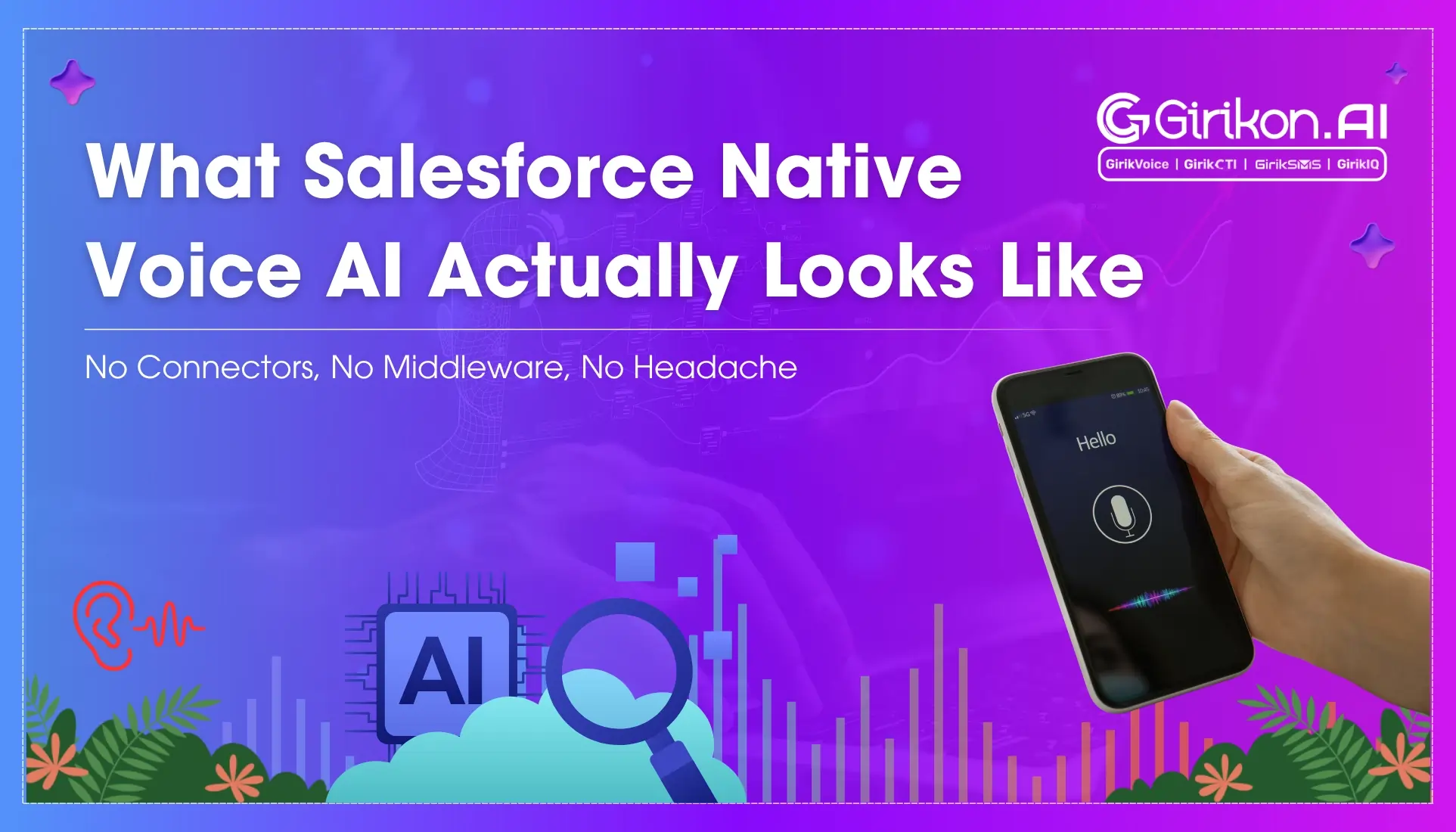
What Salesforce Native Voice AI Actually Looks Like: No Connectors, No Middleware, No Headache
Customer communication has undergone significant shift in today's digital era. Today, voice has emerged from being just another communication channel to an intelligent interface that can handle service requests, respond to queries, update CRM records in real time and more. With organizations leveraging the power of AI-enabled voice automation, many discover that the struggle isn't building AI, it’s sewing together everything.
While voice AI implementations done the traditional way often require several connectors, third-party middleware, integration platforms, APIs, synchronization tools, and complex maintenance. The result is architecture that becomes growingly difficult to handle as business processes evolve.
Consequently, businesses are making a shift toward Salesforce native voice AI — a solution that directly functions within Salesforce rather than depending on peripheral integration layers.
When organizations employ a Salesforce voice agent without connector, they do away with needless complexity while augmenting performance, security, and user experience. Rather than data moving via multiple applications before moving Salesforce, every conversation occurs within the CRM where client data already exists.
Let's find out what Salesforce native voice AI truly looks like and why businesses are moving away from systems that are middleware-heavy.
What are the Integration Challenges Faced by Traditional Voice AI?
Salesforce is a simple integration project. Most deployments include a chain of technologies where calls must move through a telephony platform, a voice AI platform, integration middleware, API entries, CRM connectors, and ultimately Salesforce. Every additional layer creates another possible point of failure – leading to delayed CRM updates, broken integrations, duplicate client records, issues related to data synchronization, amplified infrastructure costs, lengthy implementation timelines, and tough troubleshooting.
Rather than streamlining client engagement, this fragmented structural design adds pointless complexity. The challenge isn't the technology — it's the numerous systems and connectors needed to make the whole thing work together.
What Is Salesforce Native Voice AI?
Salesforce native voice AI automation functions completely within the Salesforce ecosystem – doing away with the need for different middleware platforms, third-party connectors, or data management tools. Rather than directing client interactions through multiple applications, the AI converses directly with the objects, workflows and permissions of Salesforce in real time.
This centralized approach allows the voice agent to access CRM records, generate new leads, update chances, trigger Salesforce Flows, execute Apex actions, schedule appointments, retrieve history, and log conversations by default — everything from a single setting. By doing away with external integration layers from daily business processes, Salesforce native voice AI offers more efficient system that is simple to deploy, handle and scale.
What ‘No Connectors’ Mean in Truth?
A Salesforce voice agent without connectors doesn't do away with the need for telephony, it completely removes the need for several integration layers between disjointed systems. Rather than providing multiple connectors that need constant arrangement, monitoring, testing, and troubleshooting, a Salesforce-native architecture keeps business logic within Salesforce, where client data already belong to. This allows voice AI to directly interact with Salesforce - reducing complexity, augmenting reliability while streamlining operations.
Why Eliminating Middleware is Crucial for Removing Operational Complexity?
Middleware helps connect disjointed systems while adding significant operational complexity through integration servers, API arrangement, authentication, tracking, and ongoing maintenance. With Salesforce voice AI no middleware, organizations do away with a complete technology layer, leading to faster deployments, fewer integration failures, lower licensing costs, and a more reliable architecture that's simple to manage and scale.
What are the Benefits of voice AI inside Salesforce?
Real Time Data Access
One of the major advantages of voice AI inside Salesforce is real-time access to client data. Without depending on external systems, the AI can recover interaction details, account history, service cases, prior interactions, product ownership, contract status, and custom objects. This enables faster and highly tailored, and context-aware interactions.
Leveraging Automation Already Built
One of the most overlooked benefits of Salesforce voice automation is that organizations can utilize the automation they might have already built. Existing Salesforce Flows, validation rules, approval processes, Apex automations, assignment rules, and workflows remain unaffected. Rather than replacing these processes, a native voice AI initiates them through natural interactions, allowing businesses to continue their existing Salesforce automation to voice interactions without the need to build workflows.
Better Security
Native architecture of Salesforce fortifies security by decreasing the number of external systems involved in client interactions. Every additional connector introduces new risks, from API authentication tokens to integration servers and third-party data storage. By keeping client interactions within Salesforce, organizations can utilize existing role-based access, audit logging, unified authentication, data governance, and regulatory compliance - creating a more secure and well-managed environment with fewer points of susceptibility.
Faster Deployment
Voice AI implementations usually require months of integration work, with development teams spending significant amount of time configuring APIs, testing connectors, building middleware, and fixing authentication and orchestration issues. Salesforce native voice AI strips off much of this complexity - allowing implementation to focus on interaction design, business workflows, user permissions, AI training and voice experiences.
Consistent Customer Experiences
Customers expect disruption-free experiences, regardless of the department they interact with. Voice AI inside Salesforce offers access to the same real-time client data to teams across different departments. Since every discourse is recorded within a unified environment, teams share a consolidated view of client history, ensuring hassle-free information, seamless handoffs, and tailored interactions across the overall customer journey.
| Benefit | How Salesforce Native Voice AI Helps |
|---|---|
| Real-Time Data Access | Accesses CRM records, account history, service cases, contracts, and custom objects instantly. |
| Leverages Existing Automation | Works with Salesforce Flows, Apex, validation rules, approval processes, and workflows. |
| Better Security | Reduces external connectors while utilizing Salesforce security, governance, and compliance features. |
| Faster Deployment | Eliminates extensive middleware and connector configuration, reducing implementation complexity. |
| Consistent Customer Experience | Provides a unified customer view across departments with centralized conversation history. |
Final Words:
Modern businesses require voice AI that streamlines operations rather than adding integration complexity. Salesforce native voice AI allows organizations to streamline interactions directly within Salesforce - eliminating the requirement for middleware and connectors. By combining Salesforce with voice AI, businesses can get access to CRM data, streamline processes, deliver tailored experiences, decrease cost of maintenance, and implement AI solutions that scale with their business.