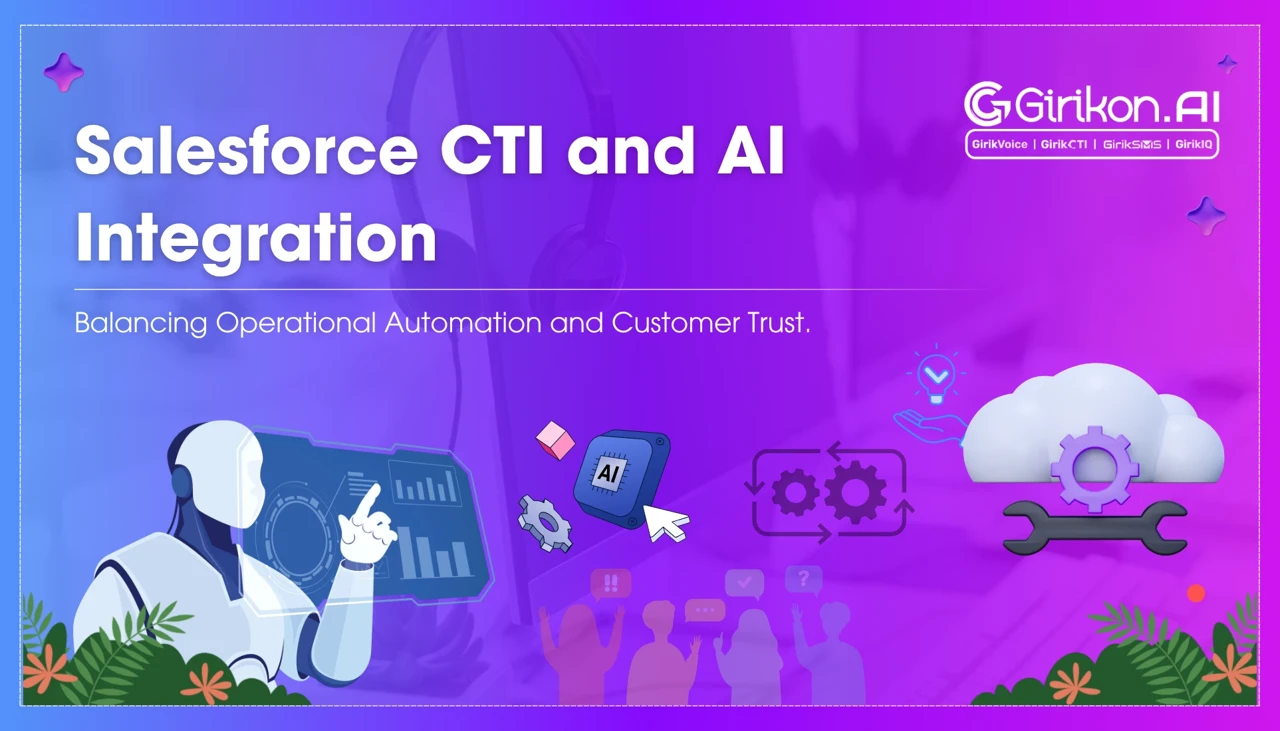
Drive smarter sales with Salesforce CTI and AI by automating routine tasks while keeping human judgment at the center. Discover how intelligent call workflows, real-time insights, and trusted customer interactions create stronger relationships and better outcomes.
- 1Leverage Salesforce CTI with AI to empower sales representatives by automating routine tasks and providing real-time customer insights, allowing them to focus on building relationships.
- 2Integrate AI-driven cloud telephony with Salesforce CTI to gain advanced capabilities like next-best-action recommendations, real-time conversation analysis, and predictive lead scoring.
- 3Automate CRM updates and deliver real-time sales guidance to representatives during customer interactions to improve efficiency and effectiveness.
- 4Prioritize high-intent leads identified by AI to ensure sales teams focus their efforts on prospects with the greatest potential for conversion.
- 5Balance AI automation with human empathy and expertise in Salesforce CTI to avoid a "trust gap" and ensure personalized customer experiences for complex needs.
Salesforce CTI in the Age of AI: Balancing Automation with Human Trust in Sales
The objective is no longer to substitute sales representatives with automation but to empower them with AI contact center solutions. That's the reason why many organizations are increasingly leveraging Salesforce CTI with artificial intelligence.
While a sales representative responds to an inbound call, Salesforce CTI displays the caller's history, product interests, recent website activity, and previous conversations. Additionally, AI can generate suggestions for responding to objections and analyze conversations in real-time, while also automatically updating CRM (Customer Relationship Management) records.
This new reality of today's selling environment is achieved through the partnership between technology and human agents, allowing sales reps to increasingly concentrate on building true relationships with customers, while routine tasks are managed through AI.
Even though technology has created tremendous change in selling practices, meaningful human connections remain at the heart of every interaction. As such, most successful businesses are attempting to achieve a balance between connecting with their customers and using human trust telephony for Salesforce CTI to make their sales processes more efficient.
Human Trust Telephony for Salesforce CTI Evolution
Traditional Salesforce CTI
Earlier CTI solutions primarily focused on connecting the phone systems with Salesforce CRM. Their main objective was to reduce manual effort and streamline call handling for sales and support teams.
Main functionalities included:
- Click to call
- Basic call routing
- Call recording
- Automatic call logging
- Screen pop-ups
Modern AI-enabled Salesforce CTI
Today's AI-driven cloud telephony for enterprises is not just about connecting calls. It goes far beyond telephony integration and supports the sales team throughout the conversation-- all thanks to its AI incorporation that can:
- Recommend next-best actions
- Trigger workflows automatically
- Analyze conversations in real time
- Generate automated call summaries
- Predict customer buying signals
- Prioritize high-intent leads
How is AI Reshaping Sales Conversions
While combining cloud telephony and CRM data, AI can automate routine tasks and provide sales teams with real-time intelligence while they communicate with customers. Here is more into how AI reshapes sales conversions.
Automate CRM Updates
Representatives were required to manually update Salesforce with customer details, call outcomes, and notes---which is a cumbersome process. AI contact center solutions eliminate this burden by automatically capturing activity records, call outcomes, and customer information within the CRM.
Deliver Real-Time Sales Guidance
During live conversations, AI acts as an intelligent assistant and provides object-handling suggestions and next-best actions. One great example of this is how AI can generate relevant response options and talking points when a prospect questions pricing.
Identify the Highest Value Prospects
AI can determine which leads are most likely to buy and how many have participated in webinars, downloaded resources, and visited websites. This gives sales teams a targeted approach to pursue only leads that have the greatest potential to turn into actual sales.
Why Does Excessive Automation Lead to Trust Gap
AI has the ability to automate functions and provide enhanced interactions. However, when it comes to building trust between customers and businesses, nothing can replace the human agents' expertise and empathy.
- Perception of Being "Handled by a Machine" Rather than feeling like an individual, customers may perceive themselves as just another entry in the CRM system when they encounter automated responses at every stage of their journey.
- Not Keeping Customers Engaged Customers can easily feel overwhelmed by the number of follow-ups and reminders they receive through phone and mobile contact when companies focus only on building processes.
- AI's Ability to Empathize with Humans Is Limited AI has certainly made strides in being able to read emotional signals and analyze customer sentiment from text and voice communication, but without human judgment, AI cannot demonstrate true empathy or adapt itself to high levels of uncertainty.
How Salesforce CTI Creates the Ideal Human-AI Partnership
Even though AI made certain advancements in Salesforce CTI, some aspects of sales continue to rely on human expertise. In laymen's terms, when customers expect personalized guidance, seek reassurance, and face complex decisions, human-AI partnership becomes indispensable as they ensure:
-
Complex Customer Needs Across industries, including healthcare, enterprise technology, financial services and manufacturing, customers have widely different expectations, objectives and priorities. While AI-Powered Salesforce CTI can read customer behavior and present the salesperson with relevant next best actions based on data, the salesperson often needs to clarify requirements and ask further follow-up questions based upon their understanding. All of which are outside the capabilities of AI, providing the idea that human agents better serve their customers
-
Long-Term Relationships The development of long-term customer relationships involves a company establishing a deep connection with the customer by providing personalized support and frequent communication. And this could be done via the cooperation between human engagement and AI-driven customer communication in Salesforce. Artificial intelligence automates follow-up calls, sends reminders to agents about scheduling check-in calls and notifies them when a customer is trying to reach them. On the other hand, human agents address all of the customer's concerns and remain available when there are problems or challenges, to provide them with solutions that address their unique needs. This process can contribute to increased customer retention for companies.
-
Rapport Successful sales discussions aren't built only on product knowledge, but on trust and rapport between sellers and their customers. This is where human sales generate long-term customers while receiving insights generated by Salesforce CTI that can help in determining the best course of action and suggestions for conversation. Moreover, getting an understanding of the customer context (like, the mode of communication and requirements) will make it easy for the human sales rep to adjust his/her tone of voice, interpret body language and frame questions accordingly so that the customer feels appreciated.
Best Practices for Balancing Automation and Human Touchpoints
While using AI-powered Salesforce CTI in the best way possible, organizations can not just automate customer interaction but also improve efficiency. Here is how organizations can balance automation and human connection.
-
Be Transparent
Communicate with your customers about how you would like to implement AI (for instance, making appointments, call routing, data collection or verification purposes). This will clearly show your callers that your objective is to make their experience better, not to replace human sales.
-
Personalize Every Interaction
Human trust Salesforce CTI collects rich customer data-- including engagement patterns, purchase behavior, customer history, and previous interactions. Human agents, by taking a glimpse of this information, can provide relevant recommendations instead of relying on generic messaging.
-
Use AI to Assist
Sales representatives rely on artificial intelligence to use CRM for generating task updates, prioritizing leads, summarizing calls, and suggesting conversation. Such support driven by AI and CRM enables agents to concentrate on getting to know the needs of their customers and building long-lasting relationships.
-
Continuously Monitoring of Caller Feedback
Measuring call outcomes, customer satisfaction, customer engagement, etc. is essential for an organization to come to know how the use of automation can affect the customer experience in a positive way. Such insight will further help in enhancing AI workflows, retaining customer trust, and improving service quality.
Conclusion
The future is all about getting the right blend between artificial intelligence and human intelligence. Organizations that have successfully done this are better positioned to achieve maximum business ROI with Salesforce CTI
Want to convert more leads into sales via AI? The time has come to get in touch with GirikCTI. Leveraging our intelligent telephony services, the team helps businesses to nurture customer relationships and sales representatives with AI-powered insights.