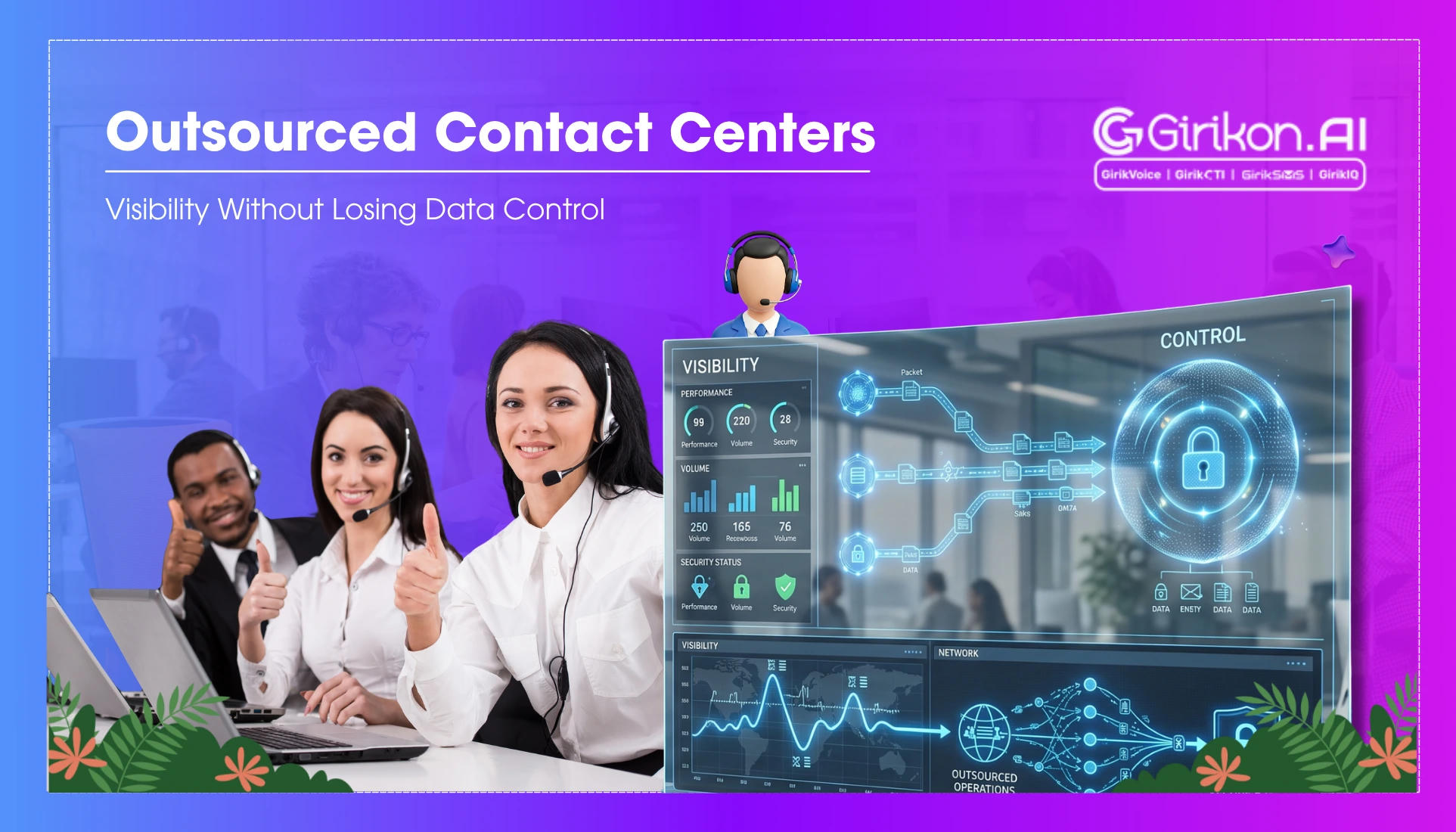
Outsourced contact centers can deliver greater flexibility, efficiency, and scalability—but they also raise an important question: how can businesses gain real-time visibility into customer calls without losing control of sensitive data? This blog explores practical ways to balance call visibility, data security, and operational oversight, helping organizations build stronger partnerships with outsourced contact centers while keeping critical customer information under control.
- 1Prioritize achieving operational visibility and robust data governance simultaneously in outsourced contact center relationships, rather than treating them as competing priorities.
- 2Understand that true call visibility in BPO operations requires insight into call handling speed, cost drivers, and service adherence to prevent decision-making gaps.
- 3Address the visibility vs. data control challenge by clearly defining what information the BPO needs, how it's accessed, who owns the data, and how access is monitored.
- 4Leverage platforms like Salesforce to create a client-controlled reporting system that integrates customer and operational data, enabling tailored insights without compromising data security.
- 5Implement Salesforce CTI and CRM functionalities to link contact center activities directly to customer information, measure performance, and define role-based visibility for internal stakeholders.
As customer conversations extend beyond the business, visibility can become a matter of trust. Outsourced call centers handle thousands of calls, communications, and data every day—while newer technologies like AI voice agents are adding another layer to the customer interaction landscape. Yet, clients still need visibility into these interactions while controlling the data.
The challenge here is gaining visibility without giving unnecessary access to information or weakening data governance. This balance becomes even more important when businesses rely on their outsourcing partners to provide both efficiency and accountability.
Instead of treating reporting and data management as competing priorities, companies are now looking for ways to achieve greater visibility and strong data governance through advanced methodologies.
This is where BPO client reporting Salesforce comes into the picture as a solution that helps achieve transparency in reporting with client owning the data.
Why Call Visibility Matters in BPO Operations
When businesses leverage an outsourced call center, visibility goes beyond the number of calls being handled. Businesses must know how fast customers' calls are being handled, what affects the cost, and whether the provided service is meeting their requirements; without this information, companies risk having loopholes in their decision-making processes.
This becomes imperative in situations where there are multiple platforms, teams, or vendors handling customer communications. In such scenarios, it becomes difficult to correlate call activity with costs, performance, and results, particularly when tracking Salesforce CTI call logging activity across different communication channels. Eventually, organizations find themselves spending money on redundant features or technologies because they are unaware of their actual requirements.
The use of a centralized reporting process may serve as a solution for putting these pieces into one puzzle to help your clients gain insight into inefficiencies and improve operational processes.
The Visibility vs Data Control Challenge
Visibility may require accessibility, and here lies the complexity of outsourcing relations.
To provide its services, BPO will have access to call activity, client interactions, as well as their performance data. Meanwhile, the client must ensure that confidential information is secure and controlled according to its own rules.
The challenge is not simply deciding who can see the data. It is about determining:
- What information does the BPO actually need?
- How should that information be accessed?
- Data Ownership
- How can access be monitored and controlled?
When more than one system and vendor are involved, this issue becomes much more complicated.
On the one hand, the data can get fragmented among several platforms, and the reporting will highly depend on the outsourcing provider.
This makes client visibility contact center an important consideration for businesses. Clients need more than periodic reports; they need an appropriate level of visibility into the operations being performed on their behalf while maintaining control over sensitive information.
Thus, the goal should not be to provide the outsourcing partner with unlimited access for achieving transparency but developing the reporting approach that can give operational visibility to the businesses.
How Salesforce Supports BPO Client Reporting
A client-controlled reporting system will be much easier to implement once reporting has been connected to the existing systems of a company.
Here is when BPO client reporting Salesforce may prove to be helpful. Salesforce can become the platform to gather all the necessary customer and operations information, allowing companies to have a better understanding of how outsourced contact centers operate.
Instead of having to rely solely on reports compiled and delivered by the BPO itself, organizations will be able to tailor reporting to their specific needs.
Depending on the configuration, it can allow organizations to:
- Monitor call volume and operational trends with Salesforce call monitoring.
- Measure agent and service performance;
- Link contact center activities to customer information using Salesforce CTI and CRM.
- Define role-based visibility.
- Deliver consistent reporting across outsourced teams.
- Provide relevant information to stakeholders internally without disclosing unnecessary details.
The key thing to remember here is that technology should complement reporting and governance rather than replace it. Salesforce can provide an effective platform for consolidating and visualizing information, but companies will still need to implement certain rules regarding access, ownership, security, and data usage.
By doing so, outsourcing will become more transparent without compromising the control of clients over the process.
What Should Businesses Look for in BPO Reporting Model
A reporting solution for outsourced call centers should be more than a presentation of performance metrics. It should ensure a good balance between transparency, control, and usability.
The business needs to evaluate if the model has the following considerations:
- Data ownership: The client retains control of the underlying customer and operation data.
- Restricted access: BPO team members have access to the data only as necessary for their jobs.
- Centralized view: Information on calls and performance can be viewed from a single location.
- Scalability: The model accommodates many teams, facilities, platforms, and vendors.
- Governance: Access and use of the data can be controlled internally.
These considerations will ensure that reporting becomes a strategic component of contact center management rather than just an information sharing effort.
Conclusion
There is no need for companies to lose visibility or data control when outsourcing customer calls. The right reporting mechanism will allow businesses to provide the necessary level of operational access to their BPO providers while still having complete ownership and governance of their data.
The actual value is about enabling an interconnected world, where clients have an opportunity to see what is going on, to realize why it is important, and to do something about it. Regardless of whether the target is performance improvement, governance improvement, telephony outsourcing cost optimization, or vendor selection, visibility becomes more valuable if it is kept under the client's control.
The goal is not only about seeing more data but about seeing the right data and being able to do something about it.