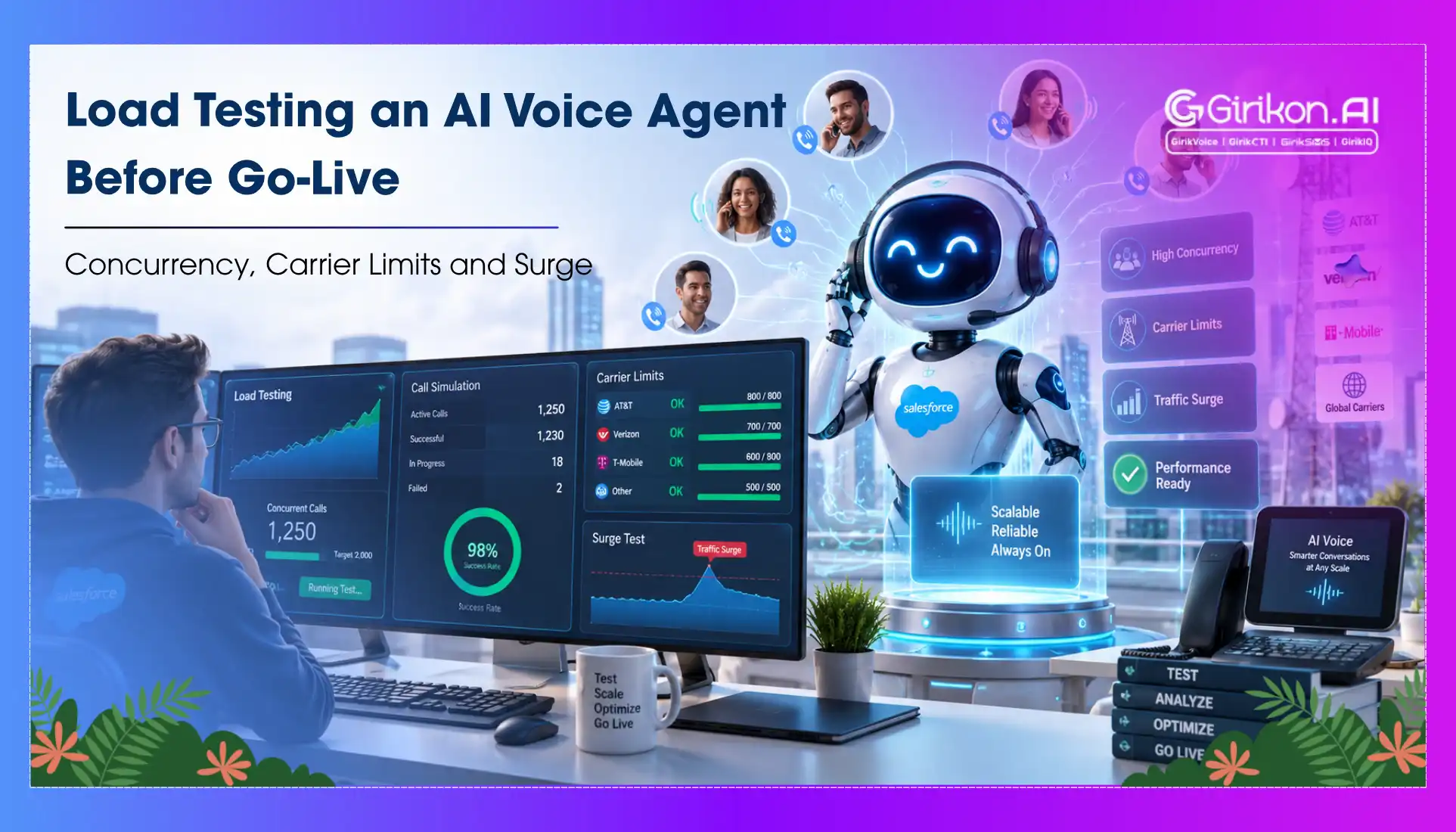
Load testing an AI voice agent before go-live helps teams identify concurrency limits, carrier bottlenecks, response delays, and surge-related failures before real customers encounter them.
Load Testing an AI Voice Agent Before Go-Live: Concurrency, Carrier Limits and Surge
AI voice agents are repeatedly tested throughout the implementation process. Teams test the conversation flow, prompts, integrations, handoffs, and different caller inputs before the agent is ready for production. Capacity usually comes during the same process, when teams estimate how much call volume the agent needs to support each month. But monthly volume can hide the point where a voice system is most likely to struggle.
An agent may handle thousands of calls across a month without approaching its limits. But the same system can run into problems when a large share of those calls arrives within a few minutes or at the same time. That is where voice AI load testing can examine how different parts — concurrency, carrier limits, call duration, and sudden traffic surges — behave together under increasing demand. These load tests reveal where capacity starts to degrade before real callers discover the limit.
Why Load Testing Matters Before an AI Voice Agent Goes Live
Functional testing can show that an AI voice agent works. Load testing answers a different question: does it keep working when multiple calls arrive at the same time? In a live call, there are multiple components of the voice stack that remain engaged throughout the duration. A live call keeps a media session active while audio is streamed, speech is recognized, the AI processes the utterance, and a response is synthesized and returned to the caller. As more calls run together, each of these components has to handle more work.
This is why voice AI load testing needs to look at the call path as a whole. The telephony side and the AI processing side can reach their limits at different points. An AI pipeline may perform well with a few test calls but start adding noticeable delay when many calls are waiting for processing. On a voice call, that delay becomes silence between the caller's question and the agent's response.
The aim is therefore not simply to prove that the agent can handle a certain number of calls. It is to find out where performance starts to change and what happens when the system reaches its limits.
Understanding Concurrency in Voice AI
Concurrency is the number of calls being processed at the same time. This matters since a system that can process 10 calls may not be able to process 100 calls efficiently in the same manner. There is also no single concurrency limit for the entire voice agent. Different parts of the system can have different ceilings.
Telephony capacity is controlled by the carrier, SIP trunk, or telephony provider. Once that limit is reached, new calls may fail to connect. AI processing capacity depends on the services handling speech recognition, language-model processing, and speech generation. When demand exceeds available capacity, calls may not fail immediately. Response times can increase as requests wait for processing. Application capacity includes all the systems used during a call: database systems, session management systems, and internal APIs. These may become bottlenecks when there are multiple calls being handled concurrently.
Test these limits separately where possible. Run a separate concurrent calls voice agent test against the AI pipeline, then test the telephony path on its own. This helps identify which layer starts to struggle instead of treating every failure as an AI problem. Measure response time at higher percentiles, such as p95, rather than relying only on the average. An average can look acceptable when a smaller group of callers experiences significant delays.
Carrier Limits Can Become the First Bottleneck
Carrier capacity is easy to overlook because the AI platform may have plenty of processing capacity left when the telephony connection starts rejecting calls. Two carrier limits matter here: concurrent calls and calls per second (CPS). They measure different things. Concurrency limits how many calls can remain active. CPS limits how quickly new calls can be established.
That distinction matters during a sudden burst. A business may have capacity for a large number of active calls but still hit its CPS limit if many calls arrive within a few seconds. The resulting failures can look intermittent rather than like a clear system-wide outage. Before testing, confirm the carrier's concurrency and CPS limits. Then test near and beyond those limits to see how the system behaves. The useful result is knowing whether excess traffic is rejected, queued, routed elsewhere, or handled through another fallback.
Surge Testing Shows What Happens When Demand Jumps
Steady concurrency is only part of the capacity picture. A voice system can handle a sustained number of calls and still struggle when traffic reaches that level too quickly. This is where surge testing differs from a standard load test. Instead of gradually increasing traffic and holding it steady, the test introduces a sharp increase in calls over a short period.
The speed of the increase matters because supporting services may need time to add capacity. If new processing resources take time to become available, a sudden spike can exhaust the capacity that is already running before additional resources are ready.
Run a stress test voice agent scenario that reflects the fastest realistic increase in traffic. Watch connection failures, response latency, dropped calls, and recovery time. Also test the fallback path. If the system reaches capacity, calls should have a defined outcome, such as waiting in a queue, moving to a human agent, or receiving a clear message. The objective is not to eliminate every failure. It is to make sure that a traffic spike produces a controlled response rather than an unexplained outage.
Conclusion
Voice AI load testing is not about finding a single capacity number. Testing concurrency, carrier limits, and surge behavior before go-live establishes how the system performs under sustained demand, how quickly calls can enter the system, and what happens when traffic exceeds normal capacity. This turns launch day from a discovery exercise into a controlled, measurable production decision, with defined limits and operational headroom.