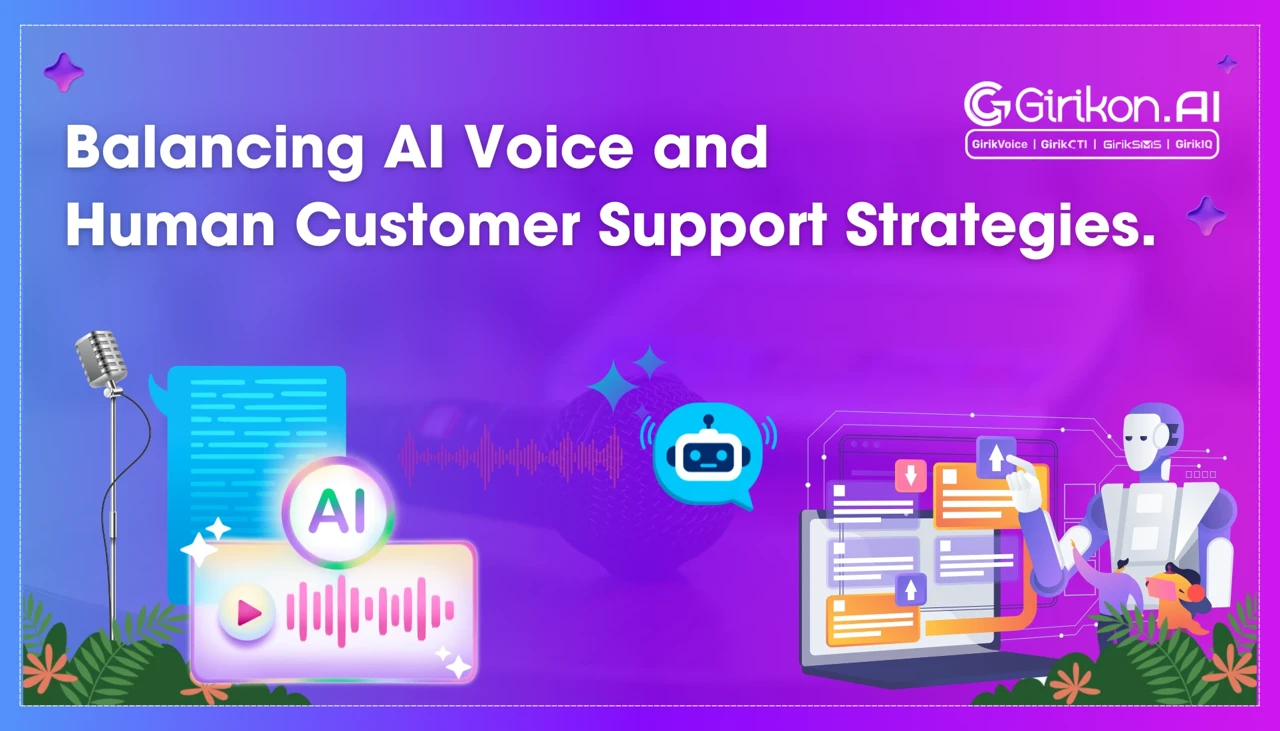
AI voice agents and human agents each bring unique strengths to Salesforce contact centers. Discover how combining AI-driven automation with human expertise creates faster, more personalized customer experiences while improving efficiency and service quality.
AI Voice Agents vs Human Agents: Finding the Right Balance in Salesforce Contact Centers
There is a version of this conversation that gets very theoretical very fast, and honestly, most contact center leaders do not have time for it. They genuinely want to know if the AI technologies they are selling can withstand actual call traffic, irate clients, and the kinds of edge cases that no vendor demo ever shows. AI Contact Center Solutions have been promising to resolve this tension for years now, and the gap between the pitch and the deployment is still, to be frank, pretty wide in most organizations.
That said, the gap is narrowing. The more unsettling topic to consider is how much of what we have been paying human agents to perform was never actually an effective use of their abilities in the first place, rather than "AI or humans?"
What AI Voice Agents Actually Do Well (and Where They Fall Apart)
To be fair, the list of things AI voice agents handle competently has grown substantially. Routine balance inquiries. Appointment confirmations. Order status. Password resets. Policy lookups that used to require a ten-minute queue just to hear an answer that existed in a database the whole time. In Salesforce contact centers specifically, where CRM data is already structured and accessible, AI agents can retrieve and surface information faster than most human agents can type.
The problem - and this is worth naming plainly - is that vendors have tended to present these wins as representative of the whole picture, when they are actually the easy part. The calls that do not fit neatly into an intent taxonomy are still a serious challenge. Customers who circle back with a second issue mid-call, or who are distressed in a way that changes what they actually need from the interaction, or who just do not communicate in tidy, parseable sentences - these remain hard for even the more capable voice AI systems.
The failure mode is not usually catastrophic. It is quieter than that. The AI resolves the surface request and misses the underlying concern. By then, the damage to system trust is already done - regardless of how the call got logged
The Human Agent Problem Nobody Likes to Talk About
Here is something that gets brushed past in most of these discussions: human agents in high-volume contact centers are frequently not operating at the level of emotional intelligence and nuanced judgment that the "humans vs AI" framing implies. The reality of a 200-seat contact center running eight-hour shifts is, in many cases, agents working from rigid scripts layered over knowledge bases layered over compliance guardrails layered over whatever unofficial workarounds the team has built to hit their AHT targets.
AI vs Human Customer Service is a genuinely interesting question when you are comparing a well-trained, empowered human agent against a capable AI system. The comparison gets more complicated when you account for what the average agent interaction actually looks like at scale, under pressure, in organizations that have underinvested in training for years.
This is not a cynical point. It is an argument for designing hybrid models that do not assume human agents are automatically the gold standard for every interaction type - and that also do not assume AI is ready to carry the full emotional weight of complex customer conversations.
How Salesforce Deployments Are Actually Being Structured
| Interaction Type | Recommended Handler | Why |
|---|---|---|
| Routine transactional queries | AI Voice Agent | Speed, consistency, 24/7 availability |
| Complaint escalations | Human Agent | Emotional nuance, accountability |
| Retention conversations | Human Agent | Relationship and negotiation complexity |
| Outbound reminders/confirmations | AI Voice Agent | High volume, low stakes |
| Complex billing disputes | Hybrid (AI + Human supervision) | Data retrieval + judgment layer |
The organizations getting the most out of Salesforce's AI capabilities are generally the ones that have done the harder internal work first - mapping their actual call taxonomy, not the idealized version, and identifying where the handoff between AI and human needs to happen before the customer reaches a frustration threshold.
Worth noting: the handoff design is where most deployments quietly fail. It is not really the AI that breaks trust in these deployments. The stickier problem is what happens in the ten or fifteen seconds after transfer - when the human agent picks up with no useful context and the customer, who has already explained themselves once, realizes they are about to do it again. That moment. That specific, avoidable moment is where a lot of goodwill quietly exits the interaction.
AI CTI for Call Centre Operations
AI-powered customer support has changed what CTI - computer telephony integration - can actually do in a contact center environment. Historically, CTI was about screen pops and basic call routing. The agent's desktop would surface a customer record when a call came in, which was useful but still left a lot of interpretive work to the agent.
What the newer systems actually do mid-call is a different category of thing from the old screen-pop. Case history surfaces without prompting, sentiment shifts get flagged from tone and word choice, and suggested actions appear before the agent has even fully caught up with who they're talking to. In Salesforce environments, the more useful part is that this AI layer is sitting inside the same Service Cloud record the agent sees, not pulling from a shadow system that may or may not be current. That alignment matters more than most vendors lead with.
Three things this changes in practice:
-
Triage accuracy improves because routing decisions are made on intent signals rather than just the number dialed or the IVR selection the customer pressed without really reading. It is not a perfect system - but it is measurably more precise than legacy routing trees that have not been updated since 2019.
-
Agent ramp time shortens when AI is surfacing the right information at the right moment rather than expecting agents to memorize product variations or policy exceptions. New agents in particular benefit from this, which matters for organizations with high turnover (and there are more of them than the vendor case studies suggest).
-
Compliance monitoring becomes continuous rather than sampled. Instead of QA reviewing 3% of calls after the fact, AI systems can flag potential compliance issues during the interaction. These are not footnotes. They are the difference between catching a problem before it becomes a regulatory matter and finding out about it in an audit.
Generative AI and the Conversation That Moves
Generative AI for Customer Service introduces a different kind of capability - not just retrieval and routing, but the ability to construct responses, summarize complex case histories, and adapt phrasing to context. For contact centers, this shows up most usefully in agent-assist applications and human ai calls, where the AI drafts a response, supports real-time customer interactions, or suggests a resolution path while the human agent reviews and sends the final response.
The honest version of this is that it works better in some channels than others. In voice, latency isn't a preference - it's still a hard ceiling. In messaging and email, AI-Powered Call Centers using generative AI for agent-assist have seen meaningful improvements in first-contact resolution and handle time, particularly for complex queries where agents previously had to dig through multiple systems to construct an answer.
The risk, which does not get discussed enough, is over-reliance on AI-generated language in interactions where personalization actually matters. Customers in retention conversations or complaints can often tell when a response feels templated - and that perception, accurate or not, undermines the interaction regardless of whether the underlying information was correct.
The Balance Question Is Really a Sequencing Question
Organizations that are stuck in the "how much AI, how much human" debate are often asking the question at the wrong level. A more productive way to think about it is sequencing - identifying which moments in the customer journey run better on speed and predictability, and which ones genuinely need a person who can sit with ambiguity, shift course mid-conversation, and sometimes just let the customer talk without steering everything toward a close.
Anyway, the contact center industry has been through enough cycles of automation optimism to know that the technology usually arrives before the organizational readiness to use it well. What is different now is that AI capabilities have genuinely crossed a threshold in areas like intent recognition and real-time data synthesis - and solutions such as telephony for Salesforce are helping organizations extend the Salesforce ecosystem into more connected customer interactions. With its integrated data model, the Salesforce ecosystem is a reasonably practical place to start building hybrid architectures that reflect how customers actually behave rather than how we wish they would.
The open question, and it remains genuinely open, is whether organizations will invest in designing the handoff layer as carefully as they invest in the AI itself - or whether that work will get deprioritized until customer experience data forces the conversation again.