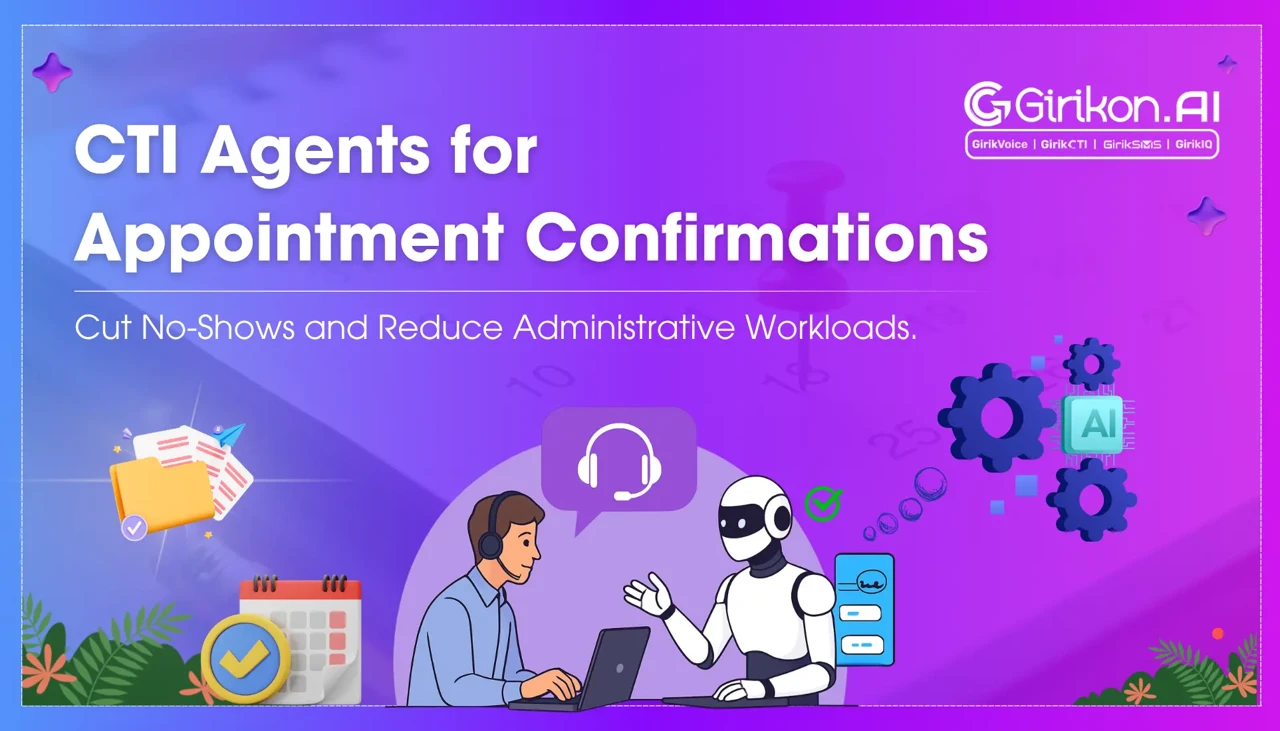
Learn how CTI agents streamline appointment confirmations, reduce no-shows, improve customer communication, and help businesses save time through efficient, automated outreach.
- 1Leverage CTI agents for appointment confirmations to automate outreach, reduce no-shows, and improve operational efficiency.
- 2Integrate CTI agents with CRM systems to enable automatic updates, streamline workflows, and enhance agent productivity.
- 3Ensure core CTI features, including multichannel reach, CRM integration, compliance, and analytics, are non-negotiable for successful deployment.
- 4Set appropriate confirmation intervals based on appointment type to optimize communication and client experience.
- 5Enable full response handling for cancellations by automatically connecting them to waitlist workflows to recover lost capacity.
Essential Guide to Leveraging CTI Agents for Appointment Confirmation Efficiency
Speed of confirmation is important for service industries. Businesses who secure them quickly gain operational efficiency and boost customer trust. CTI agents for appointment confirmations are redefining this pace. When AI call agents are integrated with CRM workflows, reminders get sent automatically, client responses are recorded instantly, and CRM records get updated without agent intervention. As a result, businesses can lower noshow rates, shorten turnaround times, and reduce staff workload, improving both agents' productivity and client experience.
To get the most out of these smart voice AI agents, businesses must know practical tips for successful deployment. So, let's understand the way these AI Call Agents transform what was once a fragmented process to now a streamlined system that strengthens both productivity and experience. In this blog, we will explore how CTI integration for scheduling delivers that efficiency, and how you can also take advantage of these smart systems with best practices.
What are CTI Agents for Appointment Confirmations?
CTI agents' systems built on Computer Telephony Integration automate the outbound contact that appointment confirmation requires. With Salesforce CTI Integration, these systems can initiate calls, send SMS messages, handle responses, and automatically update connected scheduling platforms without requiring a staff member to manage each interaction. AI call agents take this a step further by running structured two-way conversations, recognizing what a client says or selects, completing the confirmation process, or flagging exceptions in real time for follow-up.
How CTI Agents Transform Appointment Confirmations for Businesses
Reduced No-Shows
Reduced no-showoffs with timely, consistent voice AI appointment reminders can give clients a direct and immediate way to confirm or reschedule before the day arrives.
Faster Recovery
Faster recovery when cancellations occur as it's processed via an automated interaction flags the slot immediately, creating a window to fill it rather than discovering it empty on the day.
Uniform Communication
Uniform communication at every point of contact with the same message, interval, and process applied to every appointment.
Real-Time Calendar Updates
CTI integration for scheduling shows confirmation results directly in the calendar and agents get updates of the day without manual record-keeping.
Faster Client Responses
Clients respond faster when they don't have to wait for agent's availability to get responses for confirmation, reminders, or complaints.
Best Practices for CTI Agents for Appointment Confirmations Set-Up
-
1Make Core Features Non-NegotiableFour capabilities: Multichannel Reach, CRM Integration, Compliance, and Analytics are core to how your CTI deployment will produce results or not. Multichannel functionality ensures contact reaches clients through whichever channel they actually respond to via phone, SMS, or digital message.
CRM integration lets the system automatically update the schedule for confirmation results without requiring manual input. Salesforce Telephony Options enhance this process by enabling seamless communication workflows, improving call management, and keeping customer records synchronized in real time. You need compliance controls that govern call timing, consent, and disclosure requirements, with frameworks that shift across sectors and geographies. Analytics provide the data needed to identify what works and to correct what doesn't.
-
2Set Intervals by Appointment TypeAI call agents must manage the entire process—confirmation, cancellation, and rescheduling without leaving gaps for staff to cover. A client who confirms through an automated call should see that reflected in the schedule immediately. When the system cannot answer a client's question, the call should transfer to an agent immediately, a gap here can lead to delay in response and client frustration.
-
3Enable Full Response HandlingA cancelled appointment becomes a recoverable slot only if something fills it. Your client cancels through an automated interaction, the system should send immediate outreach to the next client on a waitlist automatically, not flag the gap for your agent to address later. Outbound calling solutions that manage both cancellation and rebooking transform what would otherwise be lost revenue into recovered capacity.
-
4Connect Cancellation Outcomes to Waitlist WorkflowsSet confirmation timings to match the appointment type, and not applying same process for different bookings. Shortnotice visits require reminders closer to the scheduled time, while highvalue sessions benefit from alerts sent earlier. Using appointmentspecific timing for reminders gets you faster responses, reliable records, and reduces agent's efforts. Teams get a consistent and efficient process without manual management.
-
5Test Messages Before DeploymentAny assumptions about how clients will behave often don't match when tested against real behavior. Before extending to all appointment types, test a defined subset of bookings. Identify the points in the interaction where clients confirm, disengage and where the process fails. Voice AI reminders lose importance if they are too long, fail to deliver the next available step and are shared at the wrong time, leading to low response rates and poor customer engagement.
-
6Define Escalation Triggers EarlyAutomation delivers consistent results when interactions follow a predetermined order. Every outbound solution should set clear escalation triggers to protect the client experience, reduce unresolved interactions, and prevent frustration that erodes trust. This is also when any requests that are about clinical concerns, nonstandard options, or calls that need human oversight should bypass automation and move directly to a human agent.
Closing Remark
Missed confirmation from clients leads to wastage of agents' efforts, time and productivity. When confirmation processes depend on agent availability, the risks multiply with delay in reminders and calls don't go through. CTI agents for appointment confirmations eliminate dependencyrelated issues. It can handle outreach, capture responses, and update records without requiring an agent at each step. For organizations still managing confirmation through manual follow-up, the question isn't whether CTI integration for scheduling would help; it's what a well-configured deployment would look like against current workflows.
Service providers must understand the benefits of Voice AI agents in streamlining the confirmation or cancellation process for clients and also how it eases out the workload for agents. To have the maximum benefit, connect with a CTI voice AI agent provider and understand the difference AI Call Agents can make in managing your customers and delivering the return you expect.