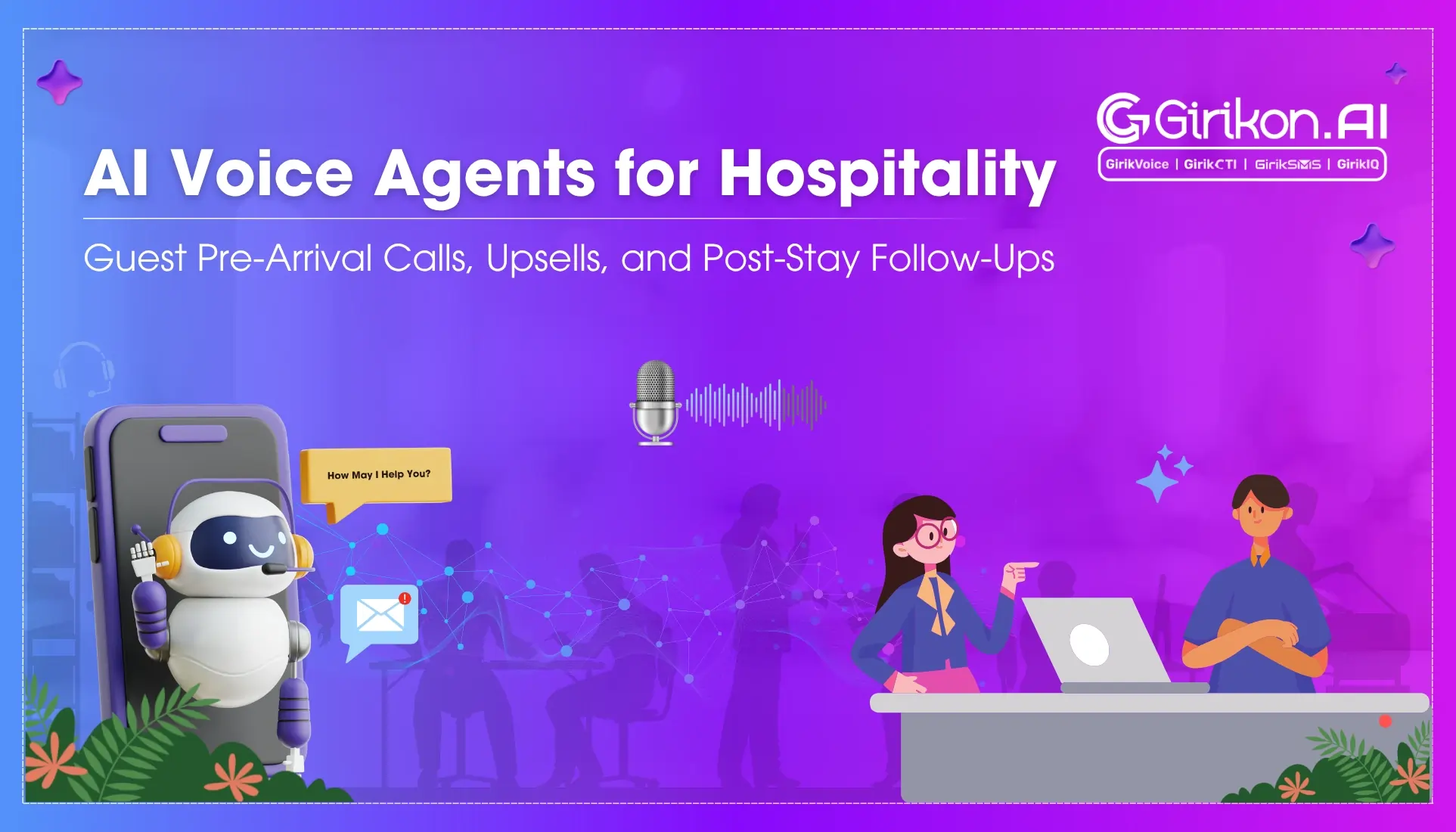
Discover how AI voice agents are transforming hospitality with automated pre-arrival calls, personalized upsells, in-stay support, and post-stay follow-ups that enhance guest experiences and drive additional revenue.
- 1Implement AI voice agents for hospitality to automate pre-arrival calls, upsell services, and conduct post-stay follow-ups.
- 2Leverage AI voice agents to enhance guest communication by providing timely and personalized interactions.
- 3Utilize AI voice agents to increase revenue through effective pre-arrival upselling of amenities and services.
- 4Improve guest satisfaction and loyalty by using AI voice agents for efficient post-stay feedback collection and engagement.
- 5Recognize that phone calls remain a vital communication channel in hospitality, and AI voice agents can effectively modernize this channel.
AI Voice Agents for Hospitality: Guest Pre-Arrival Calls, Upsells, and Post-Stay Follow-Ups
The phone call isn't dead. Not even close. While everyone's been obsessing over chatbots and messaging apps, something quieter has been happening - hotels that invested early in hotel guest communication automation have been pulling ahead. Review scores up. Cancellations down. Guests spending more on property. No single dramatic shift - just a slow compounding of small wins. And the common thread running through most of it? Voice. The calls that properties always meant to make but never quite got around to - confirmation touchpoints, upgrade conversations, post-stay check-ins - are finally getting made. Just not by a person.
We should be clear about what we mean, though. This isn't a modern spin on the hold-music-and-press-1 system everyone's been hanging up on since 2003. The experience has moved. These systems converse - they pick up context, respond to what a guest actually says, adjust. Something shifted in the last couple of years and the gap between "automated" and "natural" got a lot narrower. Worth understanding why.
Why Voice - and Why Now?
Email open rates in hospitality hover around 20–30%, according to various industry benchmarks. Push notifications get swiped away. But a phone call? People pick up. Or at least they listen to the message. Voice has an intimacy that text just can't replicate - and that's exactly why hotel voice AI has become such a compelling tool for guest engagement.
The timing makes sense too. A few things converged. The underlying language models got genuinely good at holding a natural back-and-forth - not just answering questions but navigating them. Voice synthesis caught up. The weird, slightly-off cadence that used to give everything away? Mostly gone now. Response delays shortened too - that awkward pregnant pause mid-sentence that made older systems feel like they were buffering has largely disappeared. Conversations just... move now.
Which means what used to be a glorified automated menu is now, when configured properly, something a guest might not mind at all - maybe even appreciate. That's genuinely new territory. And it's what's made AI voice agents viable for tasks that previously needed a real person on the other side.
The Pre-Arrival Call
Picture this. You've got a booking two days out. Your phone rings, and it's the hotel - but not someone reading stiffly off a checklist. The voice is unhurried, picks up on your responses, and actually asks whether you'd like to pre-book dinner or whether the king bed works for your group. It mentions that an upgrade might be available and asks about your arrival time. Three minutes later, you hang up feeling like the property already knows you're coming.
That's what a well-configured hotel booking voice assistant delivers at scale. And the downstream effects aren't small - fewer walk-in surprises at check-in, issues flagged before they become complaints, and a first impression that's warm rather than transactional.
A few things a pre-arrival AI call typically covers:
- Booking Confirmation Booking confirmation and any recent changes.
- Transportation Support Transportation and parking options.
- Upgrade Opportunities Room upgrade availability.
- Special Occasions Special occasion flags such as anniversaries and birthdays.
- Additional Services Pre-ordering room amenities or dining reservations.
Think of it as a digital version of the maître d' who already knows your name. The detail that changes everything - and it costs nothing extra per guest, because the system scales.
Upselling Without the Awkward Sales Pitch
Here's the thing about upselling in hospitality - guests don't hate being upsold. They hate being upsold badly. There's a version of this that feels like getting cornered at check-in while someone rattles through a laminated list of add-ons. That version is transactional and slightly uncomfortable for everyone involved. Then there's the version where someone - or something - just casually mentions that the terrace suite opened up and it's only marginally more than your current booking. Different experience entirely.
AI guest services delivered through voice can land much closer to that second version, consistently. Human staff get distracted, rush the pitch when the lobby fills up, forget to mention the package altogether. The AI version doesn't have a bad shift. Every call gets the same unhurried delivery - offer made clearly, no pressure, space for the guest to respond.
The upsell categories that tend to work well over voice - room upgrades (higher floor, better view, suite), food and beverage packages (breakfast bundles, dinner reservations, minibar inclusions), wellness add-ons (spa sessions, fitness classes), and flexible check-in or check-out windows. Not complicated offers. Just well-timed ones.
Some properties have reported meaningful revenue lifts from AI-driven upsell calls - often in the 15–25% range for ancillary spend per booking. The exact numbers vary, but the directional evidence is consistent: timely, well-framed offers convert.
Hospitality Automation: Using AI Voice Agents for Hospitality as a Service Layer
Some hotels are now running mid-stay check-in calls - not a survey, just a quick touchpoint on day two of a longer stay. Someone asks how things are going. You mention the AC unit is a bit loud. That gets flagged, a staff member knocks in twenty minutes. Compare that to the alternative: guest suffers in silence, checks out, posts a three-star review mentioning the AC. The second scenario plays out every day at properties that don't have this layer.
Hospitality call automation during a stay handles the repetitive requests too - extra pillows, pool hours, a morning wake-up. Not exactly high-stakes interactions. But they pile up. Offloading that volume to an AI layer frees people up for the work that actually needs them.
Quick tip: The best-performing in-stay AI calls use conversational branching - if a guest mentions a problem, the system escalates to a human immediately. Complaints need people. Everything else the AI can handle.
After Checkout: When the Follow-Up Actually Means Something
Post-stay emails go largely unread. We all know this. Open rates are polite at best. A voice call the day after checkout is a different thing - unexpected enough to feel personal, short enough that most people stay on the line.
Post-stay calls also do real work for re-engagement. A quiet mention of an exclusive rate for a return visit, delivered in a warm voice rather than a mass email, lands differently. Guests remember it.
A simple framework for what a good post-stay AI call achieves:
- Acknowledge - Thank the guest by name, reference their stay specifically.
- Ask - A couple of open questions, not a survey. Let them talk.
- Resolve - If something comes up, offer to connect them with the manager.
- Reward - Share a loyalty point update or a return-visit offer.
- Invite - Close warmly. No pressure. Just an open door.
Human vs. AI Voice: What Hotels Should Really Know
Nobody serious is arguing that AI should replace hospitality professionals. That framing misses the point entirely. AI absorbs the predictable, high-volume interactions.
| Touchpoint | Best Handled by AI | Best Handled by Human |
|---|---|---|
| Pre-arrival confirmation | Routine confirmations | Complex bespoke requests |
| Upselling | Standardised offers | High-value, personalised pitches |
| In-stay requests | Routine (towels, wake-up calls) | Complaints, urgent issues |
| Post-stay feedback | Survey and re-booking offer | Guest recovery situations |
Hybrid is where this lands. AI for volume, humans for nuance. It's not a philosophical position - it's just what the data from well-run properties keeps showing.
What to Look For When Choosing a Platform
The market for AI voice tools in hospitality is moving fast. A few things actually matter when you're evaluating vendors - and a few things get oversold:
-
PMS Integration Connects natively with your property management system or forget personalisation.
-
Multilingual Support Your guests aren't all calling from the same country. A system that only functions well in one language creates a fragmented experience.
-
Escalation Logic Speed of handoff to a human matters when conversations take an unexpected turn.
-
Compliance Built In Call recording consent, GDPR, and DPDP requirements should be built into the platform.
-
Usable Analytics Call completion rates, upsell conversion, and sentiment trends should be easy to access and understand.
The Part Nobody Talks About Enough
The hospitality industry runs on feeling. The memory of a stay isn't built from thread counts or breakfast menus alone - it's built from moments where someone, or something, made you feel like you mattered. That's always been the hard part to scale. You can standardise a room. You can't easily standardise attentiveness.
What's becoming clear, though, is that AI guest services delivered through voice are getting closer to that bar than anyone expected them to this soon. When the call knows your name, remembers what you booked, and reaches out before you had to ask - guests don't clock it as automation. They experience it as care. That distinction is everything in this industry.
The properties that get this right early won't just run leaner. They'll build guest relationships that are genuinely hard to replicate. And in a market where differentiation gets harder every year, that's worth quite a lot.