Discover how AI voice agents remember customer context across multiple calls — from caller identification to memory updates — and deliver seamless, personalized support in every session.
- 1Implement AI voice agent memory to store meaningful context from previous customer interactions, such as summaries, prior actions, and ongoing requests, for personalized and efficient support.
- 2Integrate AI voice agents with connected business systems like CRMs and customer service applications to retrieve and store relevant customer data, rather than solely relying on the language model.
- 3Utilize multi-session AI conversations to eliminate friction in customer journeys that span multiple days or weeks, ensuring continuity and progress tracking for ongoing requests.
- 4Streamline customer identification processes through methods like authentication workflows, CRM records, and voice biometrics to retrieve comprehensive customer profiles.
- 5Enhance customer experience by enabling AI agents to build upon previous conversations, avoiding repetitive questioning and offering proactive, context-aware assistance.
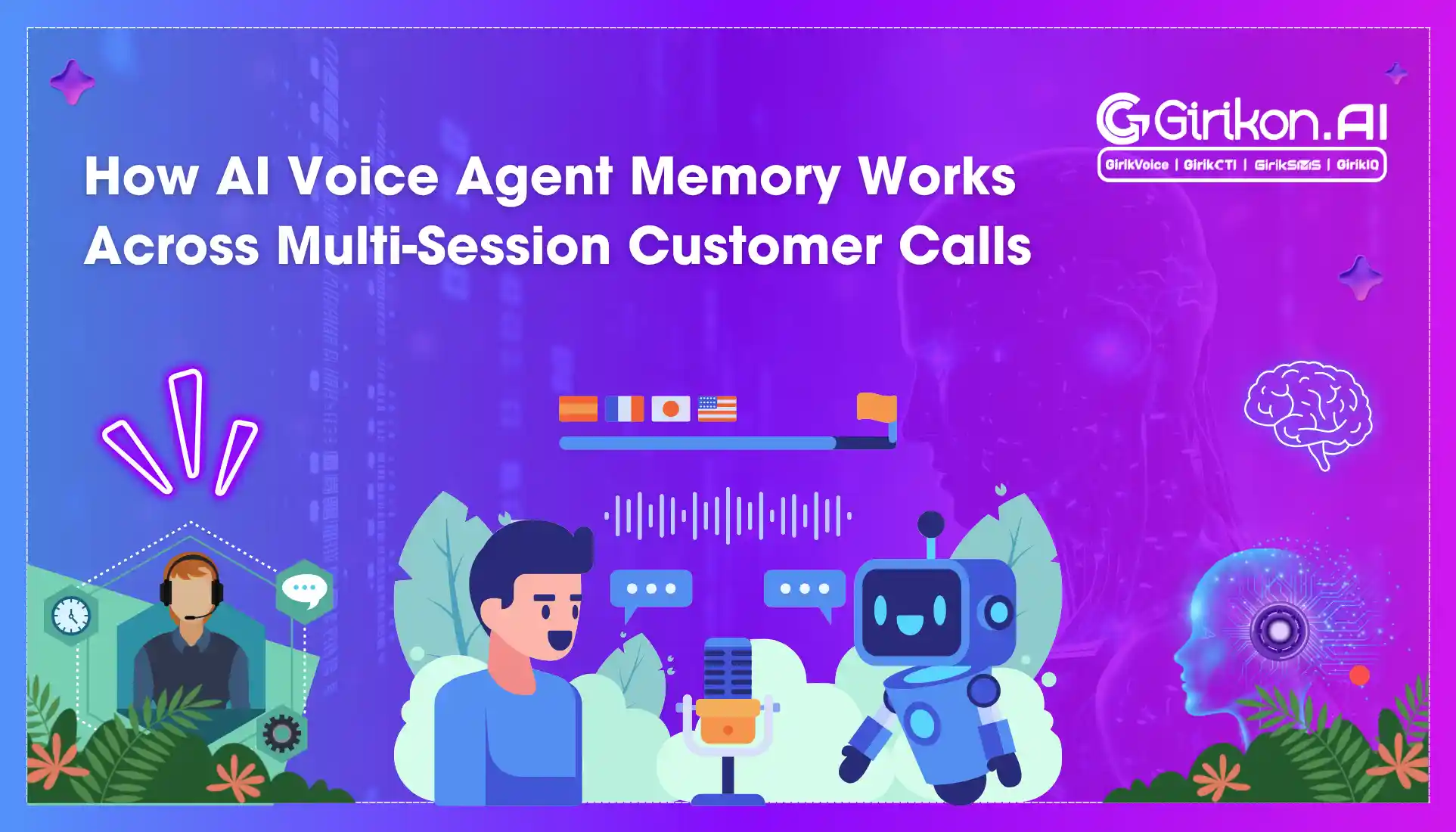
How AI Voice Agent Memory Works Across Multi-Session Customer Calls
Whether a caller seeks an inquiry about a billing dispute or a technical support matter, in conventional IVR configuration, they are forced to go back to square one each time they contact the business. Such repetitive contact creates frustration, resulting in the caller getting a feeling of not being listened to or respected.
However, the emergence of persistent memory AI voice agent has set a new standard. These agents utilize conversational memory to provide an enhanced customer journey experience. So, instead of dealing with the inbound interaction as a completely new call, the agents store context information of previous contacts, understand the customer preferences, and resume the conversation from there.
Then, how does a memory-based AI voice agent really work and deliver seamless support across multiple customer interactions? Let’s explore this guide.
What is AI Voice Agent Memory?
AI voice agent memory refers to the system’s ability to access previous customer interactions and retrieve relevant information for delivering more personalized and context-aware responses.
With this, it does not imply that artificial intelligence remembers every word of every conversation. Instead, it retains meaningful context, like:
- Conversation summaries
- Prior actions
- Ongoing service requests
- Purchase history
- Customer identity
- Previous support cases
- Preferred language and communication preferences
- Appointment schedules
- Customer sentiment
- Product or service ownership
- Previous troubleshooting steps
Also, persistent memory AI voice agents do not typically store all information within the language model. Instead, they retrieve relevant data from connected business systems, like:
- CRM platforms
- Customer service applications
- Field service platforms
- Knowledge bases
- Data warehouses
- Ticketing systems
- Order management systems
This enables AI agents to continue conversations naturally. So, rather than asking.
“Can you explain your issue again?”
“I saw when you had previously contacted us regarding an issue with your broadband service. Let me check the status of that service request.”
This continuity eliminates repetitive conversations while enabling voice AI solutions to pick up where the previous conversation left off.
Why is Multi-Session Memory Important?
While a large number of conversations with customers are usually wrapped up during a single contact session, there are many others which continue over several days or weeks as customers check the status of their service request, application, or issue.
Some of the most frequently encountered multi-interaction customer journey types include:
- Technical support
- Subscription changes
- Insurance claims
- Product returns and exchanges
- Sales follow-ups
- Healthcare appointments
- Loan applications
- Utility service requests
In these cases, multi session AI conversations eliminate the friction caused by disconnected conversations. Thus, enabling intelligent call assistants to retain relevant context, continue customer interaction, and track the progress of ongoing requests. As a result, businesses ensure:
- Improved first-call resolution
- Increased operational efficiency
- More personalized customer experiences
- Minimized customer effort
- Reduced average handling time
How Does AI Voice Agent Memory Work?
Here is how the AI voice agent's memory allows them to understand the purpose of the current interaction and builds each new call upon the previous one.
- Customer Identification Verify who is calling and retrieve their profile
- Retrieve Context Pull summaries of previous conversations
- Understand Intent Connect the current request to prior history
- Update Memory Store the latest context after the call ends
Customer Identification
The first thing that the AI-powered call agent needs to do before accessing any previous information is identifying the caller. So, the agent determines who is calling through various identification methods, like:
- Authentication workflows
- CRM records
- Account verification
- Voice biometrics
- Customer IDs
- Phone numbers
After verifying the caller, the AI retrieves their profiles from the consolidated business systems, which will include outstanding service requests, previous interactions and any open support cases. In the end, this helps create groundwork for personalized conversation.
Retrieving Previous Conversation Context
After the caller has been successfully verified, customer history voice agents understand what has already been discussed and continue the interaction from where the last conversation ended.
Besides, it captures the most important details within the previously stored context when the call ends. These conversation summaries prevent AI from reviewing lengthy voice call transcripts and allow them to obtain only the data required for the current touchpoint.
A typical conversation summary may include:
- Current case or order status
- The customer’s issue or request
- Follow-up commitments
- Actions taken during the previous interactions
- Any resolved issues.
And if a customer reports a delayed shipment, the AI may capture records as Previous Interaction Summary, like:
- Customer reported a delayed shipment
- A replacement order was created
- Tracking number shared
- Customers requested SMS updates.
Overall, this helps AI continue the discussion during the next call.
Understand the Customer’s Current Intent
AI with customer memory does not just consider earlier engagements but also analyzes the caller’s spoken request to understand why they are reaching out. For example, if the inbound contact simply says:
“I’m calling about my replacement.”
So, instead of asking,
“Replacement for what?”
The AI voice agent connects the caller's current intent to their previous support history. If they are referring to a replacement order, AI confirms its latest order status, provides an update about that order and explains what to do next without asking for the same information again.
Additionally, by integrating the historical context of a customer's prior request, AI creates faster and more natural conversations across multiple sessions.
Updating Memory after the Conversation
Now that the conversation ends, the AI does not just stop but simply updates its memory with the latest customer information gathered during the interaction. Maintaining such records enable AI to handle future conversations based on the updated customer context, such as:
- Completed actions
- Updated conversation summaries
- Follow-up commitments
- Case or ticket status
- Escalations
- Next scheduled appointments or interactions
- Customer feedback
- Newly captured customer preferences
For example, the AI updates the conversation summary as soon as the customer’s replacement order has been shipped. This allows long term memory AI to deliver more accurate responses when the customer contacts support again in the future.
Real-World Example of Persistent Memory AI Voice Agents
Let’s assume a telecommunication provider is managing an internet connectivity issue.
First Call
A customer reports intermittent internet outages over the call. The AI voice agent, having assessed the profile of the customer, gets their account data.
In the course of the conversation, the AI:
- Creates a support case
- Conducts basic troubleshooting steps
- Determines the need for a technician visit
- Schedules the appointment
- Shares the appointment details with the customer
- Sends a confirmation
This summary becomes available for future interactions.
Second Call
The customer calls again before the technician visits to check on the service. The AI verifies the customer’s account and retrieves the prior discussion, using which, it may respond like
"It appears there has been prior contact regarding an intermittent internet disconnection issue. A technician was dispatched for test and routine maintenance at your site between 12PM and 2PM. Overall I don’t see any problem and was happy to resend the appointment details if you wanted me to."
After the Second Call
Now, the AI updates the customer’s engagement history with any new information, such as:
- Updated service ticket status
- Technical visit confirmation
- Further diagnostic steps
- New follow-up commitments
- Customer feedback
This updated information helps in continuing the conversation with the latest context.
Conclusion
With intelligent automation and enterprise grade integration, you can also build persistent memory of AI voice agents and deliver support experiences that feel consistent across multiple sessions.
So, are you ready to elevate your customer experiences? Contact GirikVoice today and see how its agents can power smarter, faster, and more connected conversations.