Compare Agentforce Contact Center pricing with native CTI to understand the key cost differences, licensing considerations, and potential savings when choosing the right contact center solution for your business.
Contact center pricing is one of the least transparent line items in most Salesforce budgets. Per-seat fees, integration charges, and maintenance contracts get quoted separately. But blend once implementation starts, leaving finance teams without a clear answer to a basic question: what does one conversation cost? Agentforce contact center pricing is built to answer that directly. It draws a clearer line between spend and outcome.
What follows is a look at the real per-conversation math behind Agentforce, set against native CTI, and the costs are visible before a contract gets signed. This blog will compare the real per-conversation economics of Agentforce against native CTI and a few tips on what factors to consider for the right ROI stack, so the numbers are clear before the next renewal.
The Problem with Native CTI Pricing
The quote for a native CTI deployment isn’t usually the number you end up paying. CTI integration costs have no fixed timeline and often run longer than expected, especially when custom middleware is needed to bridge telephony systems with the CRM. There’s another invisible cost: maintenance. Patches, version upgrades, and recurring support tickets add another layer. And a lot of CTI vendors still bill per seat, which means you're paying for capacity, not usage. An agent handling three calls a day costs the same as one handling thirty. For businesses with busy periods like festive sales, this model creates persistent inefficiency.
Then there's vendor lock-in. Once a CTI platform is wired deep into your CRM, switching providers isn't a quick decision, it becomes a multi-quarter project. When you calculate total cost of ownership, it must include all of it: licensing, professional services fees, downtime during upgrades, and the hours IT spends on maintenance instead of building anything new. Most procurement teams don't consider these. They’re focused on the price tag and miss these downstream costs completely.
Agentforce Contact Center Pricing Explained
Split Licensing Model
Agentforce splits the model in two. AI‑driven resolution on one side, and human handoff on the other. So, Agentforce licensing for contact centers prices them separately rather than bundling everything into a flat seat fee. The AI agents take on routine inquiries first. A human only steps in when a case requires one.
Per‑Conversation Cost Structure
This structure is what makes Agentforce per conversation cost, a more reliable planning metric than seat count. Instead of guessing how many seats you'll need next quarter, you're pricing against something that’s easier to forecast: conversation volume.
Native Integration Advantage
Salesforce voice pricing, built this way, ties directly into CRM data; every call or chat arrives already carrying customer history and prior context. There's no separate data pipeline to build or maintain. The integration is native to the platform, not layered afterward, which removes a category of hidden cost that native CTI systems carry by default.
Agentforce vs Native CTI: Cost Comparison
The difference between the two models is clearest in direct comparison:
| Cost Category | Native CTI | Agentforce Contact Center |
|---|---|---|
| Licensing Fees | Fixed per seat, regardless of volume | Tied to conversation volume |
| Integration Costs | Often high, custom middleware common | Built into the CRM, minimal extra build |
| Support & Maintenance | Separate vendor contracts, frequent patching | Rolled into platform updates |
| Scalability | New seats needed for growth | Absorbs spikes without added licenses |
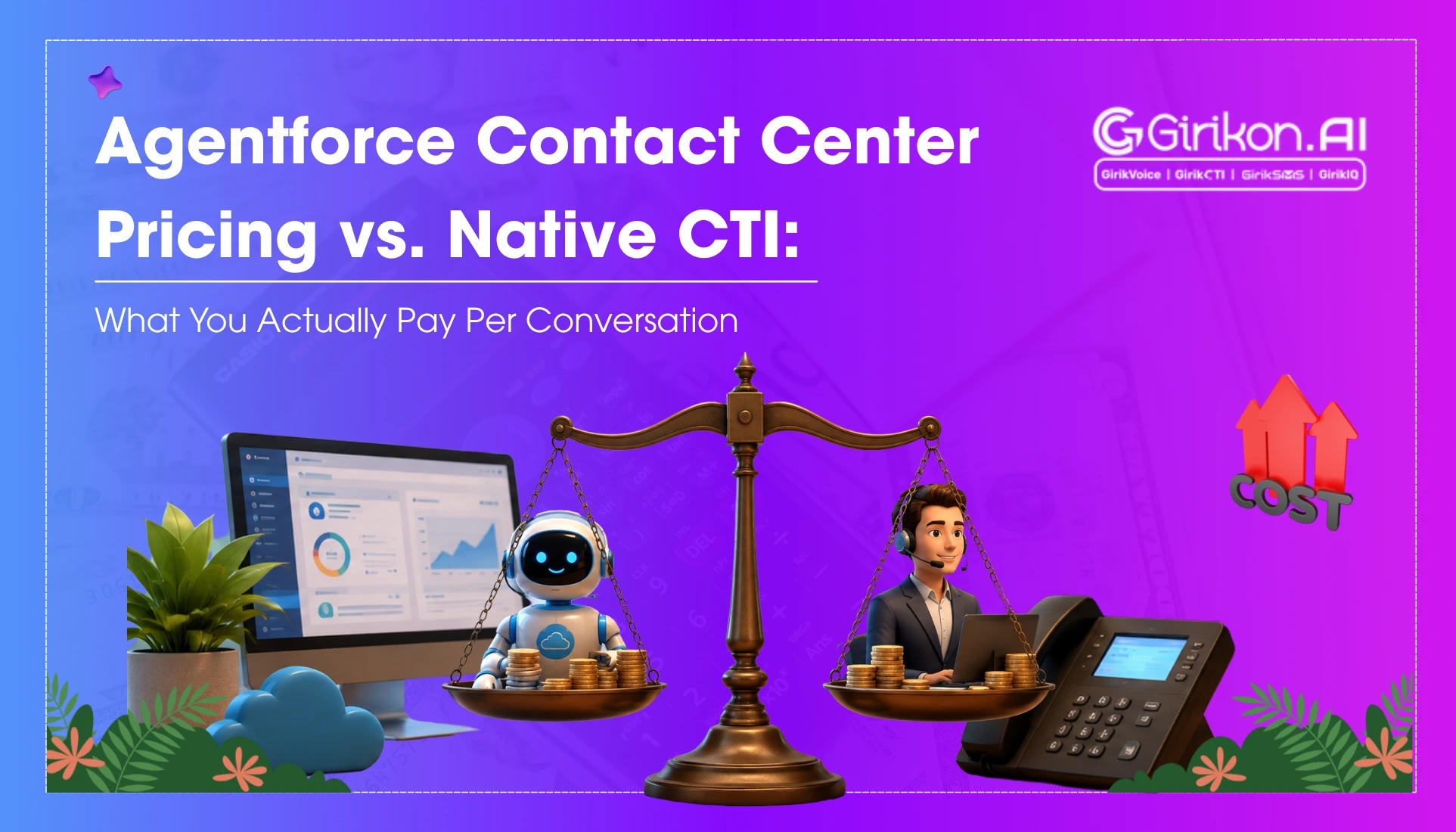
As we see through the table, a native CTI setup charges the same whether an agent handles five conversations or fifty in a day. While Agentforce ties spend to work actually done, so idle capacity stops quietly draining the budget. That difference matters most for businesses whose volume moves, for example, retailers around the holidays, support teams after a product launch. It's not marginal saving but it’s important because the pricing follows the traffic rather than struggling against it.
What are Agentforce Pricing ROI Factors?
Agentforce pricing ROI factors give businesses a clearer view of total cost of ownership. It highlights where savings come from, where hidden costs are avoided, and how pricing can match actual conversation volume instead of idle capacity. Some ROI factors are Salesforce CTI ROI, reduced operational costs, improved agent productivity, lower infrastructure expenses, and better scalability.
-
Operational Efficiency When your team offers faster resolution, it lowers case costs. This is one of the key Salesforce CTI benefits for support teams, because routine inquiries can be resolved quickly, reducing the average cost per case without requiring manual intervention. It’s not a reduction in agent value; it’s a reallocation of resources, giving agents more bandwidth to handle complex issues that require judgment rather than repetition.
-
Compliance Built‑In A CTI system, not really made for regulated industries, often ends up needing costly rework for consent workflows, audit logging, and data residency controls. So you see unplanned expenses show up, even if you planned for everything, right. But that’s not how it goes with Agentforce. The platform sort of builds GDPR, HIPAA and other regulatory expectations into the infrastructure, from the start. And because Salesforce CTI security and compliance are integrated right into the platform, organizations can cut down the need for reruns, minimize audit risk, close those compliance gaps, and keep both the budget and reputation protected… since governance becomes part of the platform, not an add on later.
-
Seat Optimization Automation keeps routine cases from reaching human agents. AI availability is also constant: coverage doesn't depend on shift schedules. And a sudden increase in volume doesn't require additional hiring or new seat licenses to manage, allowing teams to allocate resources more effectively and avoid paying for idle capacity.
-
Scalability Advantage Agentforce absorbs sudden increase in demand without additional licenses. Seasonal-based sales or product launches no longer require costly seat expansions, ensuring service continuity while keeping costs aligned with actual conversation volume.
-
Integration Simplicity Native CRM integration eliminates middleware overhead. Calls and chats arrive with full customer context, reducing build complexity and ongoing maintenance costs while keeping data flow unified without separate pipelines or vendor contracts. Deployment moves faster, integration risks drop, and teams gain a predictable cost structure. For a practical overview, see our Salesforce CTI integration guide.
Closing Remarks
A clear per-conversation cost changes how contact center spend gets planned or spent. Agentforce contact center pricing gives finance and operations teams a concrete figure to work from, rather than a seat count layered with CTI overhead that's difficult to fully account for. Pay close attention to these ROI drivers: efficiency, seat optimization, scalability, compliance, and integration. This shows where savings are realized and where hidden costs are avoided, and together, they make spending easier to justify and forecast.
Therefore, if renewals are becoming harder to defend, compare your actual conversation volume. Talk to your GirikCTI vendor today, and line up real conversation costs against Agentforce. It’s kind of the most straight forward way to tell whether your spending is scaling with demand, before you lock in the next contract decision.