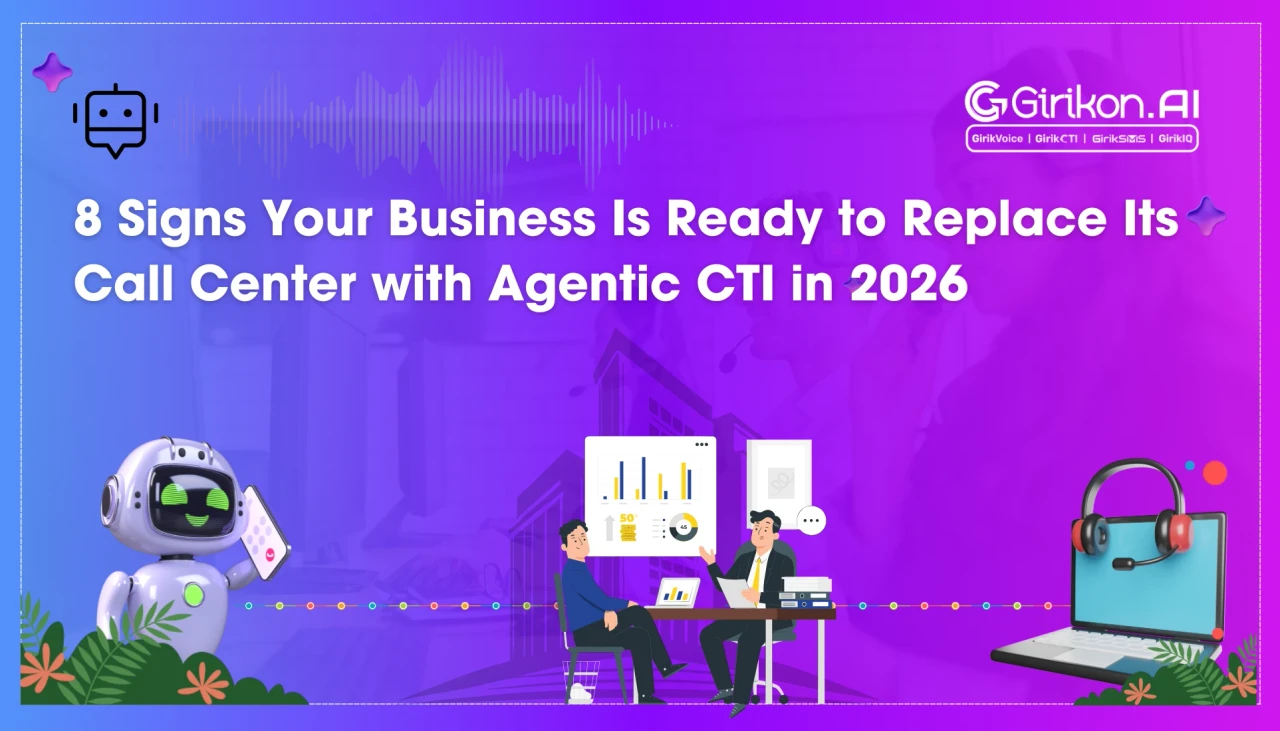
Is your business still relying on a traditional call center? In 2026, signs like rising costs, long wait times, inconsistent customer experiences, and limited scalability may indicate it’s time to consider Agentic CTI —AI-powered communication that can automate calls, understand customers, and take action in real time.
- 1Recognize when increased call volume necessitates hiring more staff, as this indicates a need to scale operations with automation.
- 2Automate routine and repetitive customer inquiries that follow predictable scripts to free up human agents. Eliminate time lost by agents searching across multiple systems for customer information by implementing a centralized solution. Prevent customer frustration from repeating information by ensuring customer context is maintained across interactions.
- 3Improve first-call resolution rates by automating information gathering and recommendation generation during conversations.
A record number of customer conversations are being handled across support environments. There are constantly growing expectations of the customers. Instant responses are expected without delays, and exceptional customer experiences are required irrespective of the channel through which the business is reached out to.
When call volumes increase, more support staff is hired to tackle the challenges. That approach works for a while. Eventually, costs increase faster than efficiency. Efficiency, on the other hand, is replaced by repetitive routine tasks that occupy most of the time. This is one of the many reasons why companies consider the implementation of agentic AI for call centers.
Unlike existing solutions that are designed for call centers, agentic solutions can route calls or provide customer information on screen alone. All the relevant details can be found under a centralized platform, where workflows happen in a controlled environment. This decreases the need for manual efforts in day-to-day operations. Routine activities can be handled by default, while the possibility of human intervention can still be maintained. Instead, a greater focus is being placed on simplification so that attention can be directed toward other critical tasks. Readiness for agentic CTI adoption may be demonstrated when such challenges are experienced.
How Agentic CTI Changes Call Center Operations
Direct call management can be enabled through CTI integration inside your CRM. Increased transparency is achieved, although substantial reliance on human involvement is still required. Agentic CTI adds another layer.
This is not about showing relevant information. Customer information can be collected, accounts can be verified, requests can be processed, and routine tasks can be completed automatically. When additional support is required, conversation details can be passed to a human representative. Routine activities can be minimized and CRM access can be maintained through CTI integration with Salesforce.
Sign 1: Increased Workforce to Meet Excessive Call Traffic
Growth should not need a matching rise in support staff. When, every seasonal peak, marketing push, or product launch basically drags hiring new agents behind it, your current operating style might not be able to scale. With agentic AI powered call center automation, a lot of the everyday conversations get handled automatically, so the business can take on higher volume without expanding headcount as fast. When this is paired with a scalable Salesforce calling infrastructure, the whole setup makes it easier to carry growth smoothly while still keeping the same customer service quality.
Sign 2: Most Calls Follow the Same Script
Naturally, not every conversation requires the intervention of a human representative. Requests regarding the status of an order, bills, scheduling of appointments, account verification, resetting of passwords, and many other similar processes are quite predictable.
When a large percentage of interactions look identical, automation becomes simpler to implement. Routine customer requests can be automated, while complex issues can be directed to agents.
Sign 3: Valuable Time is Lost Searching for Information Across Systems
Delays in customer service often led to searching for an ideal solution. Customer information is often stored across multiple systems rather than in one place. Due to which, several records may need to be reviewed before enough context can be gathered to address the issue and provide an accurate response.
This adds nothing but an extra step to complete customer interaction - resulting in loss of time and poor client experience in the end. Agentic AI for call centers extracts relevant information by default. This allows agents to focus on fixing issues rather than searching for answers.
Sign 4: Customers Keep Repeating Information
Repeating the same details repeatedly can be annoying for customers. That usually happens when systems are disconnected. Customer history lives on one platform; cases live in another, and phone interactions live elsewhere.
Call center integration with Salesforce makes it possible to bring all of these into one place. The context can be carried forward in an agentic workflow so that the client does not need to keep repeating himself each time.
Sign 5: Consistently Low First-Call Resolution
Even when more agents are hired, first-contact resolution may not be achieved if necessary information is not made available.
Record gathering, recommendation generation, background checks, and other related activities can be performed automatically during conversations.
Sign 6: Seasonal Peaks Disrupt Service Quality
Many businesses experience predictable spikes in demand. Retailers see holiday surges. The healthcare industry undergoes enrollment seasons. Financial institutions have a particular season for excess demand.
Longer wait times or additional staffing measures are often implemented to address this challenge in traditional call centers. With an agentic AI tool, organizations can augment their capacity without employing more people. Routine tasks are streamlined, and complex ones are forwarded to human experts.
Sign 7: Agent Turnover is Getting Worse
Repetitive tasks impact morale. Employees who have spent all day responding to similar questions become less engaged.
Automation eliminates many such repeated tasks. As agents are relieved from their routine work, agents can focus on issues that require experience, judgment, and problem-solving.
Sign 8: Too Many Systems are In Use
It's kinda common for support teams to lean on a bunch of separate apps through out the day. Call handling stuff, customer records , and ticket management are often split up across different platforms. When they use separate systems it can make the whole process more complicated and it also bumps up the chance of mistakes, pretty easily. With the integration of a Salesforce AI contact center , all the relevant client related details, from chats to service reports, show up for agents inside one centralized place, so they can respond faster and run more efficiently with customer support.
Questions to Ask Before Choosing an Agentic AI Platform
Think about a couple of practical questions before choosing a platform. More insight is often provided by the answers to these questions than by an extensive feature checklist.
- - Is action execution supported, or are responses simply provided?
- - Can managers review decisions after an interaction ends?
- - What measures are available to support Salesforce CTI security and compliance?
Conclusion
New technology is not the only factor that is causing traditional call centers to be replaced. A period marked by increased costs, higher call volumes, system fragmentation, and pressure to improve customer satisfaction is generally observed beforehand. Agentic AI for call centers offers different ways forward. Human involvement is reserved for decisions requiring judgment, while routine processes are handled through automation.