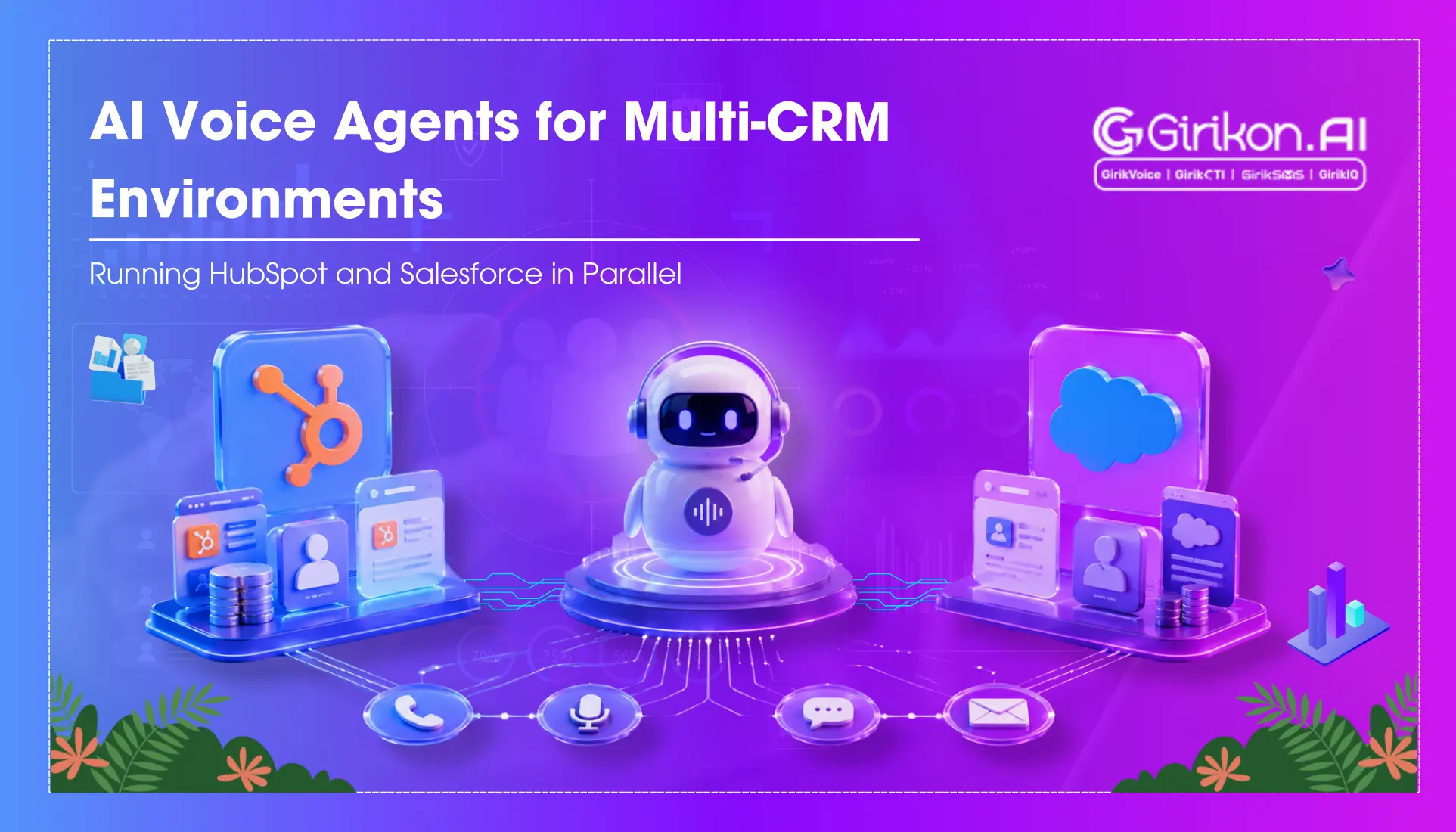
Running HubSpot and Salesforce in parallel can create duplicate records, conflicting data, routing issues, and integration complexity. Discover how AI voice agents can coordinate both CRMs and deliver reliable customer conversations.
- 1Address data authority issues in dual-CRM environments to prevent AI voice agents from pulling stale or conflicting information during live calls.
- 2Implement a robust logic layer above HubSpot and Salesforce to manage decision sequencing, including ownership resolution and write-back coordination, for AI voice agents.
- 3Design configurable fallback behaviors for AI voice agents to gracefully handle situations where record state cannot be confirmed quickly, bridging the gap between demo and reality.
- 4Recognize that scaling voice AI from single to dual-CRM environments introduces significant complexity, particularly under high call volumes with overlapping customer data.
- 5Prioritize middleware capabilities like unified contact resolution, bidirectional sync with conflict rules, and async write-back queuing for successful enterprise AI voice agent deployments in multi-CRM setups.
AI Voice Agents for Multi-CRM Environments: Running HubSpot and Salesforce in Parallel
Most organizations that end up running two CRMs simultaneously didn't plan to. They acquired a company, or a marketing team chose HubSpot before the sales team got locked into Salesforce, or some well-intentioned consolidation project stalled halfway and never recovered. The result is a patchwork architecture that nobody loves but everyone depends on - and when you layer Salesforce and HubSpot voice AI onto that kind of environment, the complexity doesn't add linearly. It compounds.
Worth noting before we go further: the conversation about voice AI in enterprise sales and service has matured considerably over the last couple of years. We're past the phase where the technology needed justifying. The current argument is about where it breaks, what it costs to fix, and whether the operational gains are real enough to absorb the integration overhead.
The Dual-CRM Problem Nobody Talks About Honestly
Here's the thing about running HubSpot and Salesforce in parallel - the surface problem looks like data duplication, but the actual problem is authority. Which system owns the contact record? Which one wins when two updates conflict? Which one do you trust when an AI voice agent needs to pull live account context in the middle of a call?
Most teams answer this inconsistently. And inconsistency is where voice AI gets into trouble fast, because a multi CRM voice automation layer has to make real-time routing decisions that depend on knowing exactly which system holds the authoritative state of a given record. When that isn't clear - and in dual-CRM environments it usually isn't - the agent either pulls stale data, surfaces conflicting information to the caller, or defaults to a generic response that undermines the whole point of having an AI agent in the first place.
The failure isn't the voice technology. The failure is that the data architecture underneath it hasn't been designed for a system that needs to act on it in under two seconds.
AI Voice Agents for Multiple CRMs: What the Architecture Actually Requires
The integration challenge here is less about API connectivity and more about decision sequencing. An AI voice agent operating across HubSpot and Salesforce simultaneously needs a logic layer that sits above both platforms - something that determines, per call and per contact, which CRM to read from, which to write back to, and in what order.
A few of the things that layer needs to handle:
- Ownership resolution: who does the contact belong to operationally - the HubSpot lifecycle stage or the Salesforce opportunity stage - and what happens when those stages disagree with each other
- Write-back coordination: after a call, which CRM captures the disposition data, and does that trigger downstream workflows in both systems or just one, because triggering both can create duplicate follow-up sequences that the customer experiences as noise
- Fallback behavior: when the agent can't confirm record state in time - and this happens more than vendors admit - what does it default to, and is that default configurable per use case or locked at the platform level
That last point matters more than it sounds. Fallback behavior in production environments tends to be where the gap between the demo and reality lives.
Where Enterprise Deployments Actually Struggle
Honestly, the deployment stories that go sideways tend to share a common shape. The voice infrastructure is solid. The CRM integrations individually work fine. What fails is the middleware - the layer that's supposed to coordinate between systems under real call volume.
An enterprise voice agent platform that handles single-CRM environments well doesn't automatically scale gracefully into dual-CRM complexity. The stress test isn't a single high-priority account call. It's a contact center running four hundred concurrent calls where twenty percent of callers exist in both CRMs with different contact IDs, different ownership assignments, and different opt-out records. That's the condition that exposes the gaps.
To be fair, some platforms handle this reasonably well. The ones that tend to succeed in these environments share a few characteristics:
| Capability | Why It Matters in Dual-CRM Environments |
|---|---|
| Unified contact resolution layer | Prevents duplicate record conflicts from surfacing mid-call |
| Bidirectional sync with conflict rules | Determines which CRM wins on field-level update collisions |
| Per-call CRM routing logic | Allows different call types to write to different systems |
| Async write-back queuing | Reduces call latency when CRM API response times spike |
| Audit trail across both platforms | Critical for compliance teams reviewing dispositions post-call |
The async write-back row in that table is the one that gets underestimated most often in pre-deployment scoping conversations.
Building a Practical Integration Framework
When we've seen this done well, it tends to follow a sequenced approach rather than a simultaneous everything-at-once implementation.
- Define record authority before anything else. Pick one CRM as the system of record per object type - contacts, accounts, opportunities - and document the exceptions. This single step removes more ambiguity from the voice layer than any amount of middleware configuration can compensate for later.
- Instrument the contact overlap. Run a deduplication analysis across both CRMs to understand the actual scope of shared records. In environments where HubSpot owns marketing-sourced contacts and Salesforce owns sales-owned accounts, the overlap is often lower than assumed - but the edge cases are messier than expected.
- Configure the voice agent's CRM priority logic per campaign or call type. Inbound service calls might route primarily to Salesforce. Outbound marketing sequences might pull from HubSpot. The agent doesn't need to choose arbitrarily if the routing logic is set in advance by workflow type.
- Test failure modes explicitly. Simulate CRM API latency, conflicting opt-out records, and contact ID mismatches before go-live. Not as a checkbox exercise - as a genuine stress test with production-like data volumes.
Worth flagging here: the compliance dimension of dual-CRM voice environments is genuinely underweighted in most implementation projects. If opt-out records exist in one CRM but not the other, and the voice agent reads from the wrong system, the exposure isn't a process problem. It's a regulatory one.
The CRM-Connected Voice AI Argument for Keeping Both Systems
There's a version of this conversation where the obvious answer is just to consolidate into one CRM and simplify everything. And sometimes that's right. But consolidation projects have a long and expensive failure history, and for many organizations the operational cost of forcing all marketing activity into Salesforce or all sales activity into HubSpot is higher than the integration overhead of running both.
A CRM connected voice AI layer, when it's architected properly, can actually make the dual-CRM arrangement more sustainable rather than less. The voice agent becomes the unifying operational layer - it's the system that has to reconcile the two CRMs in real time, and in doing so it creates an audit surface that doesn't exist anywhere else. Every call logs context from both systems. Every disposition creates a record that references both platforms. That cross-CRM data trail is, somewhat unexpectedly, one of the more useful analytical assets that comes out of these deployments.
It doesn't make the architecture clean. It makes it legible, which is different and arguably more valuable when the organization isn't ready or willing to do a full consolidation.
Where This Conversation Is Actually Heading
The organizations getting real traction with voice AI in dual-CRM environments tend to be the ones that stopped trying to solve the CRM problem first and started treating the voice layer as infrastructure that demands clarity from whatever sits beneath it. The agent forces the architecture question in a way that years of internal discussions didn't.
Whether that urgency leads to better-designed systems or just faster-surfaced problems is genuinely an open question right now. Vendors in this space are moving quickly, the middleware tooling is improving, and the number of enterprises willing to run simultaneous CRM environments as a long-term strategy - rather than a transitional state - seems to be growing rather than shrinking. What that means for the platforms, and for the voice AI vendors trying to serve them, probably won't be clear for another eighteen months or so. The tension between simplicity and operational reality has a way of resolving itself on the customers' timeline, not the vendors'.