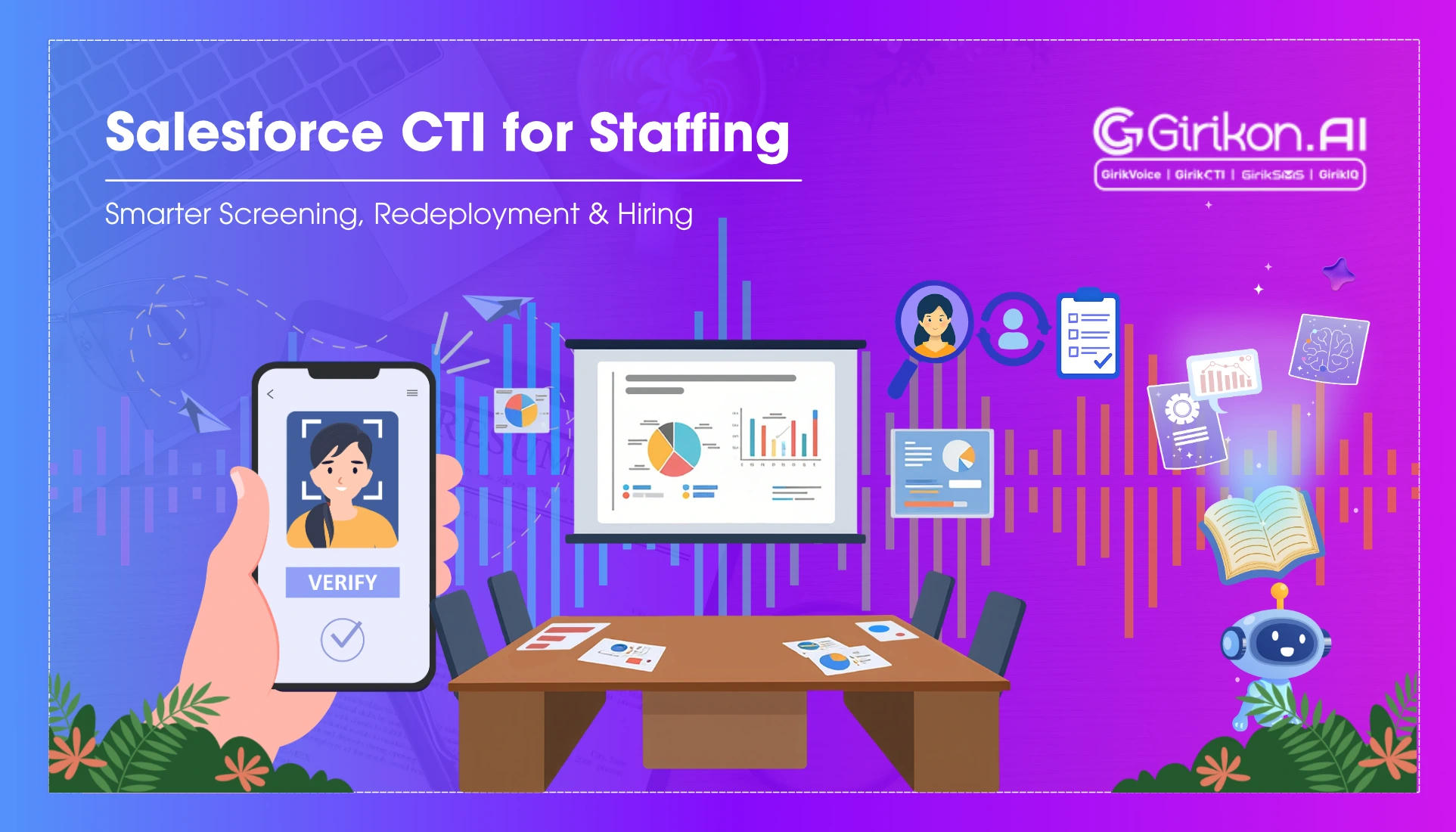
Explore how staffing agencies can use Salesforce CTI to simplify screening calls, identify redeployment opportunities, and help recruiters spend more time placing talent.
- 1Integrate Salesforce CTI to unify phone conversations with the CRM, enabling recruiters to manage calls, access candidate context, and capture call activity directly within Salesforce.
- 2Streamline candidate screening by leveraging Salesforce CTI for instant verification of essential details, minimizing repetitive questions and improving efficiency.
- 3Automate mundane calling tasks with Salesforce CTI to update candidate statuses, create follow-ups by default, and transform phone discussions into structured hiring events.
- 4Enhance redeployment efforts by using Salesforce CTI to proactively identify suitable opportunities for past placements before their assignments end, keeping them active in the talent pool.
- 5Improve recruiter throughput and reduce administrative friction by connecting telephony with Salesforce, allowing recruiters to move applicants through the pipeline faster and focus on strategic tasks.
For staffing agencies, conversation is key to survival. Right from calling candidates to confirm their availability and screening their credentials to discussions regarding the CTC, interview scheduling and follow-up post client feedback — staffing agencies need seamless conversations to ensure they bring aboard the right fit. This would require organizations to unify their conversation from a single source of truth or in other words a robust CRM system like Salesforce.
Yet, several staffing organizations still follow the traditional route of interacting outside the CRM. Recruiters may call from separate phone systems, make notes manually, search via worksheets for prior discussions, and update candidate records after the call — if they remember to do so. This is where visibility gets hampered.
A staffing agency may have thousands of conversations every week, but only a part of the data generated by those calls becomes structured CRM data. This requires staffing agencies to connect their phone discussions directly to that data. This is where Salesforce CTI for staffing can bridge the gap by bringing telephony into the hiring workflow. When implemented well, recruiters can make and receive calls from within Salesforce, get candidate context while speaking, capture call activity by default, and initiate follow-up workflows from call outcomes.
By connecting telephony with Salesforce, Salesforce CTI enables inbound, as well as outbound calls, access to client info, and call reporting. For staffing agencies, it can unify different stages of the recruitment life cycle including candidate screening, call tracking, redeployment, recruiter productivity, and placement follow-up.
Why Voice Matters in Staffing?
Let’s understand this with an example: If a staffing agency requires 6 contractors within 48 hours, a recruiter might have to contact numerous candidates within a single day. Recruiter throughput therefore becomes crucial. From candidate screening to submission, interviews, joining, and relocation, phone interactions are central to the workflow. When calling is detached from Salesforce, recruiters toggle between applications, finding recording notes, numbers, updating statuses, and creating follow-ups. Salesforce CTI brings together calling and CRM context, while solutions such as the best AI voice agent can further streamline candidate interactions and routine follow-ups. This reduces administrative friction while helping recruiters move applicants through the pipeline faster.
How Salesforce CTI Connects with Staffing Agencies?
At a high level, Salesforce CTI connects telephony platforms, recruiters, candidates, and Salesforce in a unified workflow. Besides click-to-dial, recruiters can receive inbound calls, or use calling workflows. The CTI layer captures the identity of caller, call duration, outcome, recordings, notes, follow-ups, and recruiter details. With softphones and screen pops, call activity is linked to Salesforce records by default. This creates a candidate call tracking CRM that keeps recruiting conversations unified and actionable.
Faster Screening of Candidates:
It is one of the most important use cases for Salesforce CTI in staffing. Recruiters can instantly verify location, work agreement, skills, notice period, experience, compensation and more without switching between applications. With a recruiter dialer Salesforce workflow, calls start instantly from candidate records, while earlier interactions and recruiting history remain obvious. This minimizes repetitive questions, rates screening, optimizes consistency, and helps hiring staff manage high-volume candidate interactions more efficiently.
Automating Staffing Agency Calls:
Staffing agency call automation streamlines mundane tasks around recruiter conversations rather than replacing recruiters. A typical workflow can initiate call tasks, enable click-to-dial, update candidate status, create follow-ups by default and more. Outcomes such as no answer, call back, interview scheduled, and others can resolve the next action. This transforms phone discussions into structured hiring events, helping staffing teams improve uniformity, minimize manual task, and pace up candidate movement.
Redeployment:
Redeployment helps staffing companies turn accomplished assignments into future placements. By leveraging Salesforce CTI, Salesforce call task automation, and workflow automation, agencies can initiate recruiter tasks before the end of a contractor’s assignment. Recruiters can then call candidates, capture availability, identify suitable opportunities, and initiate submissions. This structured approach keeps past placements active within the talent pool, reduces missed redeployment opportunities, and helps recruiters manage large contractor databases while creating a recurring path from concluded assignments to future revenue.
Building a Call Tracking CRM:
A candidate call tracking CRM turns conversations on phone into a searchable recruiting history. Rather than showing the last contact, Salesforce can gather screening calls, follow-ups, interview considerations, offer-related interactions, and redeployment outreach. Agencies can evaluate contact frequency, recruiter activity, speed of follow-up, call outcomes, candidate interaction patterns, and links between calls and placements. This data also supports recruiter training, performance reporting, and informed decisions across high-volume staffing operations.
Improving Recruiter Throughput:
Recruiter Throughput is about making the most of the time spent on constructive recruiting instead of manual administration. Salesforce CTI streamlines the workflow by enabling hiring staff to open a candidate record, initiate call, record call outcomes, and schedule follow-ups within Salesforce. Autodialing can further support high-volume campaigns. However, agencies must take into account consent, calling regulations, expectations of candidate besides their operating model when choosing dialing capabilities for outbound recruitment.
Screen Pop for Inbound Calls:
Inbound candidate calls can be improved by CTI. When a candidate contacts the agency, caller detection and screen-pop functionality can display the matching Salesforce record by default. Recruiters can access the candidate’s applications, opportunities, recruiter ownership, call details, and interview status by default. Rather than asking redundant identification questions, recruiters can start the interaction with context, creating a more personalized and quicker candidate experience while optimizing call-handling efficiency.
Connecting CTI with Recruiting Automation:
The importance of Salesforce CTI for staffing increases when telephony connects with Salesforce automation. Completed screening calls can update candidate statuses, while Salesforce AI call notes can capture key conversation details and ensure recruiters have an accurate record of each interaction. Availability confirmations can trigger interview tasks, and callback requests can create follow-ups automatically. Similarly, approaching assignment end dates can generate relocation tasks, while candidate submissions can notify account managers and schedule client follow-ups. This makes the phone an integrated part of hiring workflows, connecting communication with candidate management, automation, and business development.
Final Words:
Salesforce CTI for staffing brings recruiter calls into the same landscape as candidate, client, job, and data placement. Besides accelerating screening, simplify follow-ups, reduce manual entry, and optimize outbound productivity. Combined with staffing agency call automation, CTI can turn interactions into structured and measurable workflows. This allows better candidate engagement, preemptive redeployment, greater recruiter visibility, and more opportunities to turn every conversation into an effective placement.