Discover how Salesforce CTI helps auto dealerships streamline service bookings, capture sales opportunities, recover missed calls, and improve customer engagement. Learn how integrating CTI with Salesforce enables dealership teams to manage calls efficiently, follow up faster, and turn more conversations into service appointments and vehicle sales.
- 1Implement Salesforce CTI to integrate phone systems with the CRM, enabling tracking of all customer interactions and reducing missed opportunities.
- 2Streamline service booking by using CTI to route calls, display customer and vehicle history, and automate appointment workflows.
- 3Recover missed calls efficiently by using CTI to record unanswered calls, create follow-up tasks, and assign callbacks to the appropriate staff.
- 4Convert more sales calls by using CTI to instantly identify callers, access customer records, and gain context on previous interactions.
- 5Enhance customer experiences by providing agents with complete customer context, leading to more personalized and consistent interactions across sales and service.
A ringing phone could be your next vehicle sale or your next empty service slot. Which one will it be?
Well, it totally depends on how you handle calls from customers looking to schedule service, check vehicle availability, book test drives, and discuss financing. If these calls are managed through disconnected phone systems, sales opportunities and service bookings can easily slip through the cracks.
However, with Salesforce CTI for dealerships, teams can connect every call to the customer journey, sales activities, service workflows, and follow-ups, thus responding faster, recovering calls, and capturing more opportunities that might otherwise be missed. In this blog, let's explore how Salesforce CTI can streamline dealership calls.
Why Do Dealerships Need Salesforce CTI?
Even when dealing with a large number of calls in services, parts, sales, clients, etc., some dealerships zap old-school telephone systems that do not have any clear evidence of what happens prior to, during and after calls thus making it complex to follow up on opportunities.
Salesforce CTI changes that by moving calls straight into the CRM system. Thus, letting agents access customer information, route calls, log interactions, and take the right next action from one dealership phone system CRM.
This gives dealership team the tool to:
- Track inbound and outbound call activity
- Reduce missed sales and service opportunities
- Access customer and vehicle information during calls
- Automate post-call follow-ups
- Route calls to the right department faster
- Improve visibility into dealership call performance
How can Salesforce CTI Drive More Dealership Opportunities?
Streamline Service Booking Calls
Service departments receive calls for inspections, repairs, oil changes, maintenance appointments, etc. With Salesforce CTI, service advisors handle these calls more efficiently as it ensures:
- Routing calls to the appropriate service team or the right advisor through Salesforce CTI call queue management.
- Reviewing previous service interactions and vehicle details.
- Displaying the customer's Salesforce record during the call.
- Capturing the reason for the call without switching systems.
- Recording appointment details and initiating the next step in the booking workflow.
This not just helps manage service bay booking calls but also reduces the risk of losing appointments because of delays.
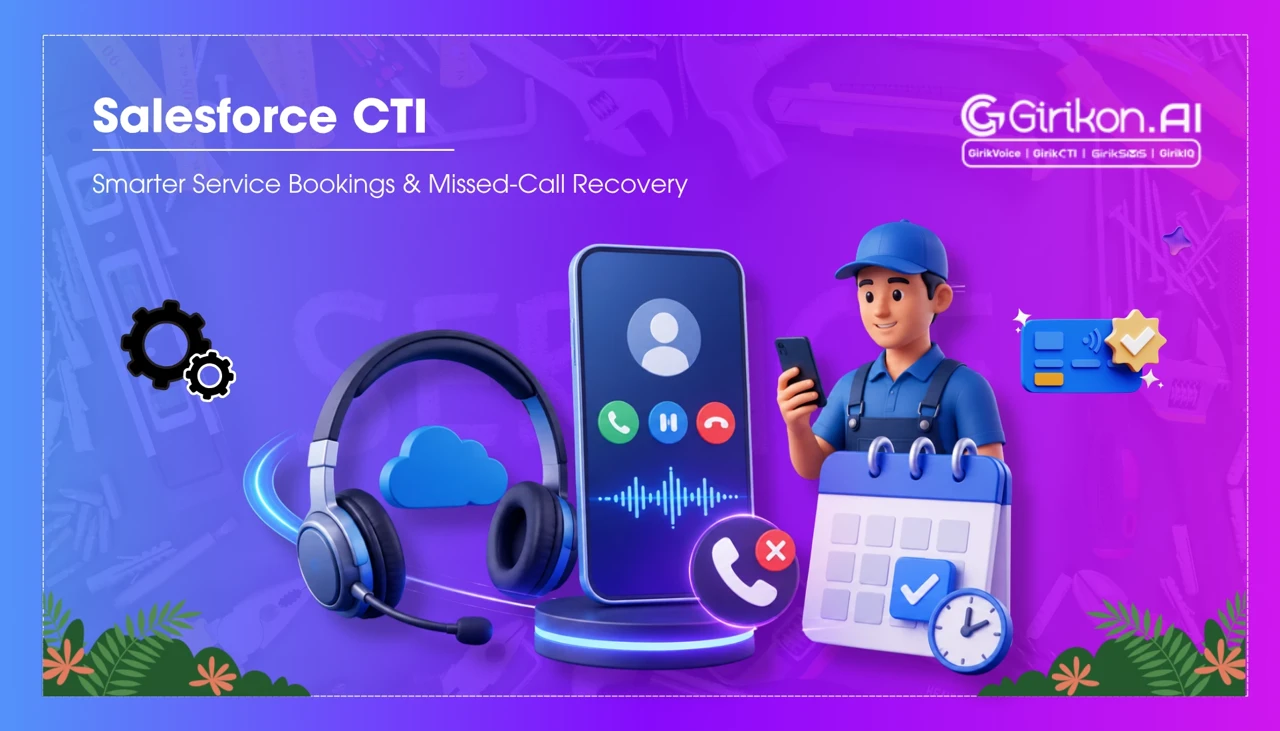
Recover Missed Calls Faster
A missed call can mean a lost service appointment, or a customer is taking their vehicle purchase to another dealership. With a Dealership phone system CRM, team can create structured missed-call recovery process by:
- Recording unanswered calls in Salesforce.
- Creating a follow-up task or workflow.
- Identifying the caller when possible.
- Assigning the callback to the appropriate representative.
- Recording the outcome once the customer is contacted.
This turns missed-call recovery into a repeatable dealership process rather than something agents have to remember manually.
Convert More Sales Calls
Not every sales opportunity originates with a website submission, some leads still like calling the dealer for asking questions about the prices, availability, financing, test driving, trade-in etc. Salesforce CTI makes conversations more trackable and actionable by:
- Identifying callers or surface lead or customer records instantly.
- Logging inbound and outbound calls automatically is a key feature covered in this Salesforce CTI call logging guide, helping teams maintain accurate call records and improve customer interactions.
- Giving sales teams context on previous interactions and inquiries.
- Improving visibility into how phone calls convert to sales opportunities.
- Providing better visibility through automotive call tracking in Salesforce.
The sales team, therefore, learns how phone conversations correlate with leads and appointments.
Provide More Tailored Customer Experiences
Customers don't have to repeat themselves every time they call, as dealerships acquire full customer context, track all previous interactions seamlessly, and analyze those conversations. This ultimately ensures:
- Reduced repetitive questions
- Better customer context
- More personalized conversations
- A consistent experience across sales and service interactions
Also, this helps agents address the requests quickly without making customers frustrated.
Extend Support Beyond Business Hours
CTI combined with automation can help dealerships manage calls outside regular operating hours. Important or valuable queries can be routed following predetermined rules, whereas routine queries can be processed using an automatic voice workflow process. This helps:
- Provide consistent call handling
- Reduce the risk of missed opportunities
- Capture customer intent after hours
- Maintain a better level of customer support beyond regular hours.
Thus, ensuring customer requests are captured and acted on at the right time even when their sales and services teams are unavailable.
What Should a Dealership Phone System CRM Include?
Rather than just connecting callers to agents, Salesforce CTI for dealerships should manage the complete conversation lifecycle with key capabilities, including:
Click-to-Call
Without manually entering phone numbers, Sales and service teams can call customers directly from their Salesforce records. This reduces dialing errors, makes follow-ups quicker, and helps agents reach customers without switching between applications.
Call Routing
The query for service request may be routed to the service advisor, whereas the query for vehicle availability may be routed straight to the sales team. This will avoid any time delay and help the customer in reaching the appropriate individual.
Automatic Call Logging
Inbound and outbound calls can be automatically logged against the relevant lead, customer, or contact record. This creates a complete history of phone interactions, enabling teams to understand previous conversations while avoiding their reliance on manual updates.
Caller Identification
Agents can see customer details and previous interactions when an existing customer calls. This helps them identify the caller, surface relevant Salesforce information, and get useful context before starting the conversation.
Missed-Call Tracking
As unanswered calls are captured and associated with appropriate customer records, dealership teams can easily identify who needs a callback urgently.
Call Recording and Transcription
Automotive call tracking in Salesforce not only records calls but also uses Call Recording and Transcription to help managers review conversations, understand customer concerns, and eliminate the need for lengthy manual notes.
Call Analytics
It becomes easy to monitor the performance of the agents, call traffic, response rate, missed calls, call outcomes, etc. with the analytics generated in the Salesforce CTI.
Conclusion
From recapturing the missed call to streamlining booking services, the appropriate CTI solution can capture more opportunities and make the difference in the business.
GirikCTI brings CRM data, calling, tracking, automation, and routing together to help dealerships make every conversation count. Book a free demo to learn more.