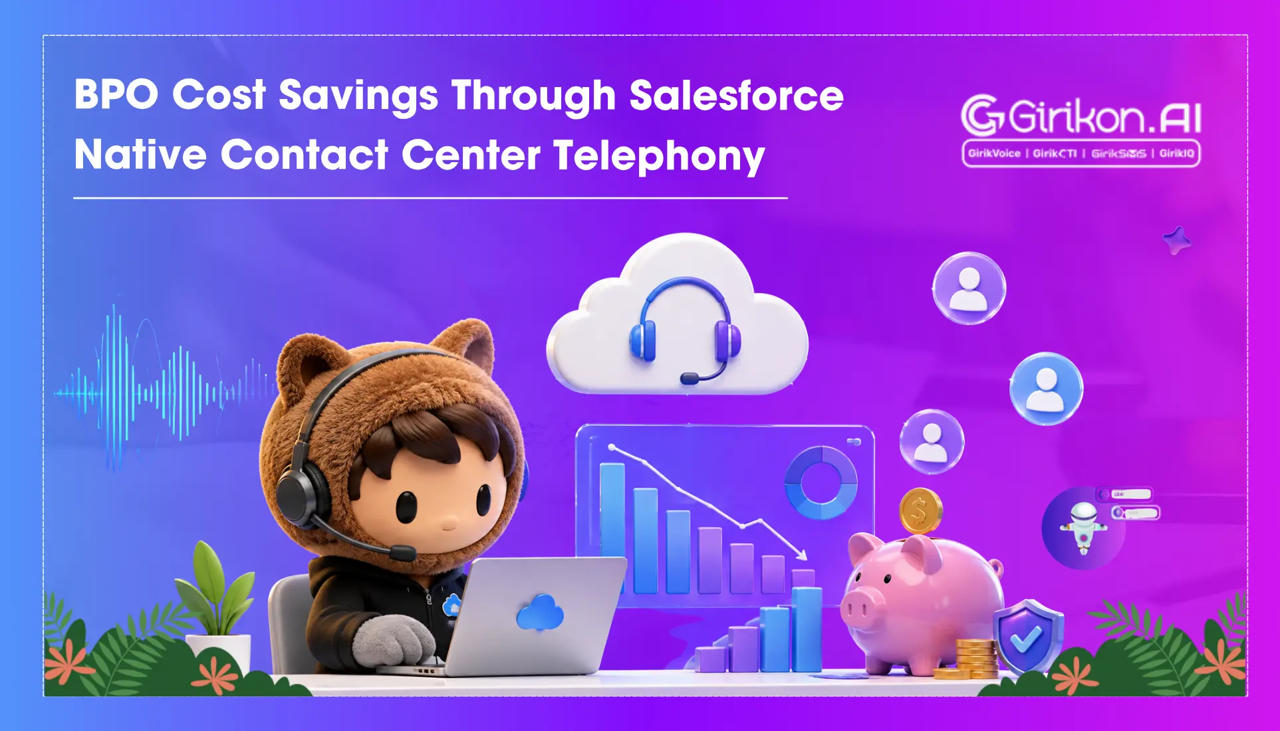
BPOs are under constant pressure to reduce cost per seat while maintaining agent productivity and customer experience. Yet, adding separate vendors for telephony, CRM integration, analytics, and call management can quickly increase technology costs and complexity. This blog explores how Salesforce-native telephony can help BPOs simplify their technology stack, reduce vendor overhead, improve agent efficiency, and achieve more predictable **cost-per-seat optimization** without sacrificing critical contact center capabilities.
- 1Consolidate technology vendors by adopting Salesforce-native telephony to eliminate duplicate licensing and reduce tech bloat.
- 2Reduce overall seat costs by right-sizing telephony license tiers to match actual agent usage patterns.
- 3Eliminate hidden operational costs associated with legacy on-site phone systems by migrating to cloud-based telephony.
- 4Streamline agent workflows and decrease Average Handle Time (AHT) by integrating data-driven IVRs that leverage Salesforce customer data.
- 5Rethink the number of vendors required for contact center operations by integrating capabilities into a single Salesforce environment to lower cost-per-seat.
For a BPO, every seat is a business unit with a measurable cost and an expected return. That makes the technology stack behind each agent more than an IT decision. Telephony licenses, CRM subscriptions, contact center platforms, integrations, implementation fees, support contracts, and administrative overhead all contribute to the economics of every productive seat.
Yet many BPOs still approach this problem by adding another vendor whenever a capability is missing. Need better calling? Add a telephony provider. Need CRM integration? Add middleware. Need analytics? Add another platform. These decisions can look reasonable at an individual level. But altogether, they create a fragmented technology stack that gradually pushes up the BPO contact center cost per seat and makes it harder to manage efficient, scalable BPO contact center solutions.
For BPOs operating on tight margins with hundreds or thousands of agents, this can become a competitive disadvantage. The alternative isn't simply finding a cheaper telephony vendor or comparing different Salesforce telephony options, but rethinking how many vendors are required to deliver the same agent experience.
What Goes into the Cost of a BPO Contact Center Seat?
The cost of a seat is rarely limited to what a BPO pays for an agent's CRM or telephony license. Several expenses sit around that seat, and some are easy to overlook when they are spread across different vendors and contracts.
- Software and telephony licenses are the most visible costs. A BPO company may be charged separately for CRM, voice platform, dialer, workforce tools, and many other contact center functionalities. The prices may also vary according to usage, calling minutes, storage, etc.
- Integration costs add another layer. When systems come from different providers, they need to exchange customer records, call data, recordings, and other information. Building and maintaining those connections takes development resources and can introduce additional middleware or integration platforms, increasing overall Salesforce CTI integration costs.
- Implementation and administration also affect seat economics. New tools require configuration, testing, training, troubleshooting, and continuous optimization. As the scale gets bigger, even the smallest administrative expense can become significant. Then there are the less obvious costs. Agents may switch between applications during a call. Supervisors may work across multiple dashboards. IT teams may manage several vendor relationships and troubleshoot issues across system boundaries.
These activities do not always appear as separate line items, but they still affect how efficiently each seat operates. This is why BPO contact center cost per seat is better viewed as a measure of the entire technology and operational stack rather than the price of a single license.
How Salesforce-Native Telephony Reduces Cost Per Seat for BPOs
For most BPOs, the question of how to reduce BPO seat cost is not just about what each vendor charges. It is about how many vendors are running in parallel to deliver what could come from a single environment. Salesforce-native CTI reduces this complexity by consolidating capabilities that currently sit across separate systems into one environment.
-
Eliminate Duplicate Licensing and Tech Bloat
- Consolidate contact center vendors with a native ecosystem: Third-party contact centers and CTI middleware come with individual licensing fees. Combining the capabilities of CRM, routing, Salesforce call recording, and voice intelligence into one Salesforce-native system eliminates the added costs.
- Right-size minute tiers: Auditing actual usage data across agent groups can reveal where seats are licensed for capabilities that rarely get used. Aligning license tiers to real usage patterns rather than maximum bundles reduces what each seat costs without changing the agent experience. For reference, low-volume groups can move from higher-tier voice seats to more cost-appropriate partner telephony integrations depending on actual call volume.
- Remove legacy hardware footprint: Older on-site phone systems come with hidden running costs: keeping the hardware maintained, powering it, and housing it. Shifting to cloud-based telephony removes that overhead without replacing it with anything equivalent.
-
Drive Down Average Handle Time
- Deploy data-driven IVRs: Rather than routing every caller through the same menu, Salesforce IVR can check Salesforce records first. Return customers or priority accounts get directed faster, cutting the time agents spend on queue-related steps before the conversation even starts. Thus, the time saved on each call can add up significantly across hundreds of calls handled in a day.
- Automate screen pops: Customer profiles surface the moment a call arrives, removing the manual search and identity verification steps that slow the opening of every interaction. Agents start with context already on screen.
- Automate logging and wrap-ups: Click-to-dial through Salesforce click-to-call and automatic call record creation mean agents can move to the next interaction without spending post-call time on manual summaries or disposition entry. That time compounds across every agent and every shift.
-
Optimize AI and Token Consumption
- Control prompt overhead: Unnecessary context injection in automated workflows can drive up real-time transcription and AI summary costs significantly. Restricting what gets passed into each prompt keeps consumption aligned with what the workflow actually needs.
- Optimize prompt parameters: Setting character and token thresholds per call action ensures automated intelligence stays cost-controlled without removing the capabilities that support agents during live calls.
-
Streamline Workforce Onboarding
- Shorten training period: Onboarding new agents on a single consolidated Salesforce interface is quicker than training agents on different systems. This will result in lower onboarding costs resulting from shorter training periods.
- Reduce management overhead: It becomes easier to monitor queue calls, agent performance, and status reports from a single platform when supervisors do not have to switch between systems. That efficiency compounds across larger management teams and higher agent volumes.
Conclusion
Every dollar saved per seat compounds across an operation running hundreds or thousands of agents. That is the scale at which BPO contact center cost per seat decisions actually matter—and why the vendor stack behind each agent deserves the same scrutiny as headcount, licensing, or any other major cost center. Effective Salesforce calling cost optimization can help BPOs reduce unnecessary telephony and platform expenses while maintaining the performance and flexibility agents need.
BPOs that have reduced seat costs sustainably have generally done so by simplifying how their technology works together, not by squeezing individual vendor contracts. Salesforce-native telephony is one way that simplification becomes structural, built into how the operation runs rather than negotiated one renewal at a time.