AI voice cloning creates powerful opportunities for businesses, but having access to someone's voice doesn't automatically mean you have the right to replicate it. Learn what AI voice cloning consent, synthetic voice rights, and usage permissions you need before creating or deploying a cloned human voice.
- 1Obtain explicit and informed consent from individuals before cloning their voice, clearly explaining the intended use and deployment of the synthetic voice.
- 2Define and document the specific scope of use for the cloned voice; any changes in application require securing new, additional permissions.
- 3Establish clear protocols for what happens to the voice clone, source recordings, and voice model when the agreement ends, the project concludes, or permission is withdrawn.
- 4Understand and comply with all applicable privacy laws, publicity rights, consumer protection regulations, and AI-specific laws in the relevant jurisdictions.
- 5Document all consent agreements thoroughly, including details like date, specifics, validity period, and conditions, to ensure a defensible legal position.
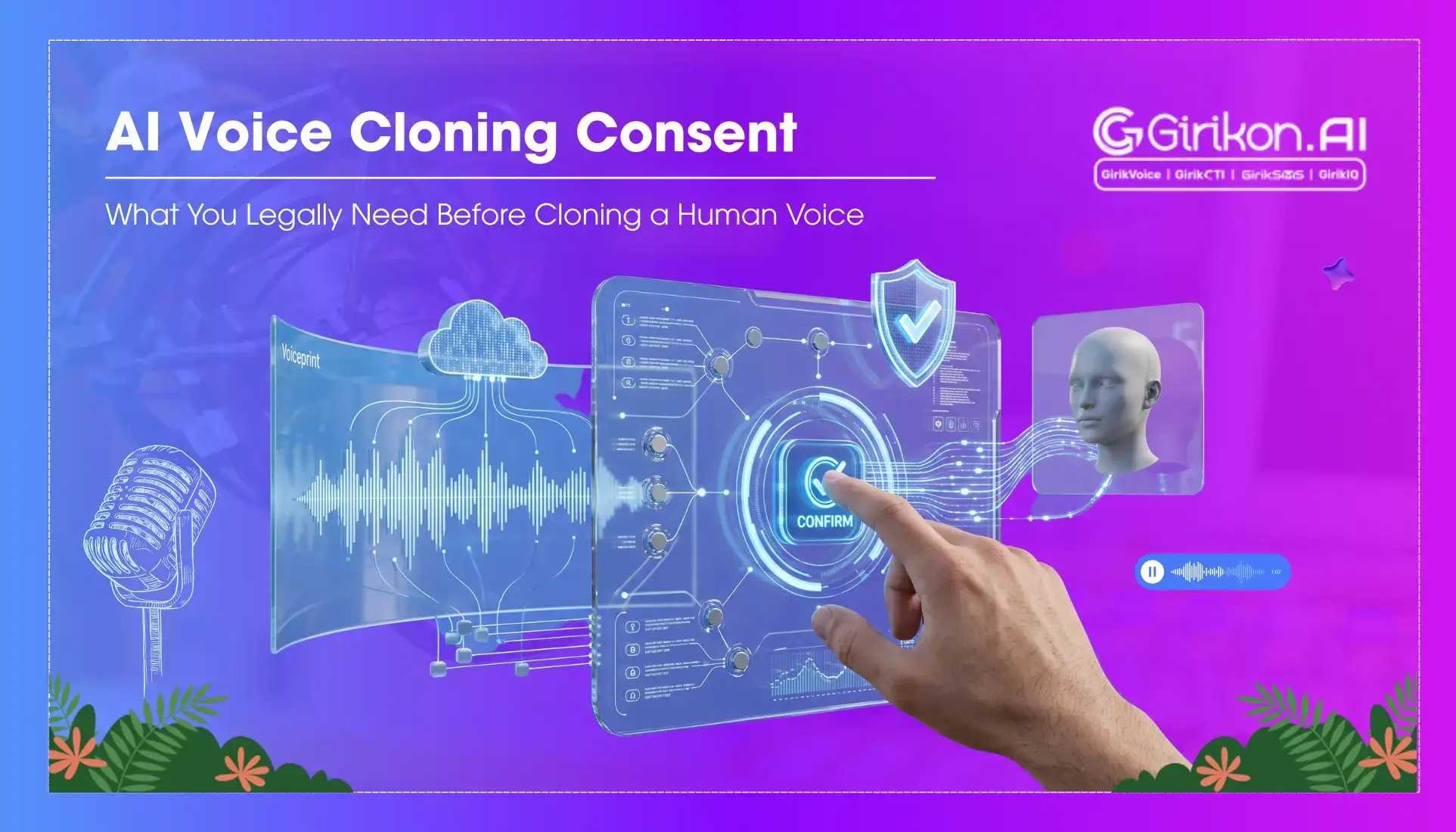
AI Voice Cloning Consent: What You Legally Need Before Cloning a Human Voice
The human voice is not only sound; it also serves as the identifier of that particular individual. This can be a branding aspect for the individual too. The pitch set speakers apart and shapes how spoken content is perceived.
For years, copying those characteristics required the original speaker, controlled recordings, or professional impersonation.
That has changed now!
Voice cloning technology analyzes voice patterns and produces speech that resembles or replicates a specific person’s human voice across various applications, like AI voice agents, training, marketing, etc. The possibilities are significant, and so are the legal considerations, such as AI voice cloning consent.
Before cloning a human voice; it is essential to have a certain limitation, as technical capability and legal permission do not always go hand in hand.
Recording Consent Vs. AI Voice Cloning Consent: Know the Difference
| Recording Consent | AI Voice Cloning Consent |
|---|---|
| Permits recording someone's voice for an agreed purpose | Permits creating a synthetic version of that person's voice |
| Usually applies to specific audio or content | Can allow AI to generate entirely new speech |
| May cover an IVR, video, training session, or advertisement | May cover AI agents, marketing, sales calls, or customer interactions |
| Does not necessarily authorize creation of a voice model | Should define how the synthetic voice can be created and deployed |
| Scope is often tied to the original recording | Should address use cases, channels, duration, and commercial use |
The key question is not whether the company has access to the recording but if it has voice cloning permission for the use it intends to pursue.
The Legal Checklist Before You Choose a Clone Human Voice
Cloning a voice isn't just a technical process — it's a legal one. Before an organization creates a synthetic version of someone's voice, it must have necessary permissions and rights.
The following isn't a post-deployment compliance checklist; it's what should be resolved before the cloning starts.
-
Obtain Explicit and Informed Consent
Recording a voice and giving consent to clone that voice is not the same thing. Any individual whose voice is intended to be cloned needs to be aware that it is going to be used for generating an artificial voice, its intended use, and how it would be deployed. AI voice cloning consent can indeed be specific, informed, and recorded. Assumptions or vague consent must not become a challenge for any business.
-
Define the Scope of Use Before Deployment
One consent does not encompass all scenarios. If the cloned voice was allowed for internal training purposes, it wouldn’t automatically have the same approval for the customer-facing agents or campaigns in marketing activities. Organizations should define the intended use clearly upfront — and if that use changes, go back and secure additional voice cloning permission rather than assuming the original consent still applies.
-
Outline What Happens When the Voice is No Longer Needed
A voice clone can remain in an AI platform, cloud environment, or business system even after the original purpose has ended. Organizations should decide in advance what happens to the source recordings, voice model, and generated voice when the agreement expires, the project ends, or the individual withdraws permission where applicable. Clear retention, deletion, and deactivation terms can help prevent a voice from continuing to be used after its approved period.
-
Know Which Regulations Apply to Your Specific Operation
Privacy laws, publicity rights, consumer protection requirements, and AI-specific regulations vary significantly by jurisdiction — and they're still evolving. Where your organization is based and where the cloned voice will be used, both determine which obligations apply. Getting clarity on this before deployment is significantly less expensive than resolving it after a dispute.
-
Document Consent and Keep It Current
A verbal consent or an email is not sufficient. All the details of the agreement need to be documented, including the time and date of the consent of receipt, its specifics, validity period, and any possible conditions. If the synthetic voice rights ever come into question, that documentation is what separates a defensible position from a difficult one.
Meeting these requirements doesn't eliminate every legal risk — but it substantially reduces exposure. More importantly, it builds a framework where the individual, whose voice is being cloned and the organization deploying it are protected throughout the full lifecycle of the AI voice.
When Should Businesses Revisit Voice Cloning Consent?
Consent should be reviewed when the deployment changes.
Consider a company that originally receives permission to use a cloned voice for internal training. It later wants to use the same voice in a customer-facing sales agent.
The right question is not:
“Did we already get consent?”
It is:
“Does the existing authorization cover this new use?”
A review may be needed when:
- The use case changes
- The audience changes
- Commercial use is introduced
- A new market is added
- A new third-party provider is involved
- The voice moves from prerecorded content to interactive AI
- The original authorization expires
A change in use does not automatically make existing consent invalid. The issue is whether the new use remains within the scope of what was originally authorized.
The Bottom Line
AI can copy how someone sounds with remarkable accuracy. But technical capability does not establish the right to use that voice.
Before cloning a human voice, businesses should secure clear AI voice cloning consent, define the permitted use, establish the relevant synthetic voice rights, and determine what happens if that use changes or ends.
The question should not simply be:
“Can we clone this voice?”
It should be:
"Can we copy this voice for any particular purpose?"
That answer should be clear before the first voice sample enters an AI system.
This article has only provided general information, and no legal advice. The requirements for voice cloning will differ greatly depending on jurisdiction, contract, industry, and use cases.